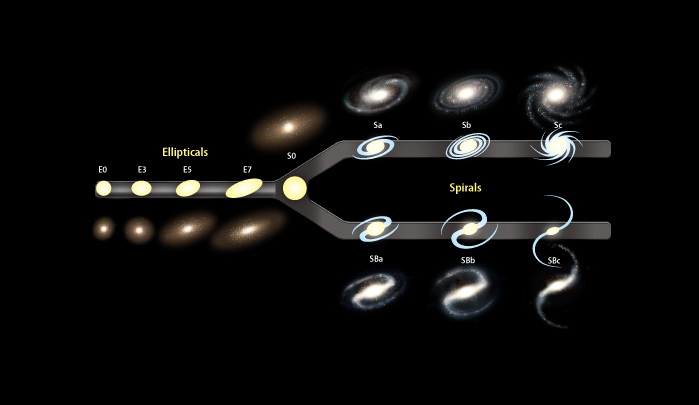
On Nov. 20, 1889, Edwin Hubble was born in Marshfield, Missouri. His 1923 observations of the Andromeda Galaxy and a Cepheid variable within it would vastly expand our understanding of other galaxies and the size of the universe. (See Oct. 5th, 1923: Hubble discovers galaxies beyond the Milky Way.)
In addition to that monumental discovery, Hubble also developed a system for sorting galaxies: In the 1930s, Hubble began to study and classify galaxies into their various so-called morphological types, the array of structures astronomers saw in photographs. He eventually assembled the types of galaxies he observed into a tuning fork-shaped diagram. It contained spiral galaxies, barred spiral galaxies — spirals containing a linear “bar” of material passing through their centers — lenticular (lens-shaped) galaxies, and elliptical galaxies. He also identified irregular galaxies, clouds of stars and gas that lacked an organized shape. Later on, astronomers identified peculiar galaxies, systems that appeared to be wracked with explosive or disruptive events. They also identified a class of galaxies called dwarf spheroidals, which seemed to be numerous in the local universe.