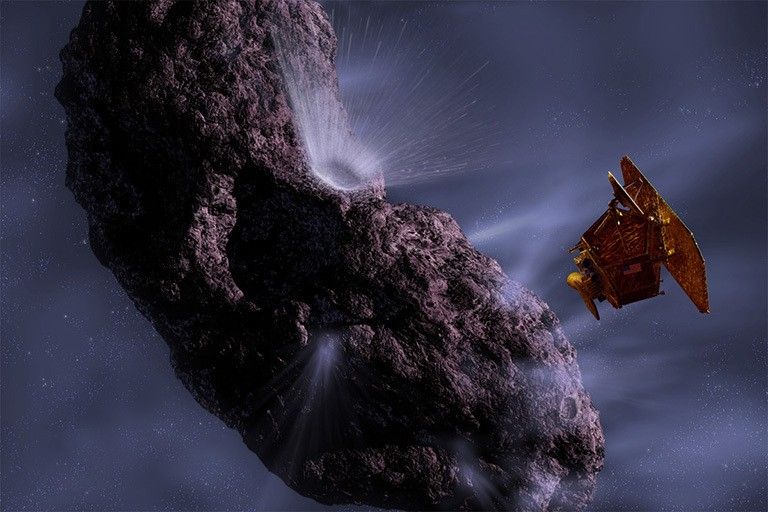
Commissioned in November of 1999 as the eighth mission in NASA’s low-cost, high-frequency Discovery program of planetary science exploration, Deep Impact’s goal was to investigate the interior of a comet, in part because these dirty snowballs contain debris from the early solar system. On Jan. 12, 2005, a spacecraft made up of both flyby and impactor components launched. On July 3rd, the largely-copper impactor was released, and the next day collided successfully with Comet 9P/Tempel 1. The resulting crater was about 490 feet (150 meters) wide.
The impact provided data that showed the comet to be highly porous, rather than a solid ice ball, made up approximately 75% of empty space and with a fine dust akin to talcum powder on the surface. The impact also revealed that the comet interior was protected from solar heating, meaning the internal material from the solar system’s formation was intact – including water ice and organic materials.
After the impact, the remaining component of the spacecraft conducted a flyby of Comet 103P/Hartley 2 on Nov. 4, 2010. Its mission would continue until 2013, sending back 500,000 images during its nine years in space.