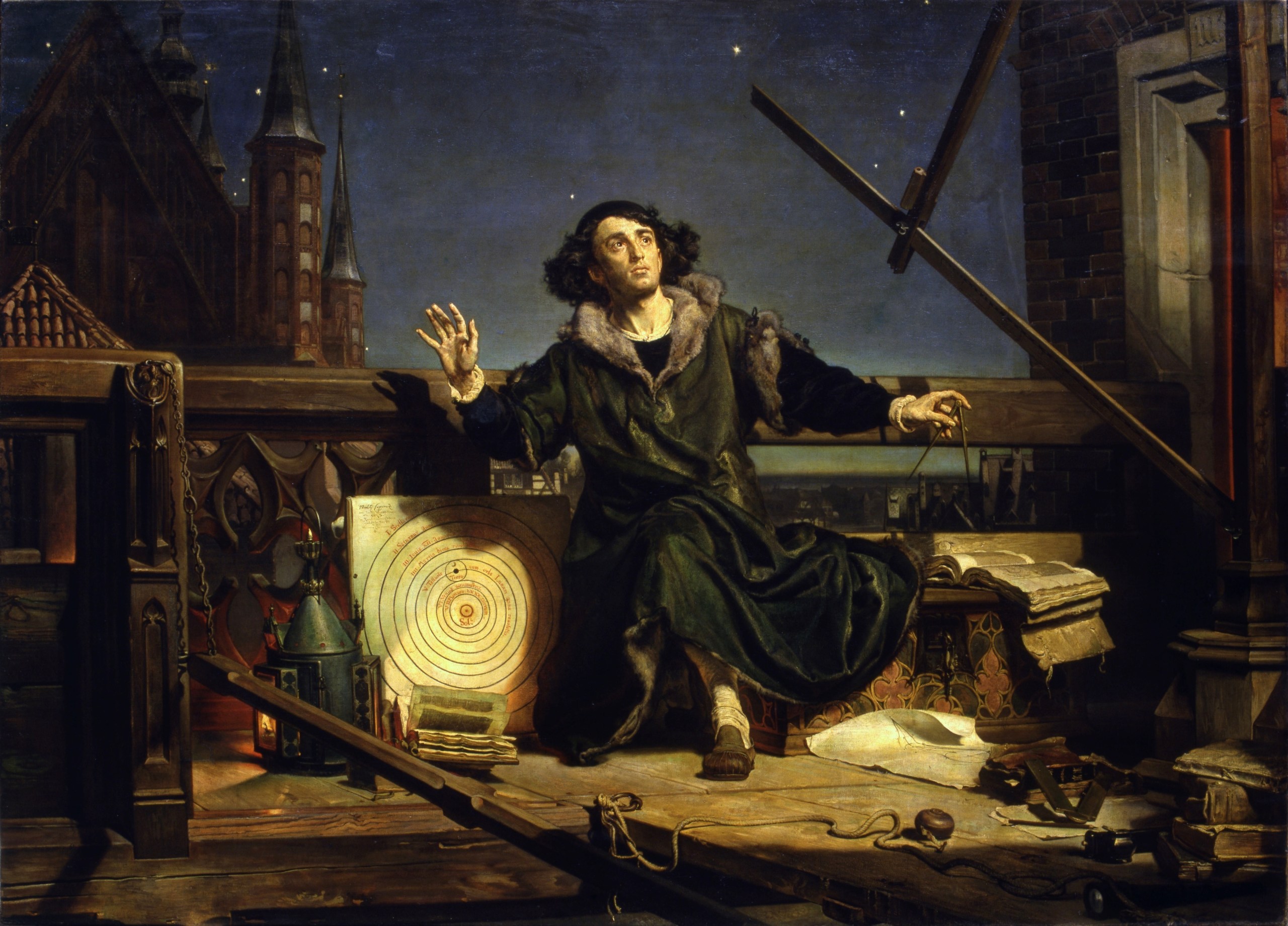
Born Feb. 19, 1473, in Poland, Nicolaus Copernicus was raised by his uncle, Bishop Lucas Watzenrode, who ensured he was well educated as he grew up. The education continued at the University of Cracow, where he studied painting and math; the University of Bologna, where he studied canon law; the University of Padua, where he studied medicine; and the University of Ferrara, where he earned his doctorate in canon law in 1503.
Copernicus also developed a keen interest in astronomy, even living and working with astronomer Domenico Maria Novara in Bologna. When his uncle helped him secure a position as a canon (a lay official who worked as an administrator, lawyer, tax collector, and doctor for the Church), the steady income gave Copernicus leisure time to pursue astronomy. By approximately 1508, he had grown dissatisfied with the Ptolemaic model of the universe, and developed his own heliocentric model. In the years that followed he expanded on the theory and circulated drafts to friends for feedback; he did not widely disseminate his work, however, possibly to avoid repercussions from the Church. De revolutionibus orbium coelestium (On the Revolutions of the Heavenly Spheres) was finally published shortly before his death on May 24, 1543. Copernicus’ model ultimately changed humanity’s fundamental understanding of its place in the cosmos – the Copernican Revolution.