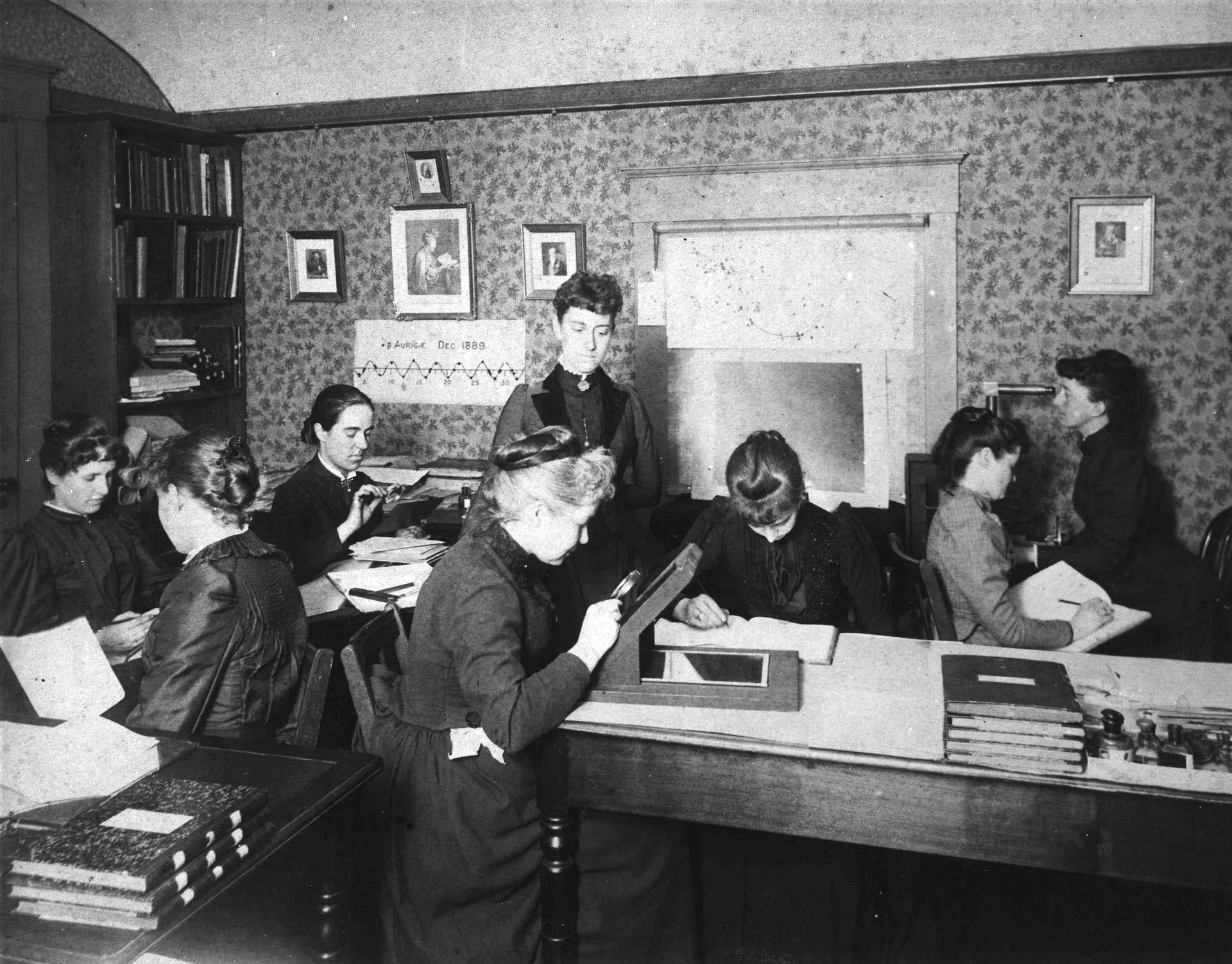
In 1878, Williamina Fleming immigrated to Boston from Scotland with her husband – but he abandoned her shortly after they arrived. Pregnant with their child, she began working as a maid in the house of Harvard College Observatory director Edward Pickering to support herself. Pickering quickly grew impressed with her intelligence and hired Fleming to do clerical work. She officially became part of the observatory’s staff of computers in 1881.
Fleming proved remarkably adept at analyzing photographic plates: During her time at the observatory, she discovered 10 novae, more than 50 nebulae (including the Horsehead Nebula), hundreds of variable stars, and the first-known white dwarf star. She also developed a system for classifying stars – the Pickering-Fleming system – based on their spectral lines. Using that system, she categorized over 10,000 stars in the first edition of the Draper Catalog.
By 1886, Fleming was managing the observatory’s women computers, including hiring additional women and editing all publications from the team. She advocated for her peers, publishing “A Field for Woman’s Work in Astronomy” and challenging the salary discrepancies between men and women at Harvard; men doing work equivalent to the women’s made $2,500 to their $1,500. She expressed her frustration in her private journal in 1900, writing, “Does [Pickering] ever think that I have a home to keep and a family to take care of as well as the men?” She went on to be the first woman to hold a Harvard University title when she was appointed curator of astronomical photographs. Fleming passed away of pneumonia on May 21, 1911, at age 54.