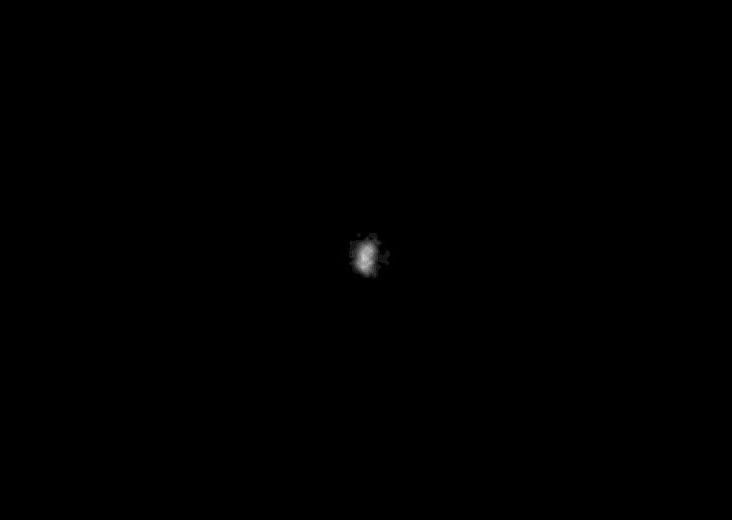
On May 1, 1949, astronomer Gerard Kuiper spotted a new moon of Neptune while examining photographic plates from McDonald Observatory’s 82-inch telescope. It would be the last moon discovered at that planet until Voyager 2 flew by in 1989. Kuiper proposed calling it Nereid, after the water nymphs who attended Neptune in mythology.
Kuiper had discovered a body on one of the solar system’s most eccentric orbits: Nereid’s orbit takes it so far from its planet that it takes 360 Earth days to encircle it. Depending on its location in that orbit, Nereid can range from about 850,000 to about 6 million miles (1.37 million to 9.6 million kilometers) from Neptune. The third-largest of Neptune’s moons, Nereid is also the largest irregular moon in the solar system. And observations with the James Webb Space Telescope showed that Nereid is bizarre in ways besides its orbit: It features abundant water ice, and is more reflective and more blue in color than similarly sized objects.
While eccentric orbits often mean a satellite was an asteroid or Kuiper Belt Object that became ensnared in a planet’s gravitational pull, scientists have suggested that Nereid was once a more standard moon, but its orbit became perturbed when Neptune captured the massive Triton.