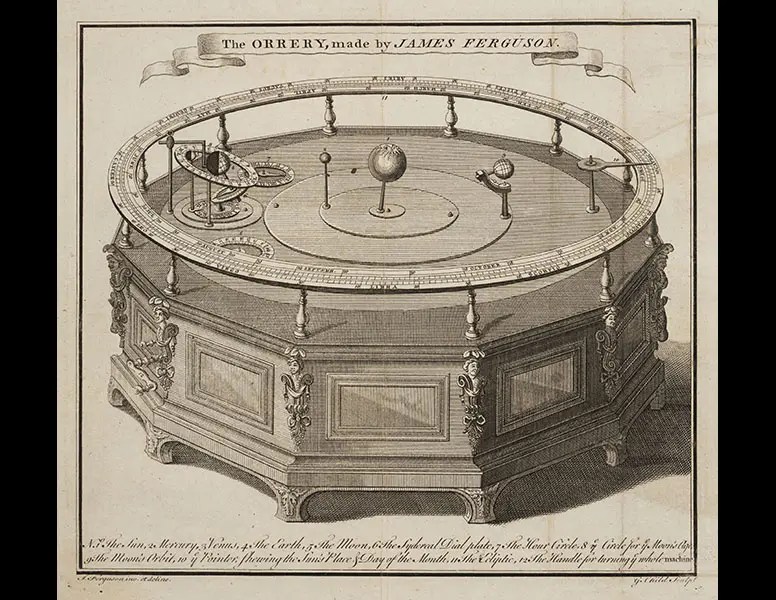
Born April 25, 1710, to farmers in Scotland, James Ferguson only had three months of formal education. Despite working as a shepherd, he taught himself mechanics and astronomy, using his evenings to map the skies with beads and string. He went on to become a repairer of clocks, and applied those mechanical skills to his interest in astronomy, building a machine with rotating plates that could predict eclipses and map the movement of the Sun and Moon (the “Astronomical Rotula”). He also designed and built multiple orries – according to stories, understanding the complex gearing with remarkably little study.
Ferguson relocated to London in 1743 and began giving lectures on astronomy and mechanics. In addition to such lectures being open to the public, Ferguson also endeavored to bring astronomy to a general audience through his books. Among others, he wrote Astronomy Explained upon Sir Isaac Newton’s Principles, which broke down Newton’s theories into understandable language, and The Young Gentlemen and Lady’s Astronomy, meant to make astronomy accessible to women. Ferguson was elected a fellow of the Royal Society in 1763, and passed away in 1776.