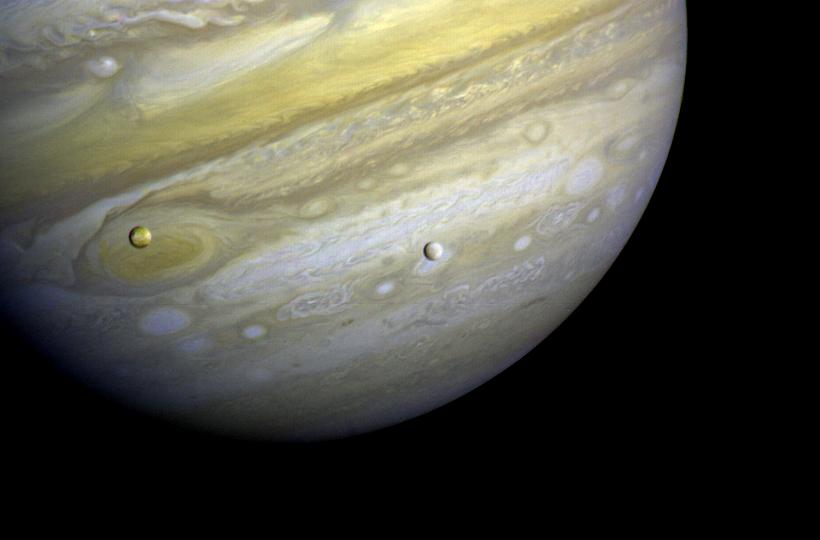
In April 1978, Voyager 1 was 165 million miles from Jupiter – but that was near enough to begin observations of the gas giant. In the first few months, observations suggested a much more turbulent atmosphere than had been expected based on the earlier Pioneer missions. By January of 1979, Voyager began taking a photo every 96 seconds, creating a timelapse series.
Closest approach came March 5, 1979, one day after Voyager 1 had captured photographic evidence of a ring system around the planet. In addition to that discovery, the probe imaged several of Jupiter’s moons – including Amalthea, Europa, Ganymede, and Callisto – and discovered two previously unknown satellites (Thebe and Metis). In addition, images of Io revealed that the moon was volcanically active. Having delivered nearly 19,000 images of the jovian system to Earth, Voyager 1 then set off for Saturn.