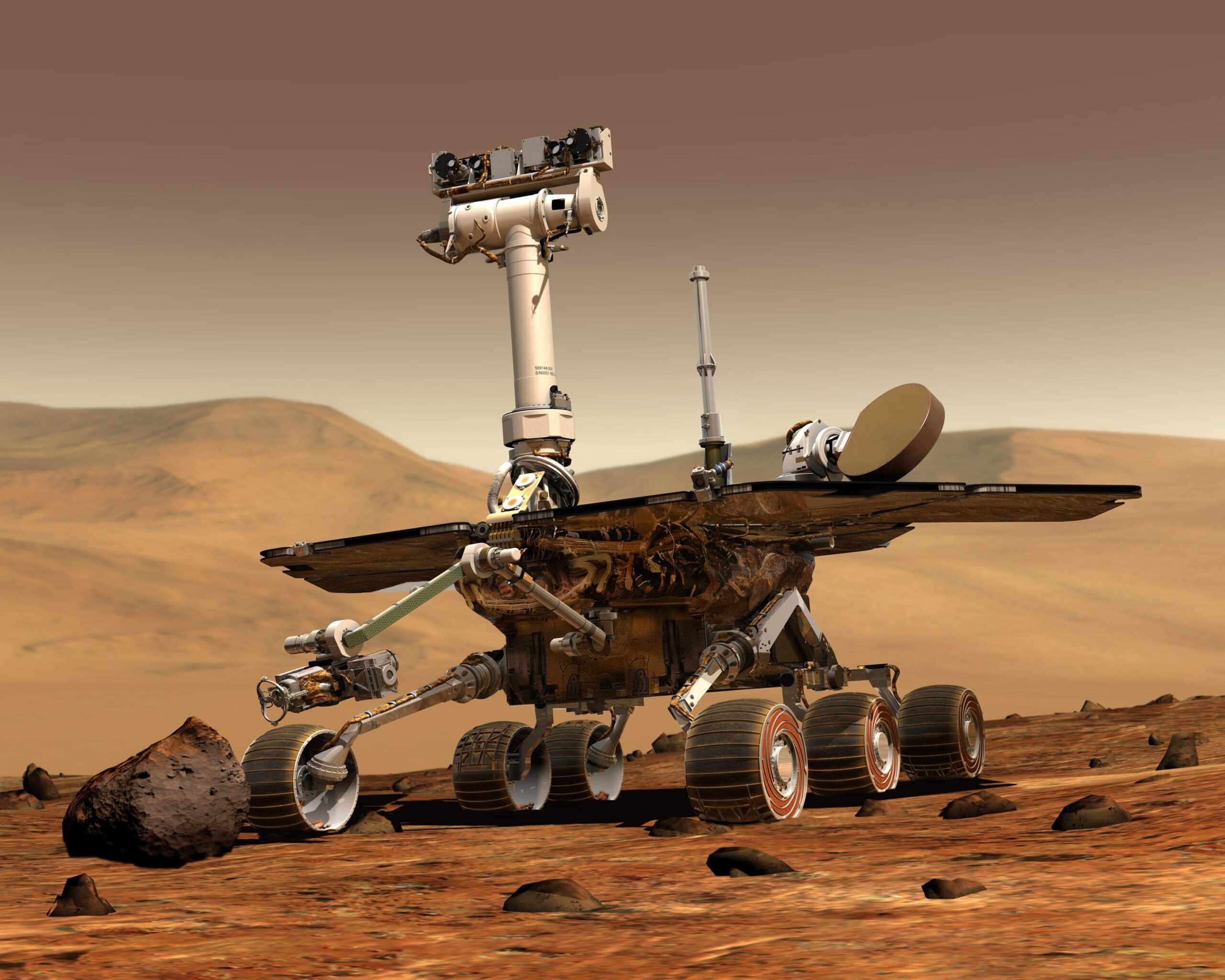
The Spirit rover landed on Mars on Jan. 4, 2004. Like its twin, Opportunity, Spirit was assigned an initial mission of only 90 sols. It exceeded this mission lifetime by more than 20 times, delivering invaluable science as it explored the Red Planet. It made its home in Gusev Crater, an ancient impact site and likely a giant dried lakebed as well.
Though Opportunity far outlasted it, Spirit still had a spectacular science mission lifetime. Highlights included the rover’s 2005 investigation of an outcrop of rocks called “Comanche.” It took scientists nearly five years to understand what the rover had uncovered there, but the result was powerful. The rocks had high concentrations of carbonate, which can only form in wet, nonacidic environments. The rovers had previously uncovered signs of acidic water, but this was their first clear evidence that Mars once hosted water that might have been hospitable to life.
In 2006, one of Spirit’s front wheels, which had been giving its engineering team trouble, ceased to drive completely. Undeterred, the team instructed Spirit to drive backwards on five wheels, dragging its unresponsive sixth behind it. Spirit successfully roved on for years in this handicapped condition. Continuing to uncover signs that Mars was once highly active, on Dec. 10, 2007, researchers announced that Spirit’s dragging dead wheel had serendipitously scraped clear a patch of almost pure silica. On Earth, such material typically forms near hot springs or in regions where acidic steam forces its way through narrow spaces. Both environments on Earth are popular with microbial life, so the martian silica points to habitable regions in Mars’ past.
Spirit spent much of 2008 weathering massive dust storms that covered its solar arrays and decreased the power available for science activities. In 2009, it regained enough energy to resume driving, but on May 1, the rover drove into soft soil at Troy and became mired. The rover team would spend more than a year attempting to free Spirit, but to no avail. In January 2010, the rover team declared Spirit a stationary research station. As the Red Planet moved into winter, Spirit readied for low sunlight levels and the associated decrease in available power. But Spirit never woke up from its hibernation. The team heard the rover’s last call on March 22.