At 12:33 A.M. EST on Jan. 1, 2019 New Horizons made its closest approach to 2014 MU69, now named Arrokoth (though at the time, it had been nicknamed Ultima Thule). It was the most pristine distant world ever explored — albeit remotely — by humans.
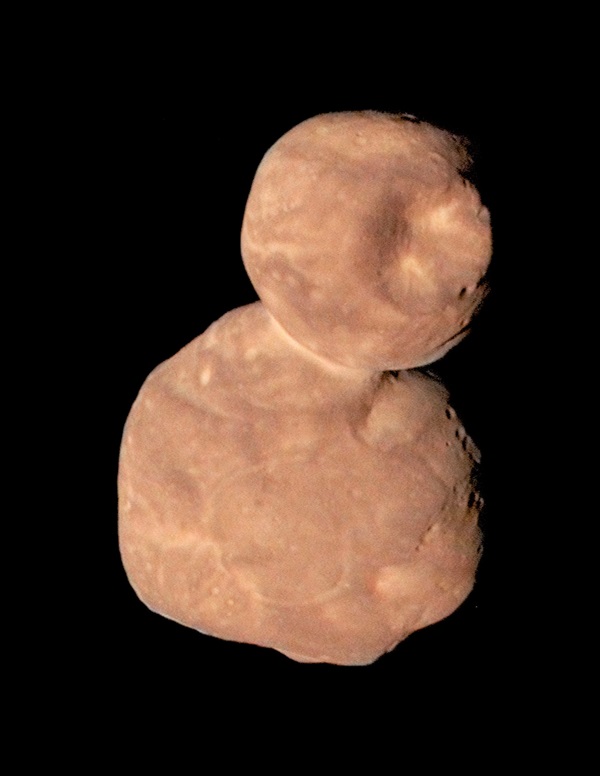
The craft zipped by the Kuiper Belt object (KBO) at a distance of about 2,175 miles (3,500 km). From its location about 4 billion miles (6.4 billion km) from Earth and 1 billion miles (1.6 billion km) past Pluto, it took more than six hours for the first images, traveling at light-speed, to reach Earth. Those images confirmed Earth-based observations that MU69 is a bi-lobed object called a contact binary, which occurs when two separate bodies slowly spiral closer until they touch and form a single body. Almost exactly 22 miles (35 km) at its longest, it spins once every 15.92 hours around a point where the two lobes connect.
The surface of Arrokoth is red; the color likely comes from tholins, which are compounds created by interactions between sunlight and molecules containing carbon, such as methane or ethane. Occasional craters pockmark the surface, likely the result of past impacts. The data from New Horizons allows researchers to draw conclusions about the objects in the distant reaches of our solar system, which represent pristine pieces of the solar nebula from which the planets were born.