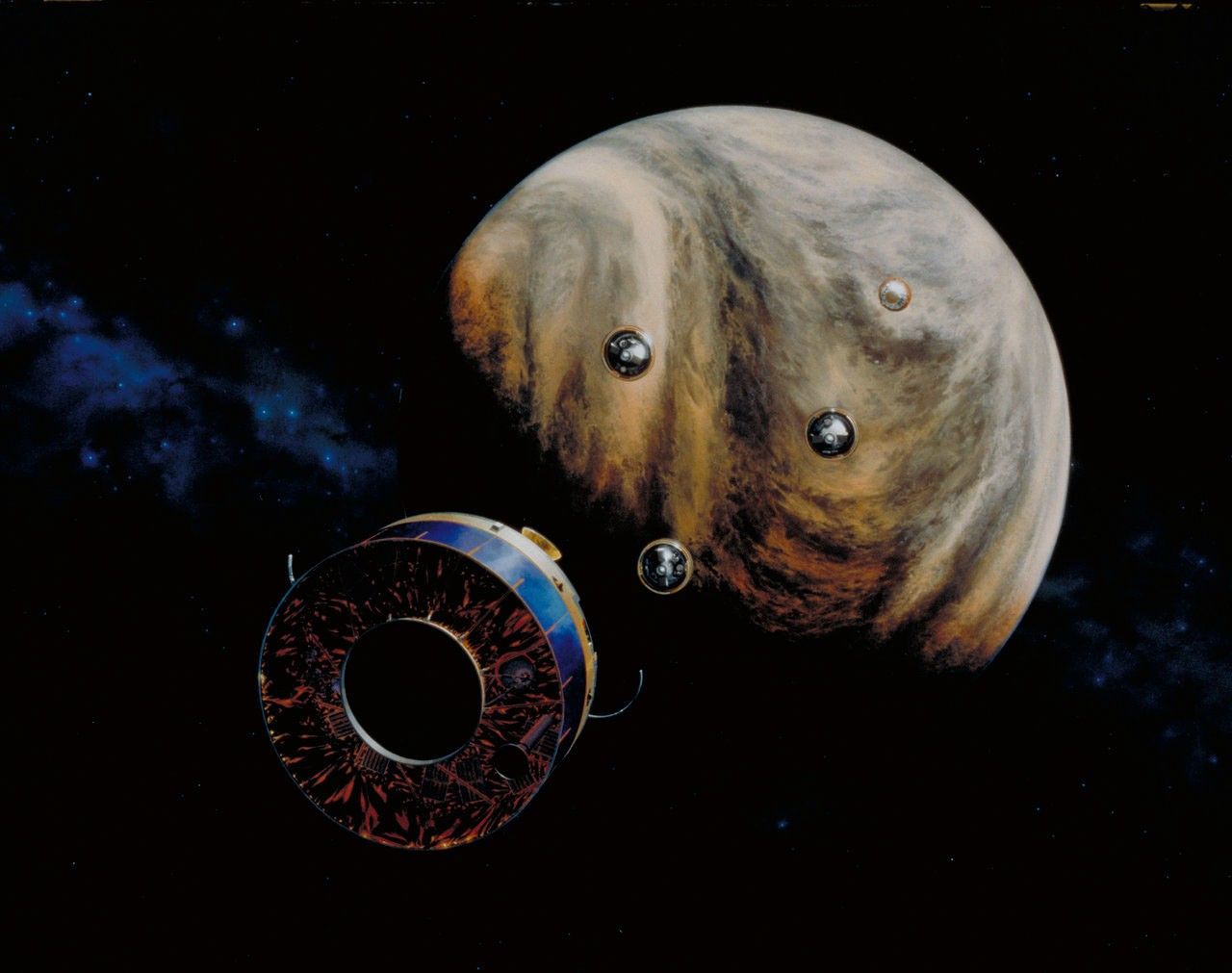
With five different components, the Pioneer Venus Multiprobe mission’s goal was to collect and return data on the venusian atmosphere and the planet’s habitability. The Large Probe featured a suite of seven instruments in a pressurized container, including a mass spectrometer, a gas chromatograph, a nephelometer (for measuring cloudiness) and a cloud-particle-size spectrometer. The three Small Probes (referred to as the Day, Night, and North probes) carried nephelometers, and gauges for temperature, pressure, and acceleration. Transported within the main “bus” spacecraft, the instruments launched for Venus on Aug. 8, 1978.
The Large Probe was deployed en route on Nov. 16, and the three Small Probes followed on the 20th. All five components reached Venus together, entering the planet’s atmosphere on Dec. 9, 1978. Over the course of just under an hour, the four probes fell to the surface – the Large Probe with a parachute and the Small Probes without – successfully returning data the whole way. Two of the three Small Probes even unexpectedly survived impact and continued transmitting information from the surface for a short period of time before succumbing to the temperature and air pressure. Meanwhile, the bus spacecraft returned details about the upper atmosphere before burning up at an altitude of 75 miles (120 kilometers).