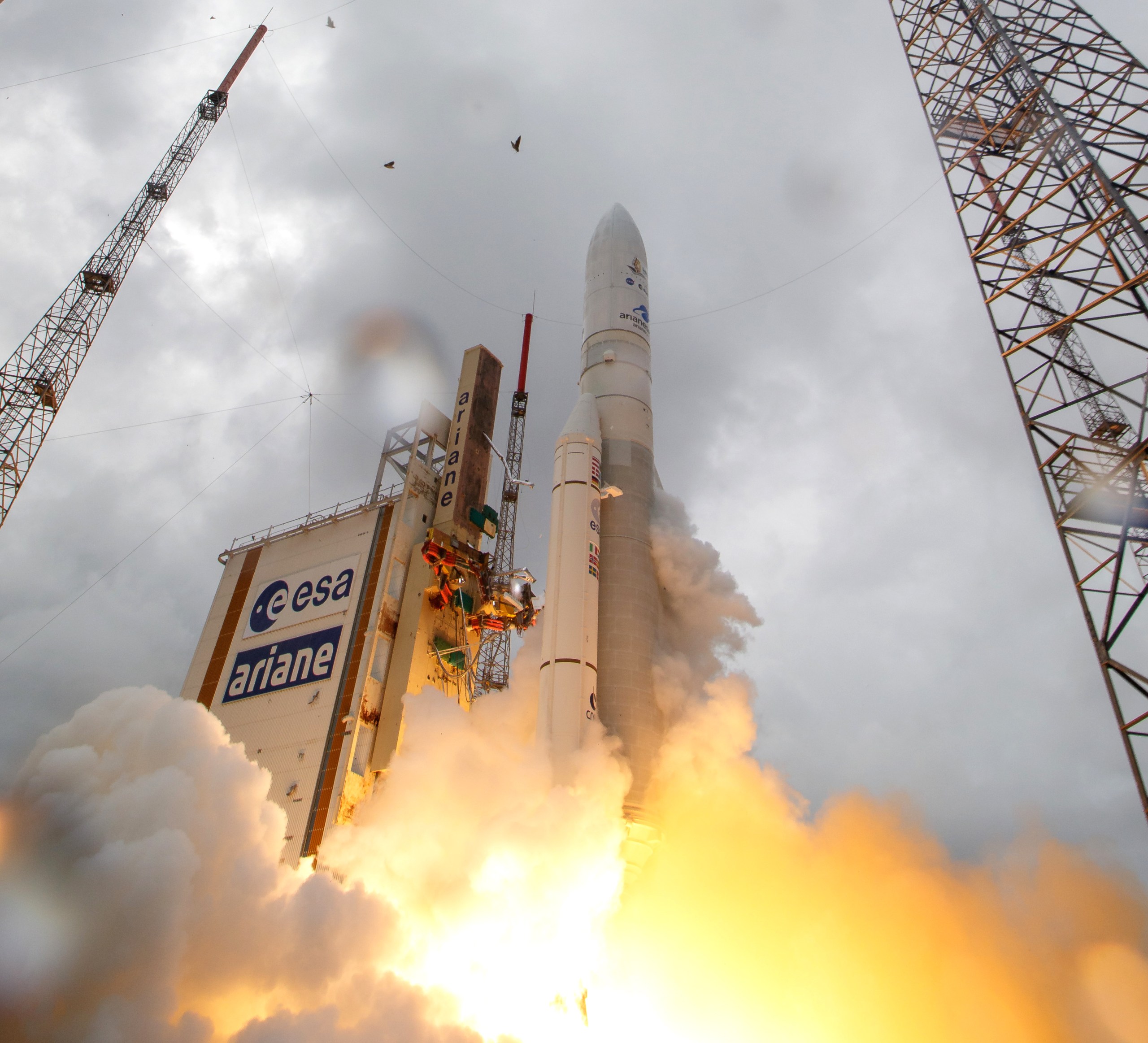
When NASA’s $10 billion James Webb Space Telescope (JWST) rode safely to space on an Ariane 5 booster from Europe’s Spaceport in Kourou, French Guiana, the liftoff at 7:20 A.M. EST on Dec. 25, 2021, marked the end of a development full of delays and cost overruns — and the beginning of the telescope’s month-long journey to its destination nearly 1 million miles (1.5 million kilometers) from Earth.
JWST originated in a 1996 report put together by a panel of astronomers attempting to plan the successor to the Hubble Space Telescope. It was originally envisioned to launch in 2007 with a price tag of $500 million. After 14 years of delays and a ballooning price tag that, at times, threatened to swallow NASA’s astrophysics budget whole, JWST emerged as the most powerful space telescope ever built. It is a joint project between NASA, the European Space Agency, and the Canadian Space Agency. Its 6.5-meter, hexagonal, segmented mirror is shielded from the heat of the Sun by a five-layer sunshield that will allow the telescope to cool to –370°F (–223°C). These frigid conditions will minimize interference at the infrared wavelengths that JWST is designed to observe, allowing the telescope to seek the redshifted light of primordial galaxies and penetrate the dusty shrouds of nebulae to see young stars.
JWST arrived Oct. 12 via cargo ship at the spaceport in French Guiana, on schedule for a Dec. 18 launch date. This slipped to Dec. 22 after an incident during launch preparations, when a band suddenly unclamped itself and jolted the entire observatory, requiring additional checks. Then, a communications problem from the telescope to ground support arose; it was traced to a bad cable and pushed the launch to Dec. 24. The final delay was announced Dec. 21, 2021: Bad weather forced a postponement to the morning of Dec. 25. When JWST launched successfully on the 25th, astronomers around the world received a great gift: relief.