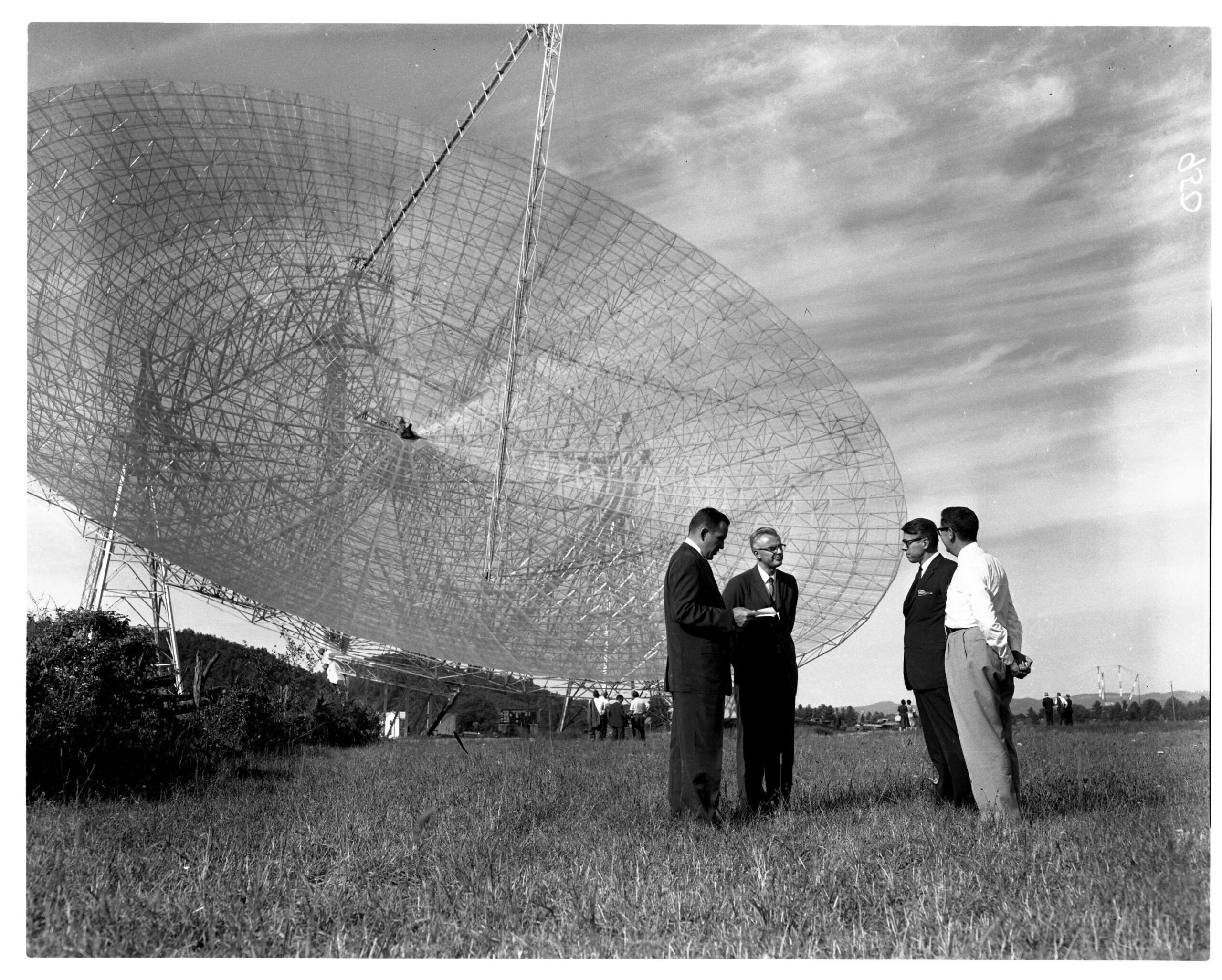
In 1958, a newly minted Harvard Ph. D. named Frank Drake came to Green Bank. Usually he sought out typical radio astronomy targets — the Van Allen Belts around Earth, say, or the surface temperature of Venus, or the radiation belts of Jupiter. But on April 8, 1960, Drake and his colleagues instead tuned in to two nearby stars, Tau Ceti and Epsilon Eridani. Their goal was simple: They were alien hunting, hoping to hear radio communications originating from intelligent extraterrestrials.
UFOs were popular then, but Drake’s research was legitimate, one of the first dedicated scientific searches for aliens. Drake had been spurred on by Giuseppe Cocconi and Philip Morrison, who the previous year had co-authored a Nature paper with the provocative title “Searching for Interstellar Communications.” It remains a foundational SETI text.
Much to Drake’s surprise, his team actually heard something in those first few experiments. Unfortunately, it ended up being just a high altitude plane. Project Ozma, as the research was called (after L. Frank Baum’s fictional monarch of Oz), was both the first SETI experiment and the first SETI false alarm. “We had failed to detect a genuine alien signal, it was true, but we had succeeded in demonstrating that searching was a feasible, and even reasonable, thing to do,” Drake wrote in his book Is Anyone Out There? (cowritten with Dava Sobel).