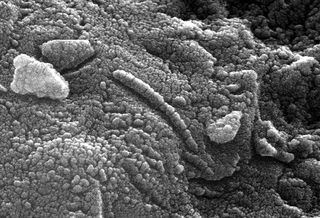
Meterorite ALH 84001 fell to Earth from Mars about 13,000 years ago, landing in the Allan Hills region of Antarctica. It was discovered in 1984 and taken to the Johnson Space Center, where in 1994 researchers saw possible signs of life: carbonate minerals and microscopic structures that resembled nanobacteria. Further research commenced, and on Aug. 7, 1996, NASA astrobiologist David McKay announced that ALH 84001 contained ancient martian life.
Suddenly a NASA that had been facing $5 billion in budget cuts saw much of its funding restored in a push for further astrobiology research. Although researchers today are skeptical of the biosignatures in ALH 84001, the martian meteorite had a big impact on finances and future planning, allowing for the development of, among other projects, the James Webb Space Telescope and the Perseverance Mars rover.
Elisa Neckar is senior production editor of Astronomy magazine, and the editor of the Today in the History of Astronomy feature on Astronomy.com.