Friday, November 27
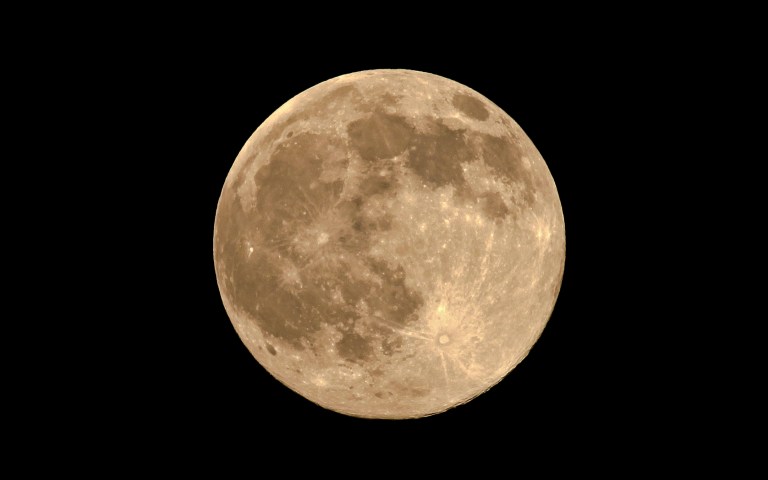
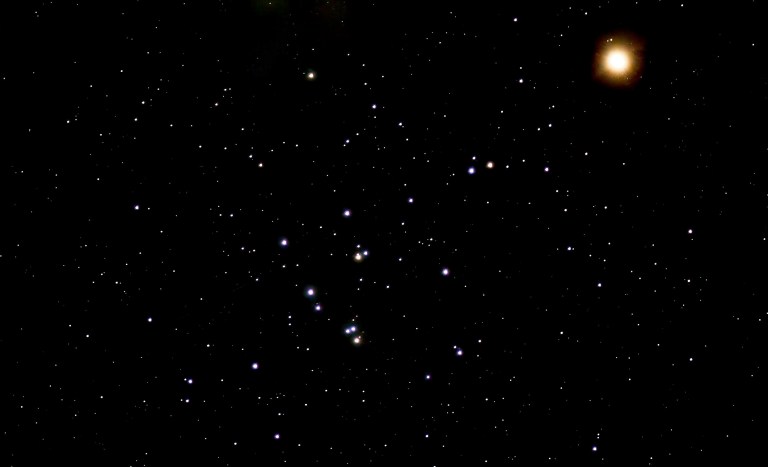
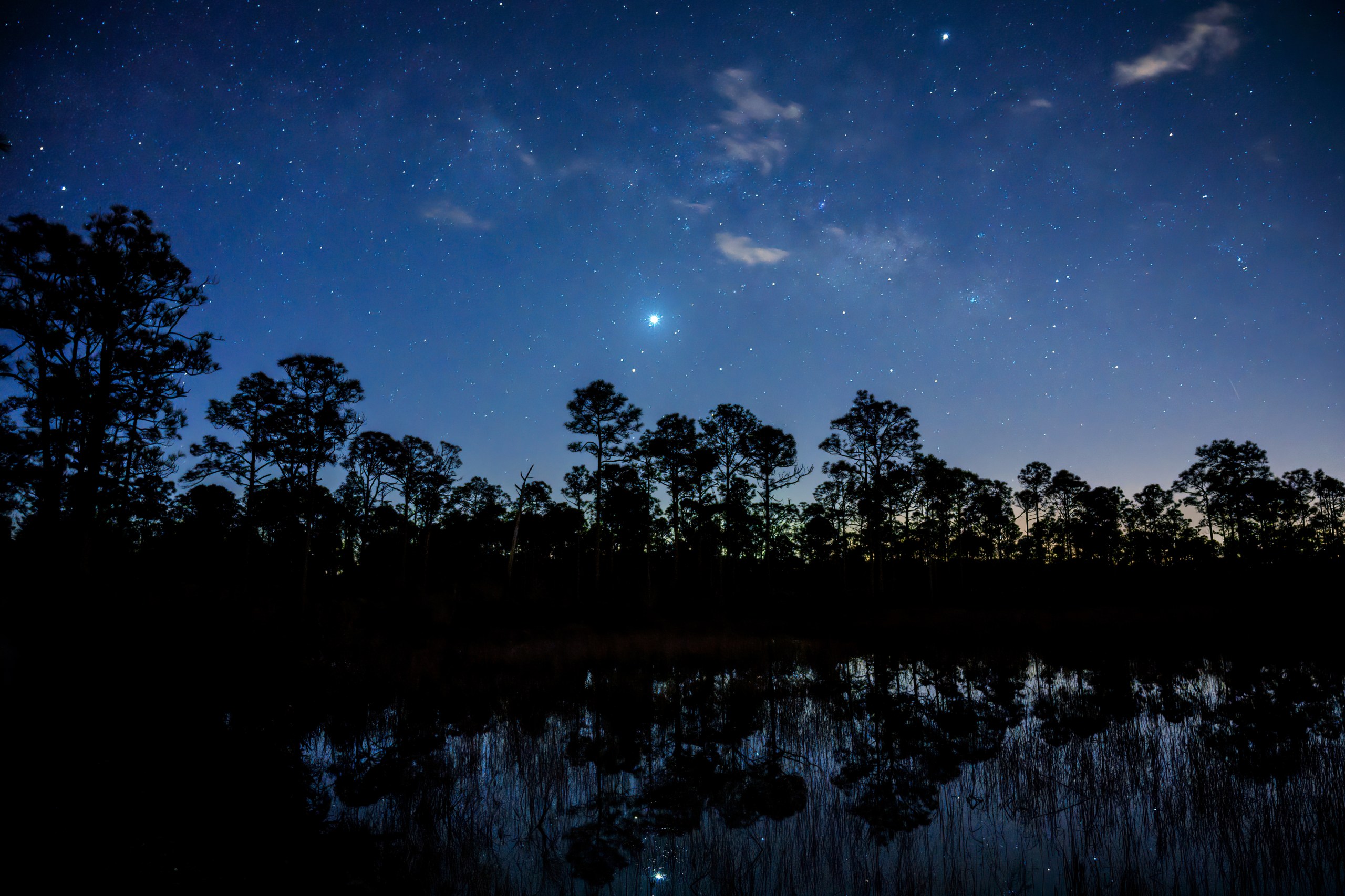
As fall deepens and winter approaches, the wintertime star patterns are reappearing in our evening sky. One is a large asterism called the Winter Hexagon, now fully above the horizon by about 10 P.M. local time. You should be able to spot this shape even with the Moon nearby, as each point in the Winter Hexagon is a bright, well-known star.
Look east late tonight to locate the waning gibbous Moon near the border of Gemini and Cancer. This will help you find the first point in the Hexagon, the pair of stars Castor and Pollux, the heads of Gemini the Twins, glowing just above the Moon at this time. From there, look upward for another bright star in neighboring Auriga — this is Capella, the next point in the Hexagon. From Capella, look left and down just a little to find the V-shaped face of Taurus the Bull, where the bright star Aldebaran shines, marking the next point. Then it’s down to Orion’s bright knee, Rigel, before you drop down and a little left, close to the horizon, to land on Sirius, the brightest star in the sky and the nose of Canis Major. The Hexagon closes out with the luminary of the Little Dog, Procyon.
Sunrise: 6:59 A.M.
Sunset: 4:36 P.M.
Moonrise: 7:53 P.M.
Moonset: 10:26 A.M.
Moon Phase: Waning gibbous (82%)
*Times for sunrise, sunset, moonrise, and moonset are given in local time from 40° N 90° W. The Moon’s illumination is given at 10 P.M. local time from the same location.
Saturday, November 28
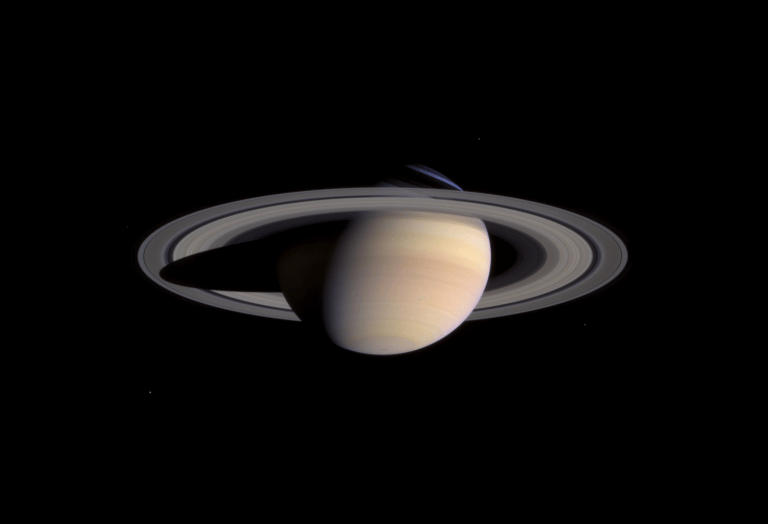
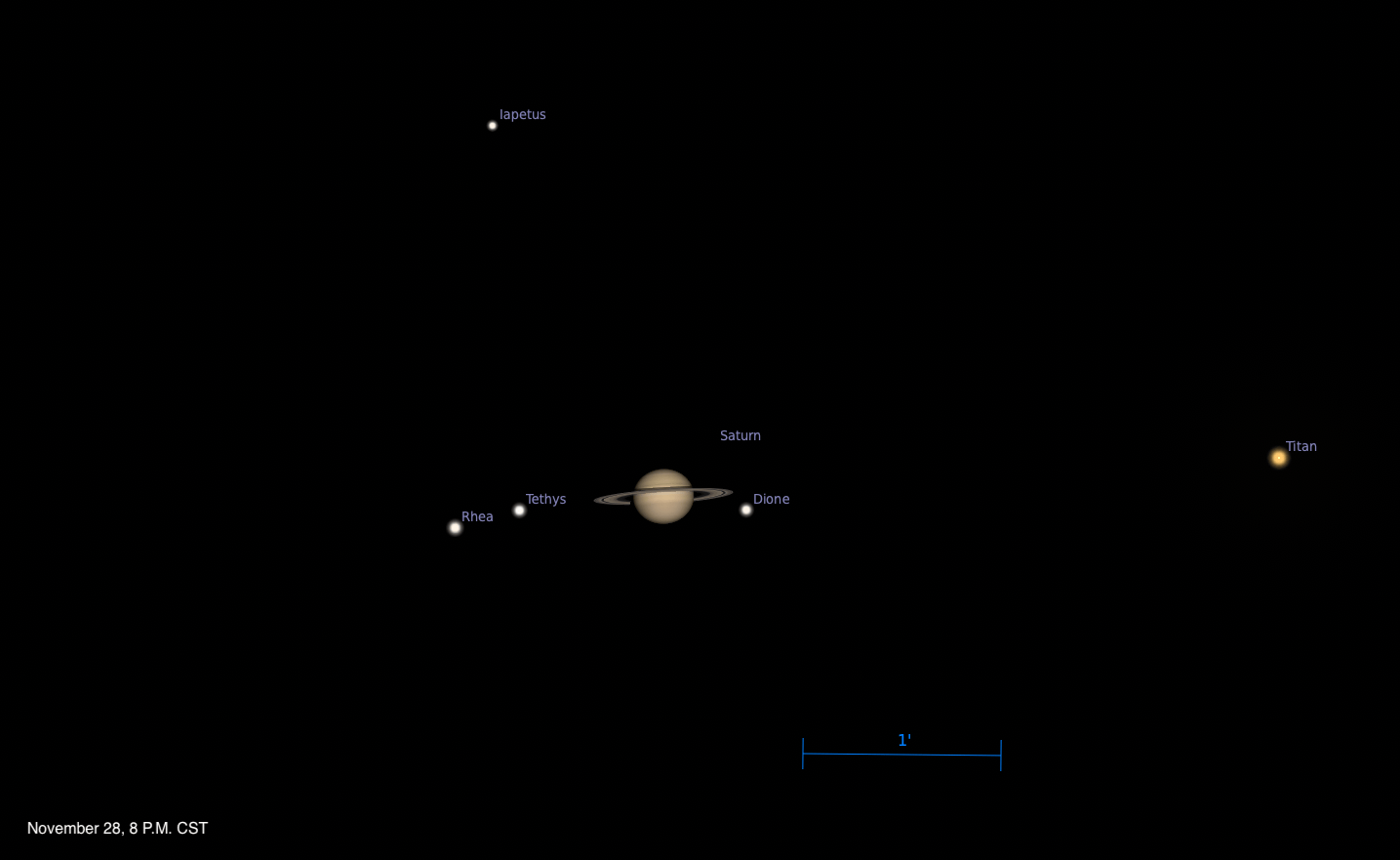
Saturn remains a bright naked-eye object all evening, setting around 2 A.M. local time. Around 8 P.M., you’ll find it high in the south, to the left of the Circlet of Pisces and above the body of Cetus the Whale.
Tonight and for the next few nights, Saturn’s strange, two-faced moon Iapetus is skimming north of the planet, making it easier to find. Now glowing at 11th magnitude, it is heading west toward a late December western elongation, when it will shine about a magnitude brighter but sit far from Saturn. Once you’ve got Saturn in your scope, look about 2’ northeast to land on Iapetus. Over the next few nights, it will move westward, reaching inferior conjunction and standing due north of the ringed world by the 30th.
If you can catch 11th-magnitude Iapetus, you’ll also see four brighter moons: 10th-magnitude Dione, Rhea, and Tethys closer to Saturn; and mid-8th-magnitude Titan, about 3’ to Saturn’s west. The latter is the planet’s largest and brightest moon, easy to spot in any size scope and often even binoculars. If you keep returning each night to track Iapetus, also keep an eye on Titan, which is moving eastward toward the planet and will pass south of Saturn on December 2. Dione, Rhea, and Tethys have smaller orbits and shorter periods, so they move visibly over the course of several hours, frequently swapping places and passing in front of or behind Saturn. For example, Dione disappears behind Saturn’s southwestern limb in an occultation around 12:20 A.M. EST on the 29th (still late on the 28th in time zones farther west).
Sunrise: 7:00 A.M.
Sunset: 4:36 P.M.
Moonrise: 9:10 P.M.
Moonset: 11:09 A.M.
Moon Phase: Waning gibbous (73%)
Sunday, November 29
Have you ever seen your shadow by planetlight? Venus reaches greatest brilliancy at 2 P.M. EST, now shining at magnitude –4.9. Rising nearly three and a half hours before the Sun, Venus will be so bright that it could potentially cast a shadow if you’re in a location with particularly dark skies (Bortle 1 or 2).
Even without perfect viewing conditions, this morning star can’t be missed. By an hour before sunrise, Venus is roughly 25° high in the southeast, blazing just to the lower left of Spica, the brightest star in Virgo. Far to Venus’ lower left, closer to the ground, Mercury stands nearly 5° above the horizon, shining at magnitude –0.7.
Compare the two planets through a telescope. Venus is a 27%-lit crescent, but its disk stretches 40” across. Mercury, by comparison, is much smaller, just 6” across, but its phase is 82%. Now through the first week of December is the best time to catch the solar system’s smallest planet, as it remains bright but appears to sink toward the horizon day by day. By the 5th, Mercury will be less than 2° high an hour before sunrise, making viewing challenging both because of potential obstacles on the horizon as well as the more turbulent layer of air near the ground.
Venus, meanwhile, stays at roughly the same altitude an hour before sunrise all month, its phase growing to nearly 50% lit by the end of the year. Earth’s sister planet will remain prominent in the morning sky through the first half of next year.
Sunrise: 7:01 A.M.
Sunset: 4:36 P.M.
Moonrise: 10:25 P.M.
Moonset: 11:43 A.M.
Moon Phase: Waning gibbous (62%)
Monday, November 30
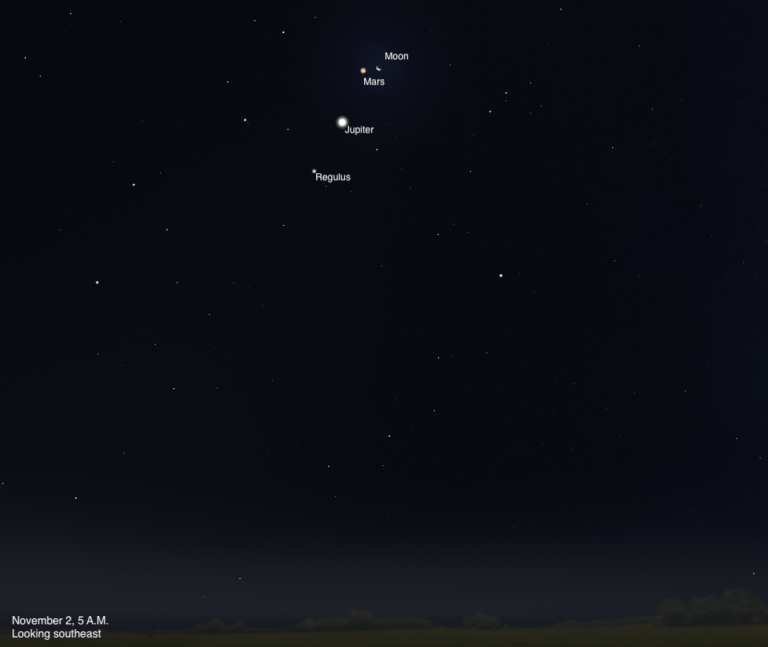
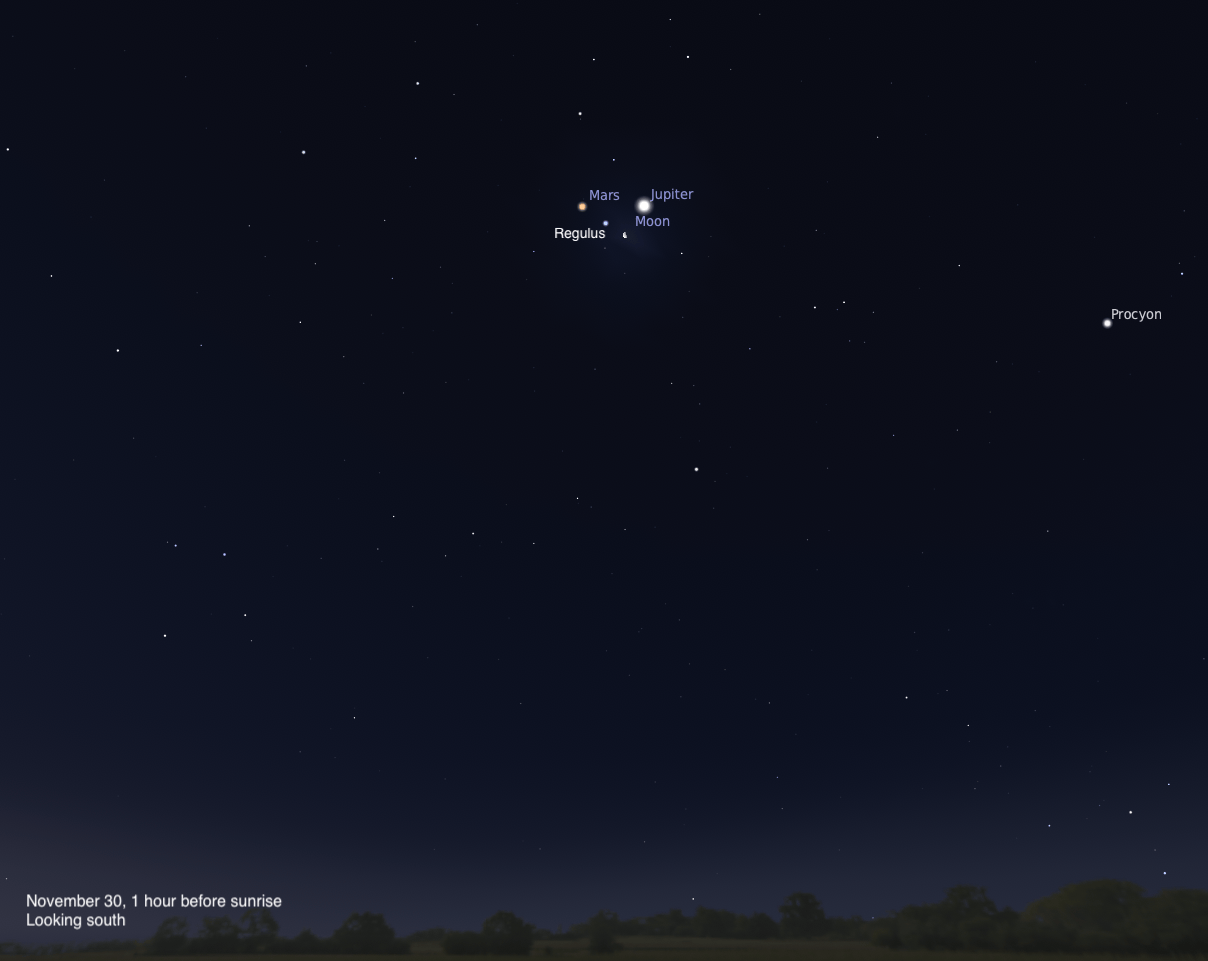
Venus remains a brilliant and unmissable morning star, but it’s not the only object worth paying attention to before dawn. Leo is hosting a celestial get-together this morning as the Moon joins two planets and the star that sits at the heart of the Lion, just beneath the Sickle asterism.
The waning gibbous Moon is the brightest object here; next brightest is Jupiter, located to the Moon’s upper right and glowing at magnitude –2.2. The gas giant stands nearly side by side with Mars (to Jupiter’s left); the Red Planet is fainter but still a respectable magnitude 0.4. Both planets are slowly growing in brightness and size as they approach opposition early next year. Through a telescope, Jupiter stretches 39” across, offering excellent views of its alternating light and dark cloud bands, and Mars is now 8” wide.
Shining between Mars and the Moon is 1st-magnitude Regulus, often drawn as both the heart of Leo and the base of the Sickle asterism’s handle. The curving backward question mark of stars that forms the Sickle’s blade and the Lion’s head in profile lies above the grouping in the sky before dawn.
Sliding along the ecliptic, the Moon passes 1.2° south of Jupiter at 4 A.M. EST, then 1.1° south of Regulus at 10 A.M. EST and 3° south of Mars at 3 P.M. EST.
Sunrise: 7:02 A.M.
Sunset: 4:35 P.M.
Moonrise: 11:36 P.M.
Moonset: 12:11 P.M.
Moon Phase: Waning gibbous (51%)
Tuesday, December 1
Last Quarter Moon occurs at 1:09 A.M. EST. A few hours later, asteroid 2 Pallas reaches a stationary point at 7 A.M. EST. Located in Cetus, it is visible all evening, setting around 1 A.M. local time. It stands highest around 8 P.M., when it’s roughly 30° above the southern horizon, about 4.2° southeast of 2nd-magnitude Diphda (Beta [β] Ceti).
Glowing at magnitude 9.0, Pallas is easy to find with a small scope. It sits near a neat triangle of 5th- to 6th-magnitude stars, which lie about 1.5° southwest of the asteroid and act as a great reference point to find it tonight. Pallas is 1° east of the easternmost star. Previously, Pallas was closing on that star, moving westward. But after tonight, it will turn and move slowly eastward again, pulling away from the little triangle night by night.
Drop about 5° south of this region for an added treat: 8th-magnitude globular cluster NGC 288, just over the celestial border in Sculptor. Spanning about 13’, this ancient ball of stars lies nearly 49,000 light-years away. It’s also near another deep-sky target, the 7th-magnitude galaxy NGC 253. Often called the Silver Coin or Sculptor Galaxy, this stunning edge-on spiral lies about 1.7° northwest of NGC 288 and can be viewed together with the cluster in wide-field instruments such as binoculars or finder scopes.
Sunrise: 7:03 A.M.
Sunset: 4:35 P.M.
Moonrise: —
Moonset: 12:35 P.M.
Moon Phase: Waning crescent (40%)
Wednesday, December 2
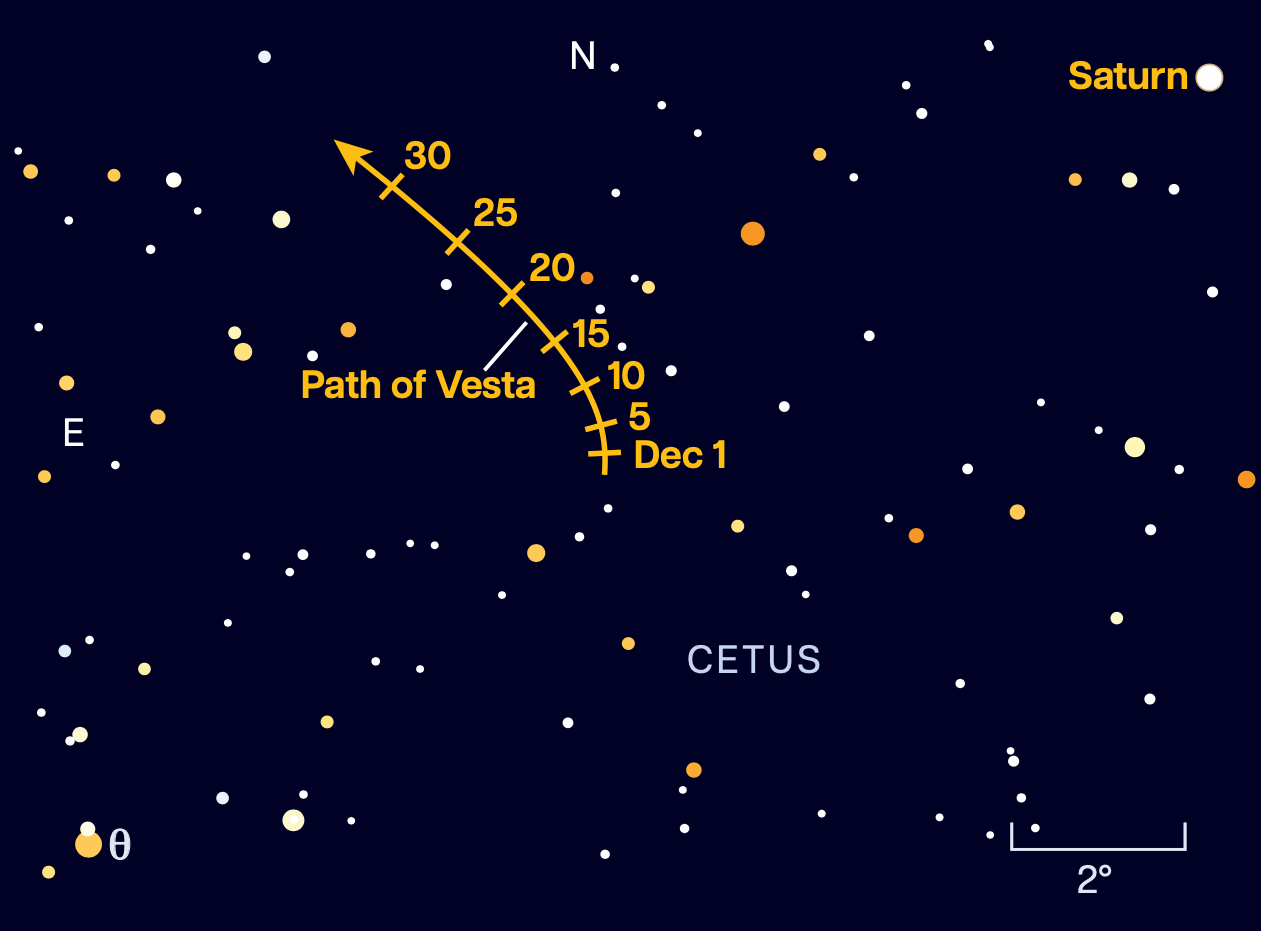
It’s now asteroid 4 Vesta’s turn to reach a stationary point at 11 A.M. EST as it, too, swims through the domain of Cetus the Whale. Visible in the evening sky, Vesta sits more than 40° above the southern horizon around 7 P.M. local time. Previously moving retrograde, or westward, it will now begin moving prograde, or eastward, against the background stars.
This month Vesta is located roughly halfway between bright Saturn to its northwest and magnitude 3.6 Theta (θ) Ceti to its southeast. Saturn is impossible to miss, as it’s the brightest object in this region of the sky. To locate 7th-magnitude Vesta, find Saturn early in the evening and slide about 8.1° east-southeast to land on the main-belt world. There aren’t a lot of background stars in the immediate vicinity, so try to match your view to the star chart above to locate the asteroid in your eyepiece. Because it’s moving slowly, you’ll need to come back every night or two to check out the view and note the light that’s shifted position — that’s Vesta.
Sunrise: 7:04 A.M.
Sunset: 4:35 P.M.
Moonrise: 12:43 A.M.
Moonset: 12:58 P.M.
Moon Phase: Waning crescent (30%)
Thursday, December 3
Look north a few hours after sunset to find the W-shaped star pattern of Cassiopeia on her head, looking more like the letter M as this circumpolar constellation swings above the North Celestial Pole. Just 1.9° northwest of Navi (Gamma [γ] Cassiopeiae), the midpoint of the M (or W), is a lovely open cluster cataloged as NGC 225 and known as the Sailboat Cluster.
Longtime Astronomy contributor Rod Pommier gave the cluster its nickname because he saw an arc of stars within the cluster that looked to him like the sail of a boat catching the wind, connected to a straight line of stars forming the mast and another eight stars outlining the vessel itself. The stars of the cluster are roughly 2,100 light-years distant, and this grouping was discovered by Caroline Herschel in 1783.
For added visual interest, the cluster is set against a complex of dark nebulae made of dust, which block the starlight behind them.
Sunrise: 7:05 A.M.
Sunset: 4:35 P.M.
Moonrise: 1:49 A.M.
Moonset: 1:20 P.M.
Moon Phase: Waning crescent (21%)
Friday, December 4
The waning Moon puts even faint deep-sky objects within reach on these early December evenings. Tonight, let’s look toward a distant elliptical galaxy nestled in the far southeastern corner of Lacerta the Lizard. Cataloged as NGC 7426, this 13th-magnitude stellar smudge sits close to a lovely pair of contrasting stars, making finding it a rewarding sight for all: While you do need a larger scope to track down the galaxy, the stars are visible even through smaller instruments, offering something for everyone.
Around 7 P.M. tonight, our target is still more than 35° high in the west. The zig-zagging figure of Lacerta sits just above cross-shaped Cygnus as the Summer Triangle sinks toward the western horizon. To Lacerta’s left (southeast) is Pegasus, and we’ll use 3rd-magnitude Matar (Eta [η] Pegasi) as our jumping-off point. From here, slide about 5° north-northeast to find a pair of stars, 6th and 8th magnitude, roughly 1’ apart. The brighter star glows blue-white, while its dimmer neighbor shines orangey-gold. NGC 7426 lies roughly 4’ east-northeast of this pair, appearing as a faint, grayish-white smudge. It measures roughly 2’ by 1.5’, its compact size helping to keep its faint light confined to a relatively small area.
Sunrise: 7:06 A.M.
Sunset: 4:34 P.M.
Moonrise: 2:54 A.M.
Moonset: 1:44 P.M.
Moon Phase: Waning crescent (14%)
Alison Klesman is senior editor of Astronomy magazine. She holds a Ph.D. in astronomy and has studied a variety of topics, from minor planets to supermassive black holes.