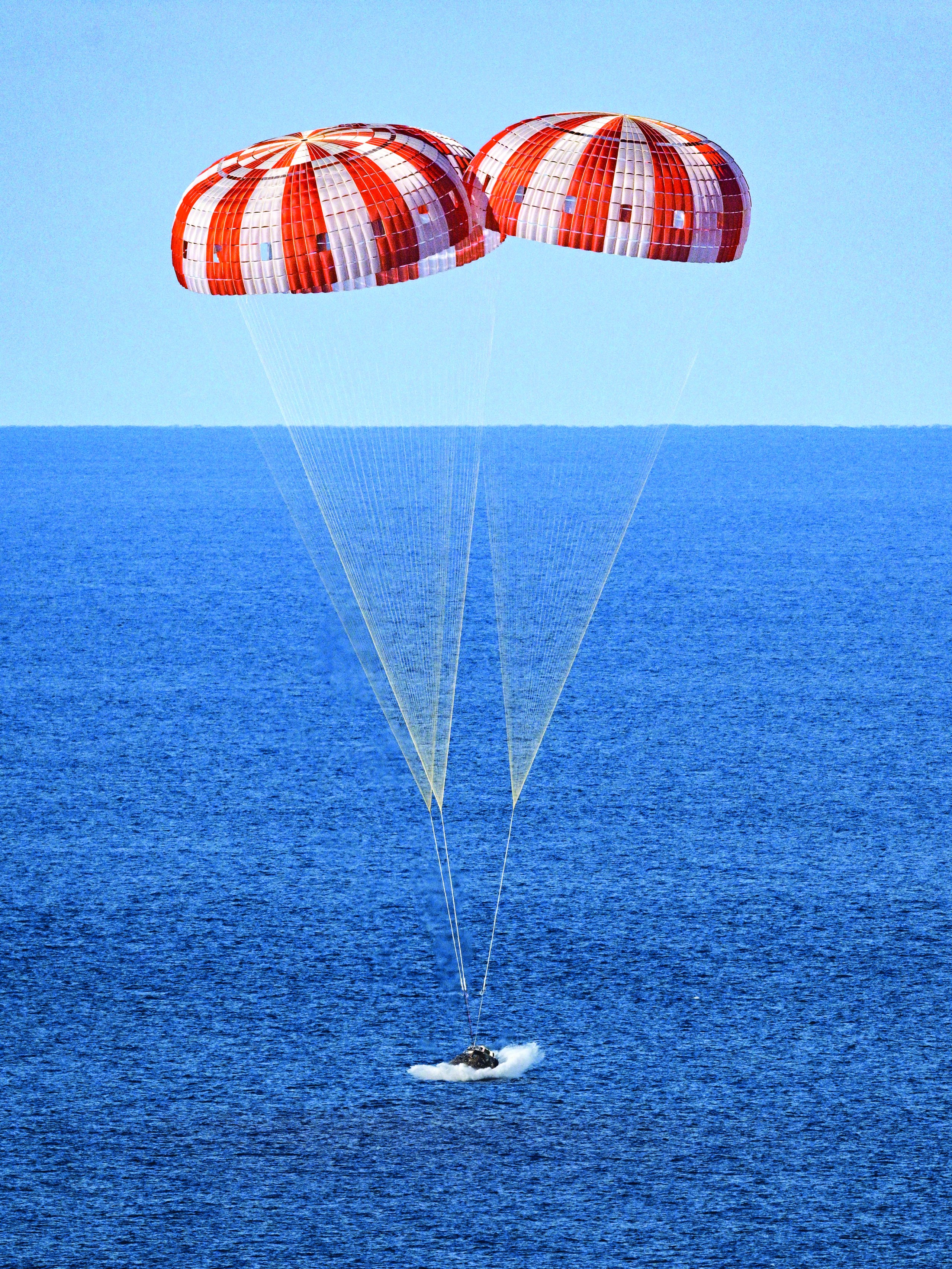
When the Artemis 2 crew splashed down in the Pacific Ocean on April 10, the excitement was palpable — Reid Wiseman, Victor Glover, Christina Koch, and Jeremy Hansen had swung around the Moon, broken a human spaceflight distance record, and come home safely. But for the Artemis program, it was just the beginning.
Between April’s historic splashdown and boots on the lunar south pole lies a series of technical challenges more complex than anything Artemis 2 was asked to solve, including newly revised mission architecture and numerous so-far unproven technologies. But perhaps the most critical item on the to-do list is to accomplish something that has never been done in the history of spaceflight: refueling a rocket in orbit. And the clock is ticking.
The rocket equation
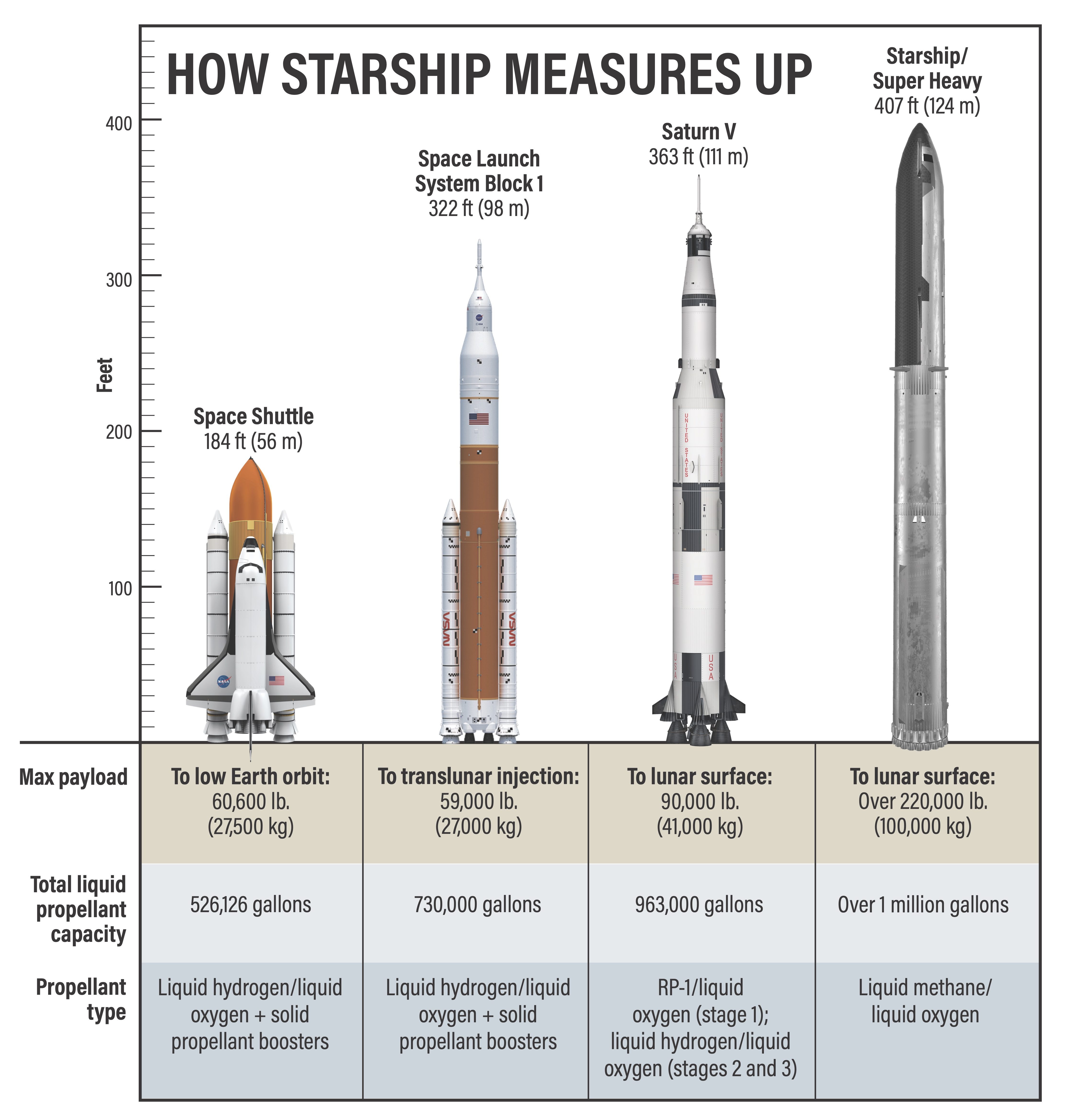
When Neil Armstrong and Buzz Aldrin landed in the Sea of Tranquility in 1969, they arrived aboard a spacecraft that had launched as a single stack from Kennedy Space Center. The Saturn V carried everything — the Command Module, the Service Module, and the Lunar Module — all at once, on one rocket. The Saturn V could deliver roughly 47 tons to translunar injection, cost the equivalent of billions of dollars per flight, and was entirely expendable. That same approach won’t work for the cadence and payloads required for building a permanent base.
The Artemis program is built around the Space Launch System (SLS) — a core stage supplemented with solid rocket boosters that combine to deliver the most liftoff thrust of any rocket in history. But despite its lifting power, SLS is actually less capable than the Saturn V when it comes to sending mass to the Moon: In its current configuration, known as Block 1, SLS can deliver around 27 tons to lunar orbit. A variant with more powerful upper stages — which would have delivered the Lunar Gateway — was cancelled as part of the Artemis restructure led by NASA Administrator Jared Isaacman.
More critically, SLS was never designed to carry a lunar lander. The entire Artemis architecture is built around a separately launched lander meeting the crew in space and delivering them to the lunar surface.
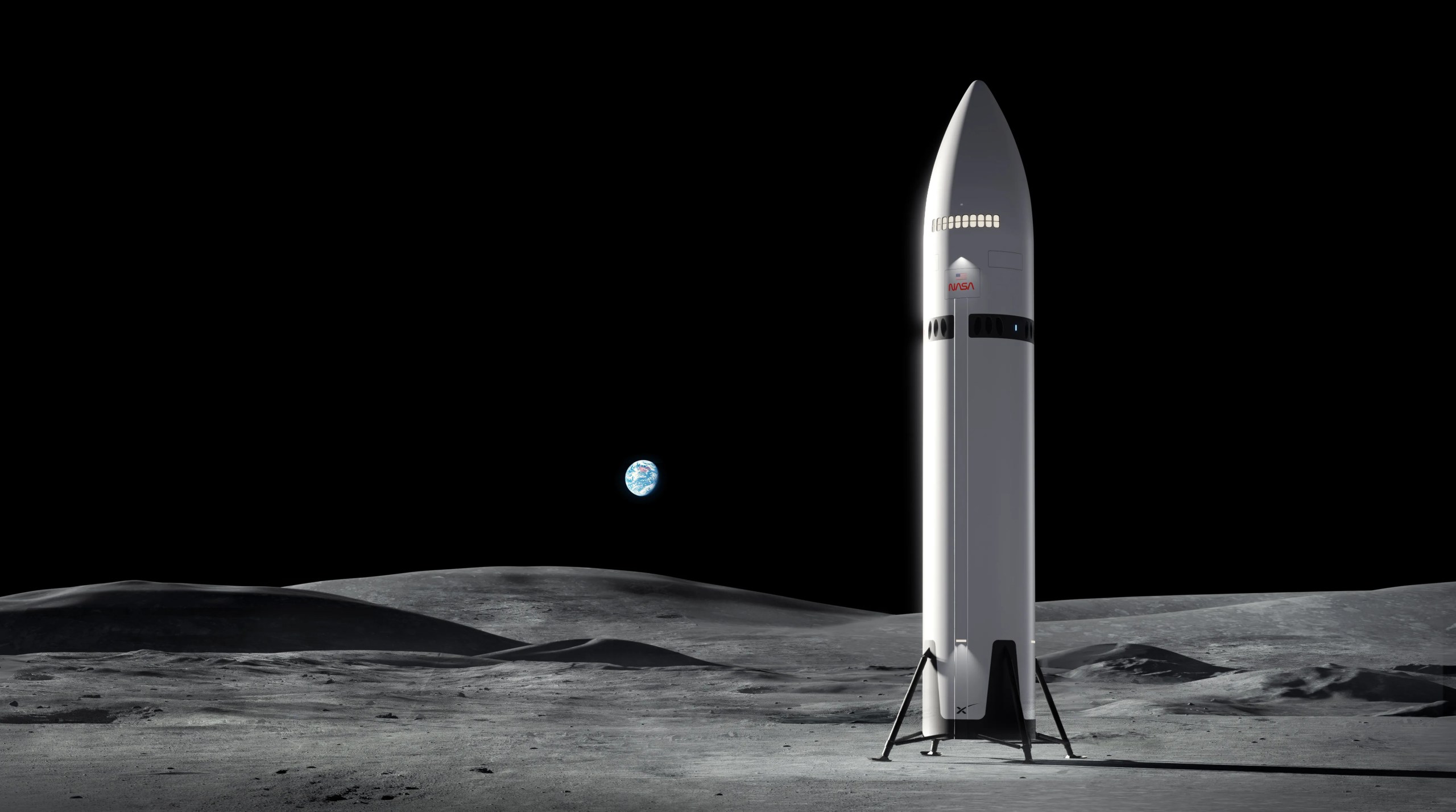
NASA has contracted two companies to build those landers: SpaceX, with its Starship Human Landing System (HLS), and Blue Origin, with its Blue Moon. And getting either vehicle to the Moon requires something Apollo never needed: refueling in orbit.
The need for orbital refueling comes down to a hard constraint of physics. A Starship or Blue Moon loaded with enough propellant to fly to the Moon and land would be too heavy to launch. The fuel required to lift that fuel requires yet more fuel, a compounding problem that engineers call the tyranny of the rocket equation. The solution is to launch the lander with its tank of propellant nearly empty and fill it once it reaches low Earth orbit (LEO), before it sets off for the Moon.
Aircraft have been refueling in flight since the 1920s. A tanker, flying in close formation with a receiver, connects the two through a flexible hose or a rigid boom, transfers fuel, and the aircraft flies on. Rockets are different.
SpaceX’s Starship runs on liquid oxygen (LOX) and liquid methane; Blue Origin’s New Glenn, which will launch Blue Moon, runs on LOX and liquid hydrogen. These are cryogenic propellants — fuels that exist as liquids only at extremely low temperatures. Transferring them between two vehicles the size of skyscrapers, in the microgravity of LEO, introduces a set of problems that aerial refueling has never had to solve: keeping the fuel cold enough that it doesn’t boil off, and managing the fact that in microgravity, liquid and gas don’t behave the way they do on Earth.
A history of attempts
Transferring cryogenic propellants between two independent spacecraft has never been done before. But engineers have been chipping away at pieces of this problem for decades.
The first precedents date to as early as 1986, from the Soviet and Russian space programs. Both the Mir space station and then later the International Space Station (ISS) were serviced by Progress cargo vehicles that transferred propellant to keep the stations in orbit. But those transfers used propellants that remain liquid at room temperature.
A more direct precursor came in 2007, when DARPA’s Orbital Express mission successfully demonstrated autonomous rendezvous, docking, and fluid transfer between two spacecraft. But again, the propellant was storable hydrazine fuel, not cryogenic.
NASA’s Robotic Refueling Mission 3 (RRM3) came close to the cryogenic challenge. Launched to the ISS in December 2018, RRM3 was designed to demonstrate both long-duration cryogenic storage and an actual tank-to-tank transfer of liquid methane — the first anyone had attempted in orbit. It achieved the first goal: Special cryocoolers kept the methane stable for four months. Then on April 8, 2019, the coolers stopped responding and could not be revived. The methane was safely vented, and the transfer demonstration never ran.
Several years later, SpaceX was able to succeed where RRM3 had failed. In March 2024, SpaceX’s Starship Flight Test 3 became the first vehicle in history to transfer cryogenic propellant in space, moving at least 10 metric tons of LOX between two internal tanks. This demo took place inside one vehicle, not two, with no docking interface to negotiate. But it was a necessary first step, and an important proof that cryogenic transfer in space is physically possible.
How to fill a rocket in space
Docking
The micro-gravity problem
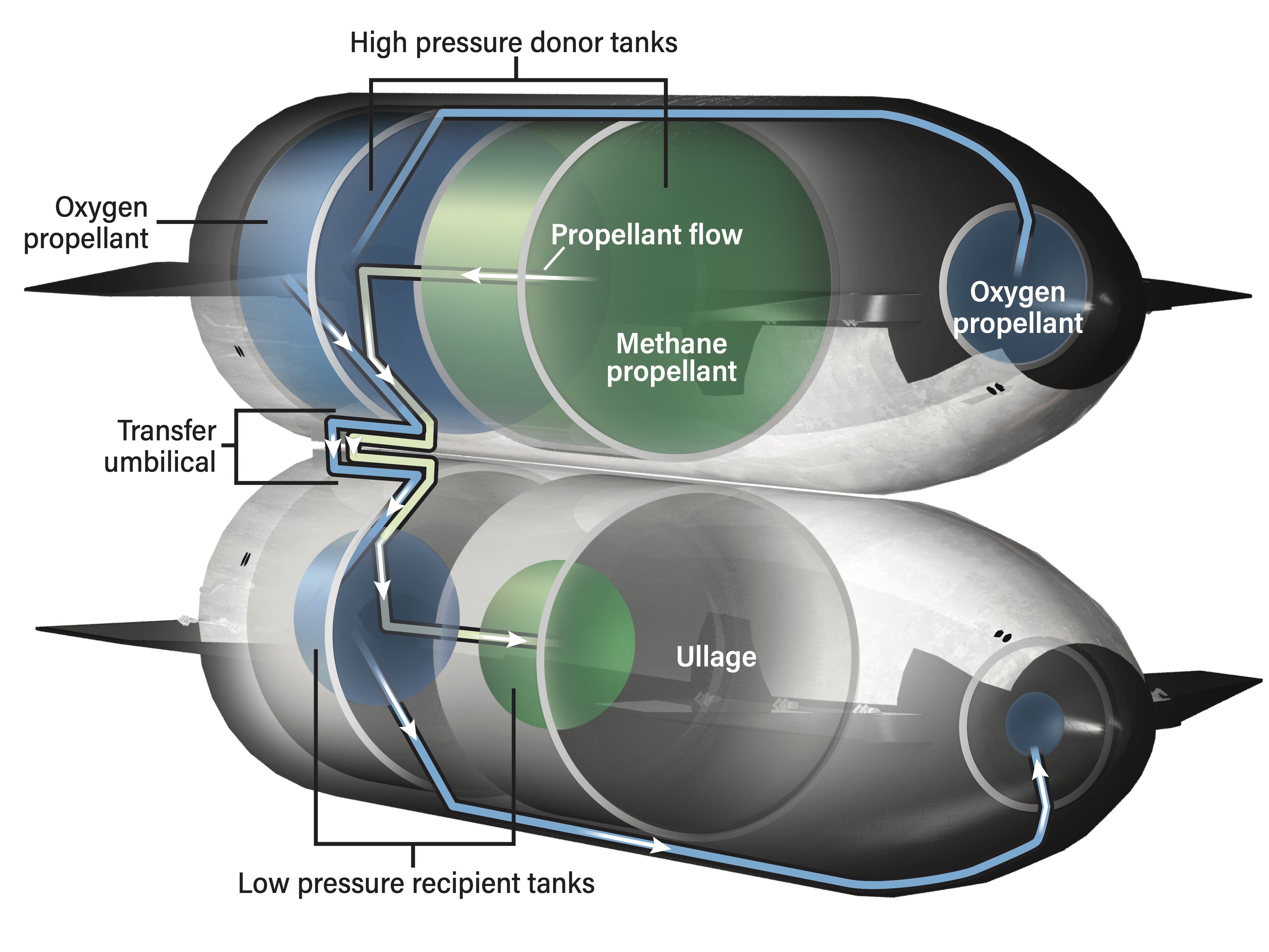
Ullage, boil-off, and pressure
The pressure delta
The boil-off problem
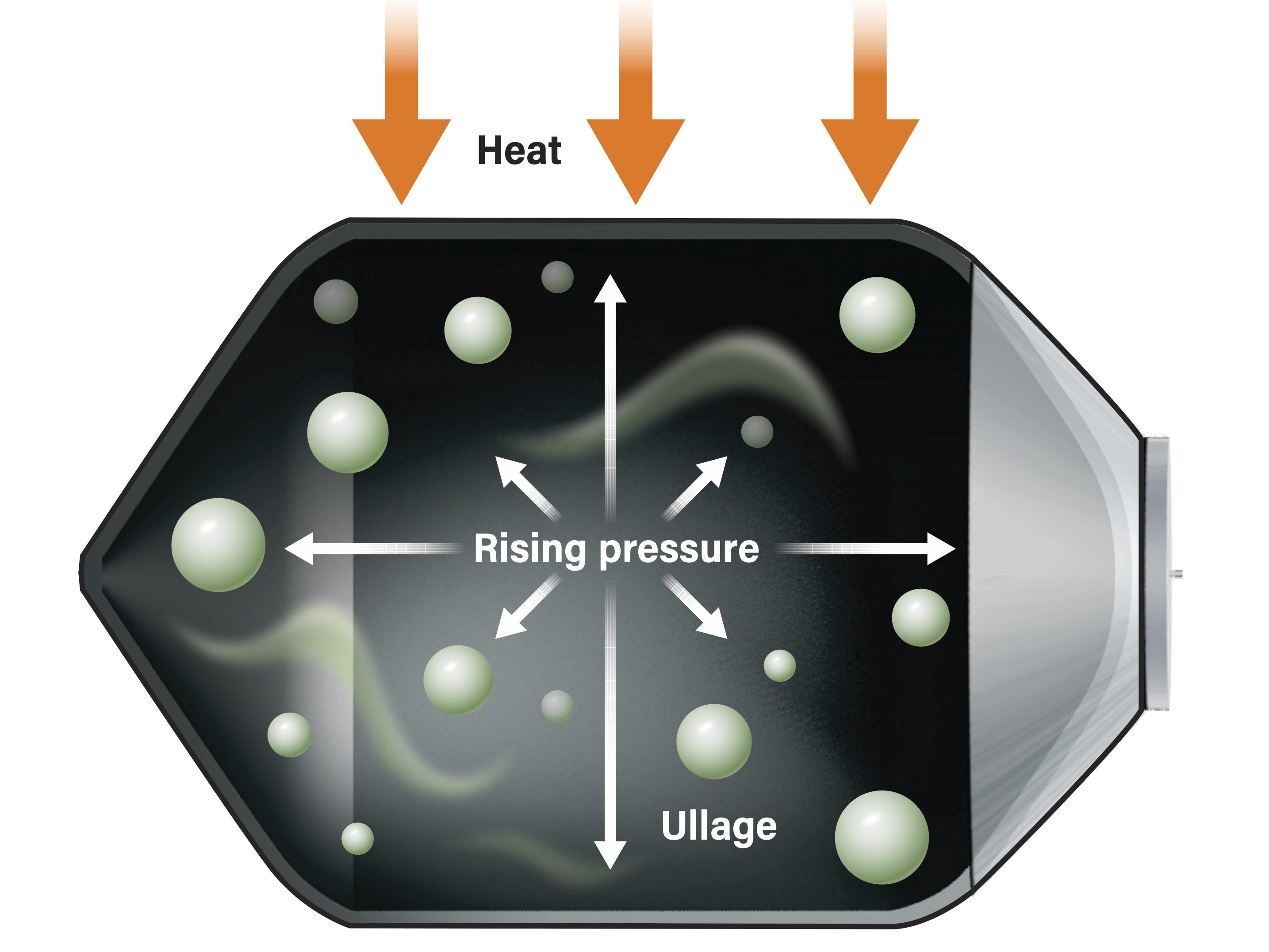
One of the biggest challenges is keeping cryogenic fuel in its liquid state. LOX boils at –297.3 degrees Fahrenheit (–183 degrees Celsius); liquid methane at –258.7 F (–162 C). Liquid hydrogen is even more extreme, boiling at –423.2 F (–253 C) — just 20 degrees above absolute zero. No matter how insulated a fuel tank’s walls are, heat from sunlight and radiation will constantly leak through. This causes liquid propellant to boil into vapor, which collects in the space around the liquid — a region called the ullage. As more vapor accumulates, pressure in the sealed tank climbs. For a fuel depot sitting in orbit for months, it’s a fundamental problem. “The most underappreciated challenge is not a single cryogenic transfer event, but long-duration cryogenic storage in orbit,” says Qiyun Cheng, an engineer and postdoctoral associate at MIT. “Over weeks or months, even very small heat leaks can accumulate.” The passive solution — venting the vapor through a relief valve — throws away propellant the mission needs. A NASA analysis for a hypothetical Mars mission found that passive boil-off losses for a large liquid hydrogen tank carrying 38 tons of fuel would run roughly 16 tons per year, meaning the propellant would boil-off long before the mission arrived at Mars.
Keeping propellants cold requires active cooling through what engineers call zero boil-off (ZBO) storage (like what was used during RRM3). Two main mechanisms have been developed. The first is jet mixing: A stream of cold liquid is pumped through the tank, cooling and condensing vapor before pressure can build. The second is droplet injection: Cold droplets are sprayed directly into the ullage, where they absorb heat from the vapor and reduce pressure without venting.
NASA has been testing ZBO storage in microgravity aboard the ISS since 2017 through a project called the Zero Boil-Off Tank experiments. The results confirmed the basic approach works. On that same hypothetical Mars mission, the analysis found ZBO storage could cut boil-off losses by 42 percent, making the mission viable. However, questions about how the technology performs at operational scale remain unresolved.
For one, active cooling systems for cryogenic fuel demand significant power. “It takes a lot of electrical work to move a small amount of heat out of the tank,” Álvaro Romero-Calvo, an aerospace engineer at Georgia Tech who directs the university’s Low-Gravity Science and Technology Laboratory, tells Astronomy. “On Earth, we have virtually infinite energy, but in space, power is limited by what your solar panels and batteries can provide, and mass costs money.” More power means more mass at launch — more insulation could reduce the needed power but carries its own mass penalty.
SpaceX will need to find a sweet spot in a tangle of trade-offs: Every kilogram devoted to insulation and cooling is a kilogram of propellant that doesn’t make it to orbit. How many tanker flights it takes to top off the lander depends on how well the company navigates that balance.
Blue Origin faces the same challenge, compounded by hydrogen’s more extreme boiling point. In July 2025, the company announced that ground testing of its ZBO technology had met all NASA objectives, demonstrating performance at what the company called “two times the performance of the current state of the art.”
The NASA Office of Inspector General (OIG), however, found in a report released March 10, 2026, that cryogenic fluid management remains one of both Blue Origin and SpaceX’s most significant technical challenges.
No gravity, no flow
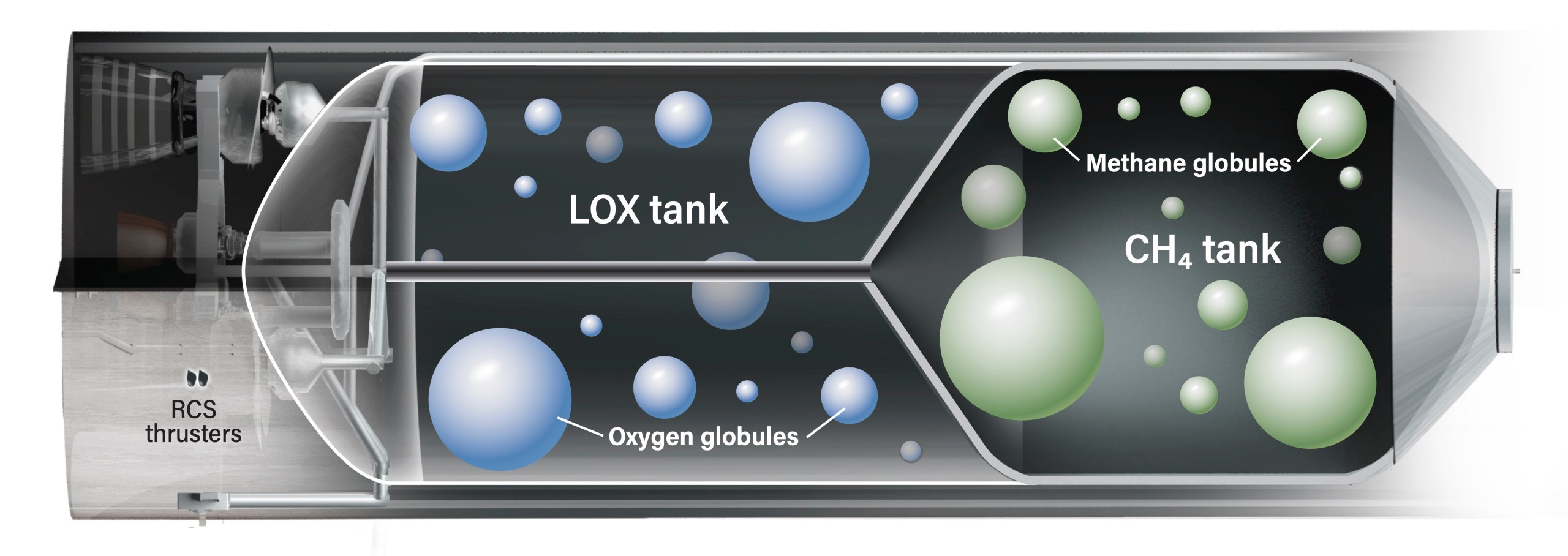
On Earth, buoyancy does the work of separating liquid from gas — less dense vapor rises, denser liquid settles. “In space, they just float around, creating froth layers or complex liquid/gas mixtures that are very hard to separate,” says Romero-Calvo.
SpaceX’s approach to the gravity problem combines two techniques. First, small thrusters fire briefly to push the spacecraft forward, creating a faint artificial gravity that settles propellant toward the back of the tank. The technique has been used for decades within single rockets before engine ignition, but applying it during a cryogenic transfer between two docked vehicles is unprecedented. Once the propellant is settled, flow is driven by pressure rather than pumps — controlled boil-off raises pressure in the donor tank, and that differential pushes propellant across the umbilical fuel line into the receiving vehicle. “The fundamental flow mechanism is because of the pressure delta across the umbilical,” Amit Kshatriya, NASA’s associate administrator, told the NASA Advisory Council’s Human Exploration and Operations Committee in April 2024, according to reporting at the time from Ars Technica.
The full details of how SpaceX will manage pressures, sequencing, and transfer remain in development. Kshatriya told the committee that SpaceX still had work ahead, as reported by SpaceNews. “The point of their flight test program before we do this is to make sure they fully understand the slosh dynamics, fully understand how the ullage is being maintained, what the settling thrust needs to be,” he said. “We’ve gone through it with them in terms of their plan for this. It’s a good plan.”
It is worth noting that even on the ground, with gravity doing its job and experienced crews managing established infrastructure, cryogenic propellant tanking caused repeated delays during Artemis 2 launch preparations. In orbit, those advantages disappear entirely.
A new roadmap
On Feb. 27, 2026 — a month before Artemis 2 even left the pad — NASA Administrator Jared Isaacman announced a sweeping overhaul, restructuring the Artemis program into a more incremental series of missions modeled on Apollo’s approach.
Under the new architecture, Artemis 3, currently scheduled for mid-2027, will not land on the Moon as originally planned. Instead, the four-person crew — commander Randy Bresnik, pilot Luca Parmitano of the European Space Agency, and mission specialists Frank Rubio and Andre Douglas — will launch aboard an Orion crew capsule and rendezvous in low Earth orbit with one or both of NASA’s contracted commercial landers — SpaceX’s Starship Human Landing System (HLS) and Blue Origin’s Blue Moon. While there, they will also test the program’s new spacesuits and life-support systems. The mission has drawn comparisons to Apollo 9 — the 1969 Earth orbit shakedown of the Lunar Module that cleared the way for Apollo 11 four months later.
Artemis 4, targeting early 2028, is now the first landing mission. NASA has said they will choose whichever commercial lander is ready and certified. If SpaceX is selected, a four-person crew will launch aboard Orion, travel to Earth orbit, and dock with Starship HLS for the journey to lunar orbit. If Blue Origin is selected, Blue Moon’s path to lunar orbit is less clear. Once in lunar orbit, two astronauts will descend to the lunar south pole, where they will become the first humans to stand on the Moon since Apollo 17 in December 1972. Over roughly a week on the surface, they will conduct moonwalks, collecting samples and performing experiments, before ascending back to lunar orbit and rejoining their crewmates aboard Orion for the journey home. The mission is expected to last around 30 days in total.
Artemis 5, currently targeting late 2028, will see two astronauts descending to the south pole, and the beginning of NASA’s construction on the surface infrastructure for a permanent base.
Beyond Artemis, NASA’s formal Moon base plan calls for $20 billion to $30 billion in investment over the next decade, unfolding in three phases toward a nuclear-powered permanent outpost by 2032. A planned space station in lunar orbit called the Lunar Gateway has been scrapped. In the words of Carlos Garcia-Galan, the former Gateway program deputy manager who now heads the space agency’s Moon base effort, every resource is now “focused on one thing, and that is to build the Moon base.”
While intended to be a simpler architecture, the timeline remains ambitious. From Isaacman’s announcement to the first lunar landing is less than two years. And before either lander flies, both companies must solve the refueling problem.
From demo to depot
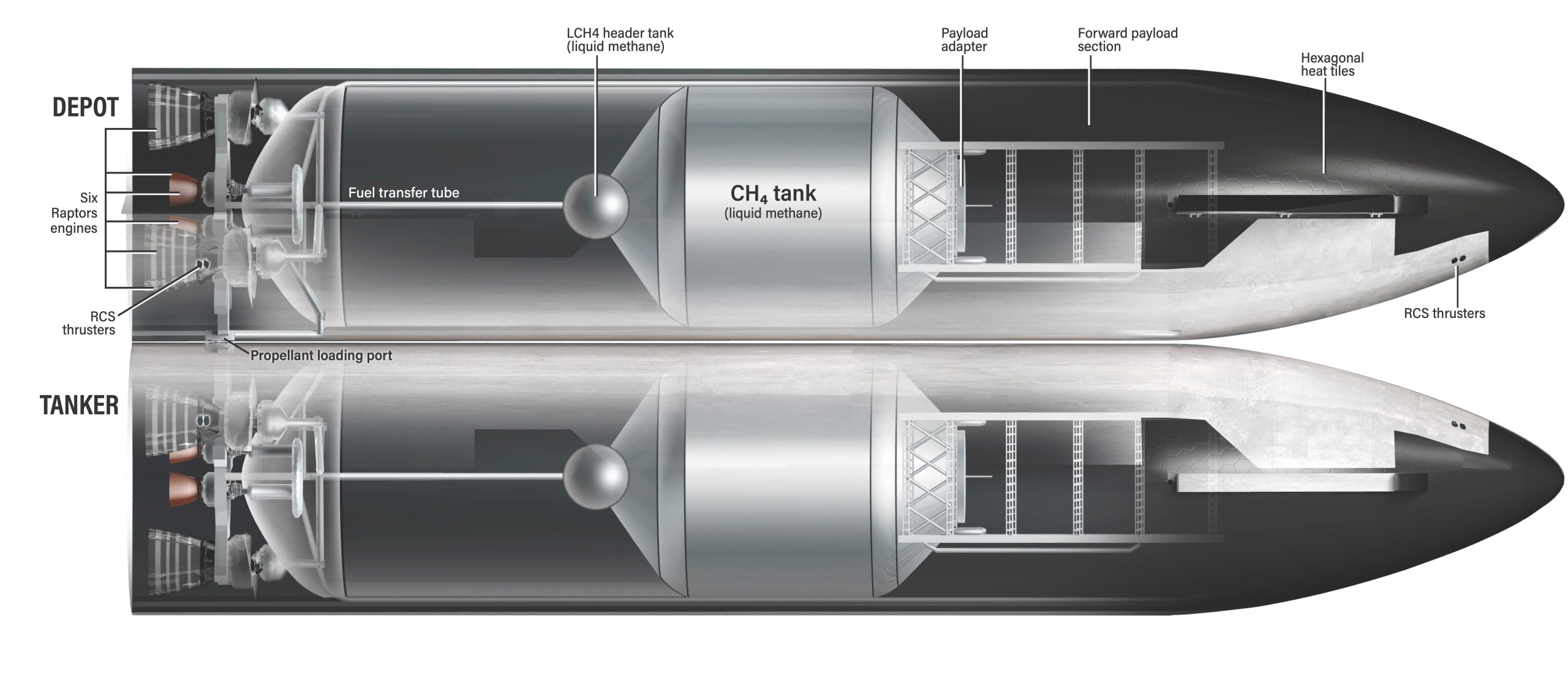
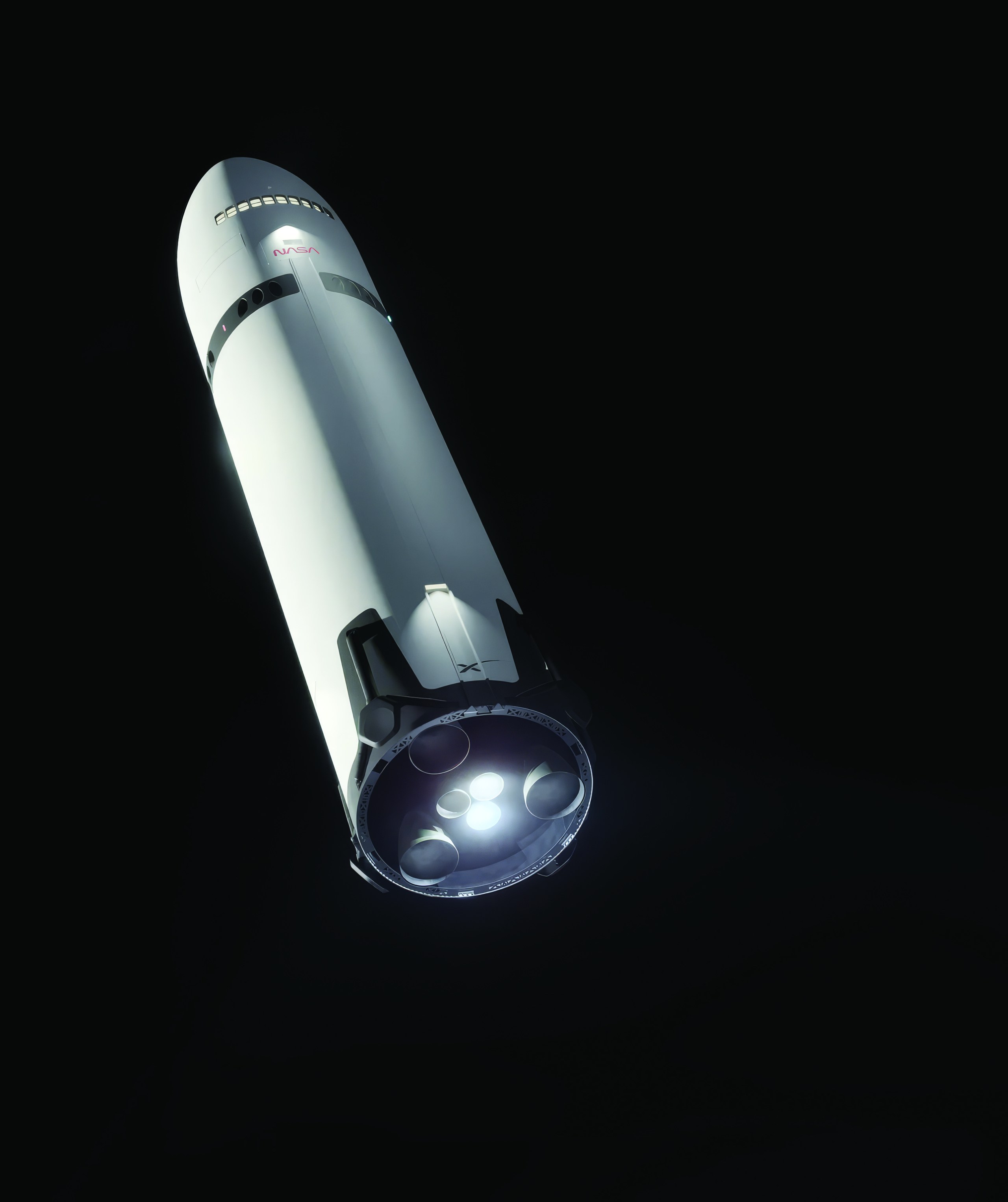
If the engineering challenges can be solved, the Starship architecture works like this: SpaceX launches a dedicated propellant depot — a modified Starship, essentially a large, insulated tank with docking ports — into LEO. Then, over a period beginning more than 200 days before the crew launches, a series of Starship tanker flights lift off from the ground, rendezvous with the depot, and transfer their propellant. NASA is targeting more than 10 such tanker flights, at a cadence of roughly one every six days. Whether it takes 10 or closer to 20 depends on boil-off losses and transfer efficiency. Once full, the Starship HLS then launches separately, docks with the now full depot, tops off its tanks, and departs for the Moon.
Before that happens, SpaceX will demonstrate the propellant transfer with a test flight. Two Starships will launch from Boca Chica, Texas, several weeks apart. The first, the target vehicle, will reach orbit and wait. The second, the tanker, will chase down the first, and dock autonomously. Next, the tanker will transfer its cryogenic propellant to the target. Both vehicles will then deorbit and return to Earth. If it works, it will be the first time cryogenic propellant has been transferred between two independent spacecraft.
The demonstration has slipped twice. It was originally planned for March 2025, then delayed 12 months to March 2026, according to a NASA OIG report. SpaceX then missed the March 2026 date as well, with the demo now expected at some point in 2026 but with no confirmed launch date announced. The OIG report explicitly flagged the delay as a risk to the overall Artemis schedule.
A successful Starship propellant transfer demonstration will clear the path for an uncrewed Starship HLS lunar landing demo. Success there clears the path for Artemis 4’s crewed lunar landing in 2028.
Blue Origin’s steeper climb
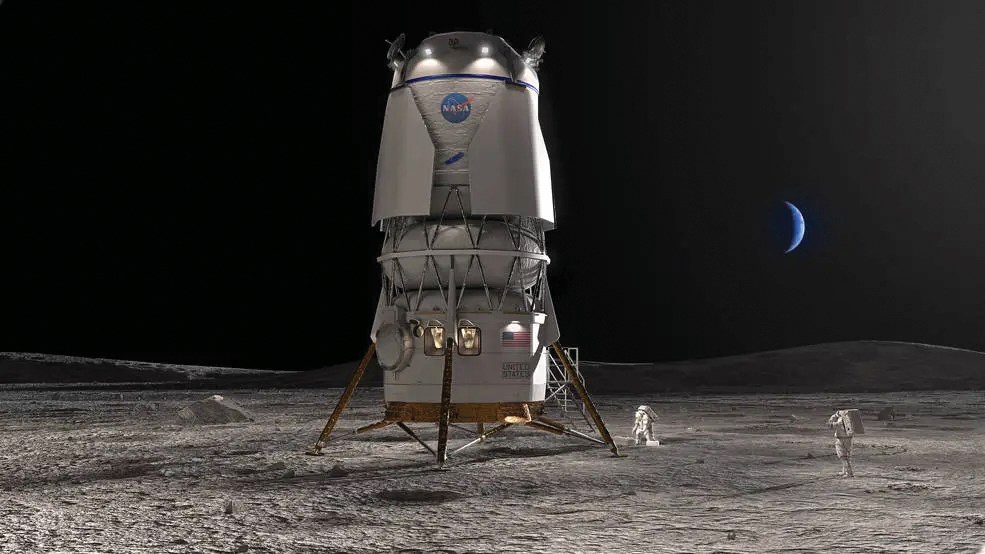
Blue Origin faces a less certain path. Unlike SpaceX, which has a defined architecture and a pending demo flight, Blue Origin does not have a published plan for how refueling will work. Its original architecture depended on docking with the Lunar Gateway, which has since been canceled. How that changes Blue Origin’s refueling approach has not been announced.
Blue Origin must also fly an uncrewed demonstration mission before NASA will certify its lander to carry crew. That demo will be flown by Endurance, the Mark 1 variant of Blue Moon — a smaller, uncrewed cargo and science lander designed to demonstrate precision landing, cryogenic propulsion, and zero boil-off storage at the lunar south pole. Only after Endurance succeeds can the crewed Mark 2 fly on Artemis 5.
Endurance completed thermal vacuum testing at NASA’s Johnson Space Center in early May — but that milestone has been overshadowed. On May 28, the New Glenn rocket Blue Origin was preparing for an Endurance launch exploded on its pad during a static fire test, destroying the vehicle and severely damaging the company’s only New Glenn pad. At a June 9 press conference, Blue Origin’s vice president of lunar permanence John Couluris said the company’s factories are running around-the-clock and that Mark 1 will be ready for launch this year, adding: “We will measure ourselves not only by our successes, but how we respond to setbacks.” Whether Blue Origin can return New Glenn to flight, resolve its refueling architecture, and land Endurance on the Moon in time to certify Blue Moon for Artemis 5 remains to be seen.
What comes next
“Crack large-scale orbital propellant transfer, and propellant becomes a commodity you launch cheaply and aggregate in LEO, which decouples deep-space capability from single-launch mass,” Romero-Calvo says. In short, the Moon, Mars, the outer planets — none are reachable without propellant transfer.
“This is a relay race,” Artemis 2’s Christina Koch said from space the day before splashdown. Artemis 2 ran its leg. When humanity will finally land on the Moon to stay, and Mars after that, hinges on the next legs — legs that are longer, more complex, and depend on as-of-yet unproven technology.
Brooks Mendenhall is a staff writer at Astronomy, based in Chattanooga, Tennessee, fueled by an unending curiosity about the universe. A former classroom teacher, he has a knack for breaking down complex concepts for a wide audience.