SpaceX is now targeting Thursday, July 23, for the 13th test flight of Starship, after the company scrubbed its first attempt on July 16. It will be only the second launch of the vehicle’s V3 configuration — the version of the rocket that will fly astronauts to the Moon for NASA’s Artemis program.
The 90-minute launch window opens at 6:45 p.m. EDT from Starbase, Texas. V3 is Starship’s biggest rocket yet at 408 feet (124 meters) tall. Its 33 Raptor 3 engines (compared with V2’s Raptor 2s) have more thrust and around three times the payload capacity. During the July 16 launch attempt, four of those Raptor 3 engines failed to ignite as the countdown reached zero, triggering an automatic abort seconds before liftoff. If Thursday’s countdown proceeds, Flight 13 will repeat most of the objectives from Flight 12 while adding a first: the deployment of 20 next-generation Starlink V3 satellites riding to space inside Starship’s payload bay.
What is Starship?
Starship is a super heavy-lift reusable rocket comprising two vehicles. The Super Heavy booster lifts off the pad, then separates and flies itself back to Earth — historically splashing down in the Gulf of Mexico, although SpaceX has previously caught it with the launch tower’s mechanical arms, on Flights 5, 7, and 8. Starship itself is the upper section, which the company calls “Ship.” It carries the payload and engines that push satellites — or eventually crew — the rest of the way to orbit, before its own ocean splashdown, with a tower catch planned for the future. The long-term goal is to refuel and relaunch both stages within hours or days.
What’s new on Starship V3?
Flight 12 in May marked the debut of Starship V3. The third major redesign of Starship and its Super Heavy booster, V3 follows the V1 that flew Starship’s first six test flights and the V2 upgrade that carried Flights 7 through 11.
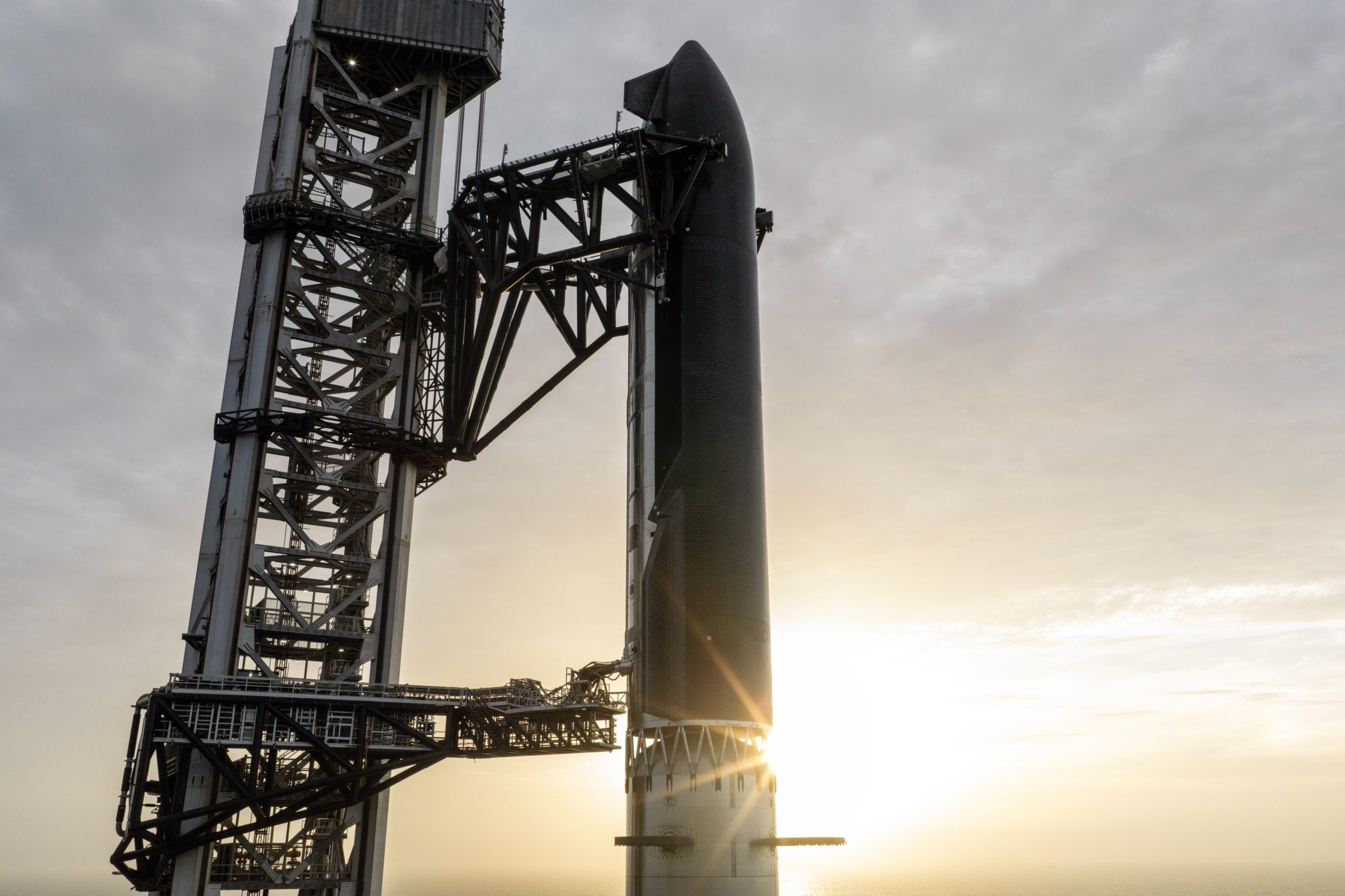
At 408 feet (124 m) tall, Starship V3 is the tallest rocket ever flown, about 4 feet (1.2 m) taller than V2. Per SpaceX, each of Super Heavy’s 33 Raptor 3 engines produces 551,156 pounds (250 metric tons) of thrust — up from 507,063 pounds (230 metric tons) on Raptor 2. Multiply that by 33 and Super Heavy V3 lifts off with over 18 million pounds (8,160 metric tons) of combined thrust.
Justin Styer, senior director at SpaceX, described that power in a behind-the-scenes video from the company, comparing it to “11 Ford F-150 trucks per second zipping out of the bottom of the rocket.”
Beyond the engines, V3 has three larger steering fins in place of V2’s four, the fuel lines are redesigned so all 33 engines can fire together more reliably, and newly added hardware that will let two Starships dock and transfer fuel to each other in space — a key ability for launching crew and cargo to the Moon and beyond.
On the ground, SpaceX has constructed a new launch pad for V3 that the company says refuels the rocket faster; moves the giant mechanical arms that catch the booster with quicker, more reliable motors; and adds a sturdier landing platform designed to survive launch after launch without repairs.
What happened during Flight 12?
On Flight 12, the upper stage reached its planned suborbital trajectory, deployed dummy satellites, and survived reentry with its heat shield largely intact — although it lost one of its three vacuum-optimized Raptor engines about 40 seconds after separating from the booster. The booster did not fare even that well. At separation, slight differences in the Starship’s engine startup timing threw off Super Heavy’s directional flip by roughly 90 degrees. Then, five of the booster’s engines failed to relight during the boostback burn meant to steer it toward the Gulf of Mexico, and it hit the water at high speed instead of completing a controlled splashdown.
The FAA classified the flight a mishap days later, grounding Starship until SpaceX completed an investigation. The investigation closed July 13, with the agency clearing SpaceX to move ahead with Flight 13.
What will happen on Flight 13?
For Flight 13, SpaceX has reworked the booster’s startup sequence to make its flip maneuver more reliable, as well as made hardware changes to Super Heavy’s engines and updates to improve boostback relight reliability. Starship’s propulsion system also picked up fixes after Flight 12’s engine loss.
Assuming Thursday’s launch takes place, Super Heavy will lift Starship off the pad before the two separate about two minutes later. The booster will then attempt a landing burn and splashdown in the Gulf of Mexico.
Starship will continue on its suborbital trajectory before deploying 20 Starlink V3 satellites, the most capable version of SpaceX’s internet constellation yet. Once deployed, the satellites will extend their solar arrays and antennas and attempt to link with the broader Starlink constellation via lasers, before burning up in the atmosphere about 20 minutes after deployment.
Six of the satellites carry cameras that will be aimed at Starship’s belly to gather imagery of the heat shield, whose readiness SpaceX needs to judge for future vehicle recovery (rather than splashdown, as is the norm now). Starship will also attempt an in-space relight of one Raptor engine — a test skipped on Flight 12 — before attempting a guided reentry and splashdown in the Indian Ocean roughly an hour after liftoff.
Flight 13’s success — and the future of Starship more broadly — is crucial for NASA’s Artemis program. NASA selected Starship as the human landing system that will take astronauts to the surface of the Moon on Artemis 4, the first lunar landing since Apollo 17.
But before that, SpaceX has to prove it can refuel one Starship using another while both are in orbit — a maneuver that has not yet been attempted, and one that depends on the version of the rocket being tested this week.
SpaceX hasn’t announced a date for that orbital refueling demonstration, but if Flight 13 is successful, it moves the company one step closer.
Brooks Mendenhall is a staff writer for Astronomy magazine and is based in Chattanooga, Tennessee.