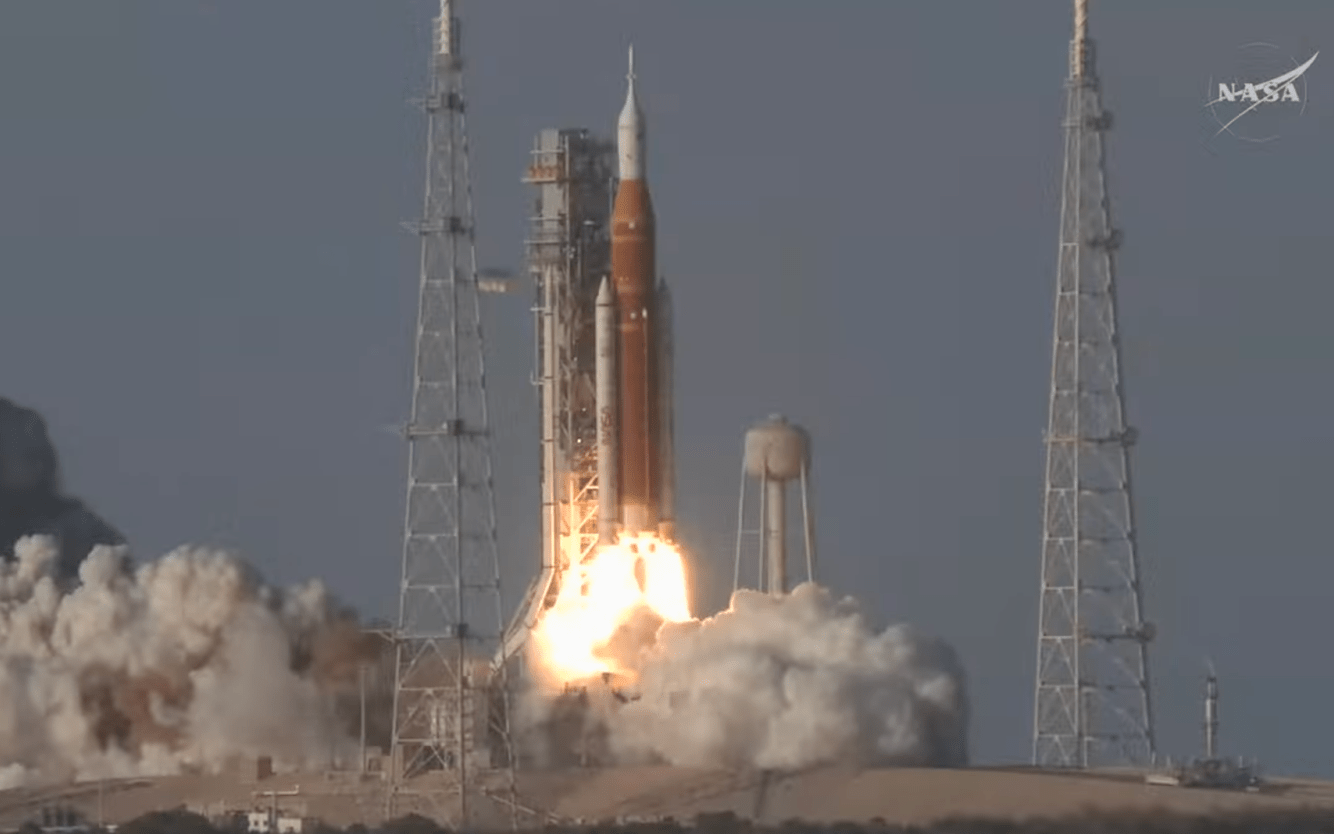
At 6:35 p.m. EDT, the Artemis 2 mission successfully lifted off from the Kennedy Space Center at Cape Canaveral, marking the first time humans have headed to the Moon since Apollo 17 in 1972.
The crew is “safe, they’re secure and they’re in great spirits,” said NASA administrator Jared Isaacman in a post-launch press conference on Wednesday evening.
The craft is currently in a high Earth orbit, where it will perform check-out tests for the next day. The next major milestone for the mission will come Thursday evening (EDT), when the ICPS lights its engine to propel the crew out of Earth orbit and begin its journey to the Moon.
The mission comes just weeks after the agency announced a major overhaul of the Artemis program, a shift spearheaded by Isaacman since being confirmed as administrator in December. The plan increases the tempo of Artemis launches, cancels planned upgrades to the Space Launch System (SLS) rocket booster in favor of developing one proven configuration, and nixes a long-planned orbital space station around the Moon in order to focus on building a $30 billion base on the lunar surface.
Artemis 2 is a crucial stepping stone to realizing those ambitions — something that Isaacman said the crew expressed keen awareness of in a conversation earlier this year. “This is a risky mission, for sure. Any type of new test flight mission going in this environment is going to be challenging,” said Isaacman. “They knew it was building up to something bigger, and I think that I think it was very helpful for them in that regard.”
To get up to speed on the mission, check out our complete guide to Artemis 2 and explore the full mission timeline.
Our live coverage of launch day has ended. Check back at Astronomy.com for the latest updates throughout the mission.
As it happened
11:40 p.m. EDT (+05:04): Artemis 2 scheduled to deploy CubeSats
Integrity is not the only payload on Artemis 2.
Within the Orion stage adapter — a ring connecting the capsule and ICPS — were four shoebox-sized CubeSats, or square-shaped miniature satellites. The CubeSats come from Artemis Accords signatories Argentina, South Korea, Germany, and Saudi Arabia. They were scheduled to be ejected shortly after the proximity operations demonstration and will perform a range of on-orbit experiments.
Saudi Space Agency CubeSats will collect data on space radiation, solar X-rays, solar energetic particles, and magnetic fields. Argentina’s will measure the radiation spectrum around Earth, collect GPS data, and test a long-range communications link.
The Korea Aerospace Administration’s CubeSat contains material designed to mimic human tissue, allowing it to measure radiation across the Van Allen belts — one of the most hazardous regions for astronauts. Germany’s experiment will study the performance of electrical components to guide the design of future lunar vehicles.
The astronauts themselves are also conducting science during the mission — both as researchers and test subjects.
They agreed to wear wristbands that monitor their movement and sleep patterns and place radiation-detecting devices in their pockets. The latter are being used beyond low Earth orbit for the first time. NASA installed six radiation sensors throughout Integrity to further measure exposure.
While on orbit, the astronauts removed their state-of-the-art spacesuits. They will don them again only during dynamic phases of the mission, spending most of it in plainclothes.
Crew members also donated blood to create miniature stand-ins of their bone marrow, contained in USB-sized chips. Bone marrow is particularly sensitive to radiation.
After completing their activities in Earth orbit, the crew will get some much-deserved rest before the translunar injection burn.
And so will we. Thanks for joining us for our coverage, and check back at Astronomy.com for full coverage of the rest of the Artemis 2 mission.
10:59 p.m. EDT (+04:23): Test drive comes to a close
As the prox ops demo drew to a close, pilot Victor Glover, who has been hand-flying Integrity for nearly the past hour, declared, "Overall, guys, this flies very nicely. … Very precise."
He continued: "The thruster firings are a lot less aggressive than I thought it would sound or feel — like driving on a gravely road. The response is quite immediate. Not all the axes are even. Roll is very, very slow. But pitch and yaw are very snappy and responsive. And when you have the zoom set right [on the docking camera], you could see very small motions, and so translations are all quite tight and very nicely balanced."
Shortly after, Mission Control gave the crew clearance to finish the demo and back away from the ICPS. "Nice flying with you, Houston," Glover called out. "Nice vehicle."
9:58 p.m. EDT (+03:24:15): Key maneuvering demo begins
One of the most exciting steps in the early portion of Artemis 2 is underway.
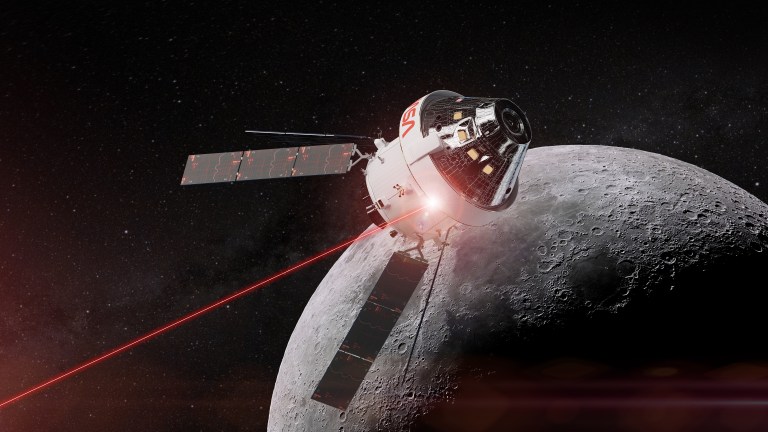
Having completed its primary objective, the SLS second stage, called the interim cryogenic propulsion stage (ICPS), is being used for target practice as the crew takes manual control of their Orion spacecraft, named Integrity. The capsule has separated from the ICPS and the astronauts are steering Integrity toward and around it, but the spacecraft are not expected to touch.
"I see it! Look at that!" one of the astronauts exclaimed as Integrity spun around, bringing the ICPS into view. “Woo-hoo!”
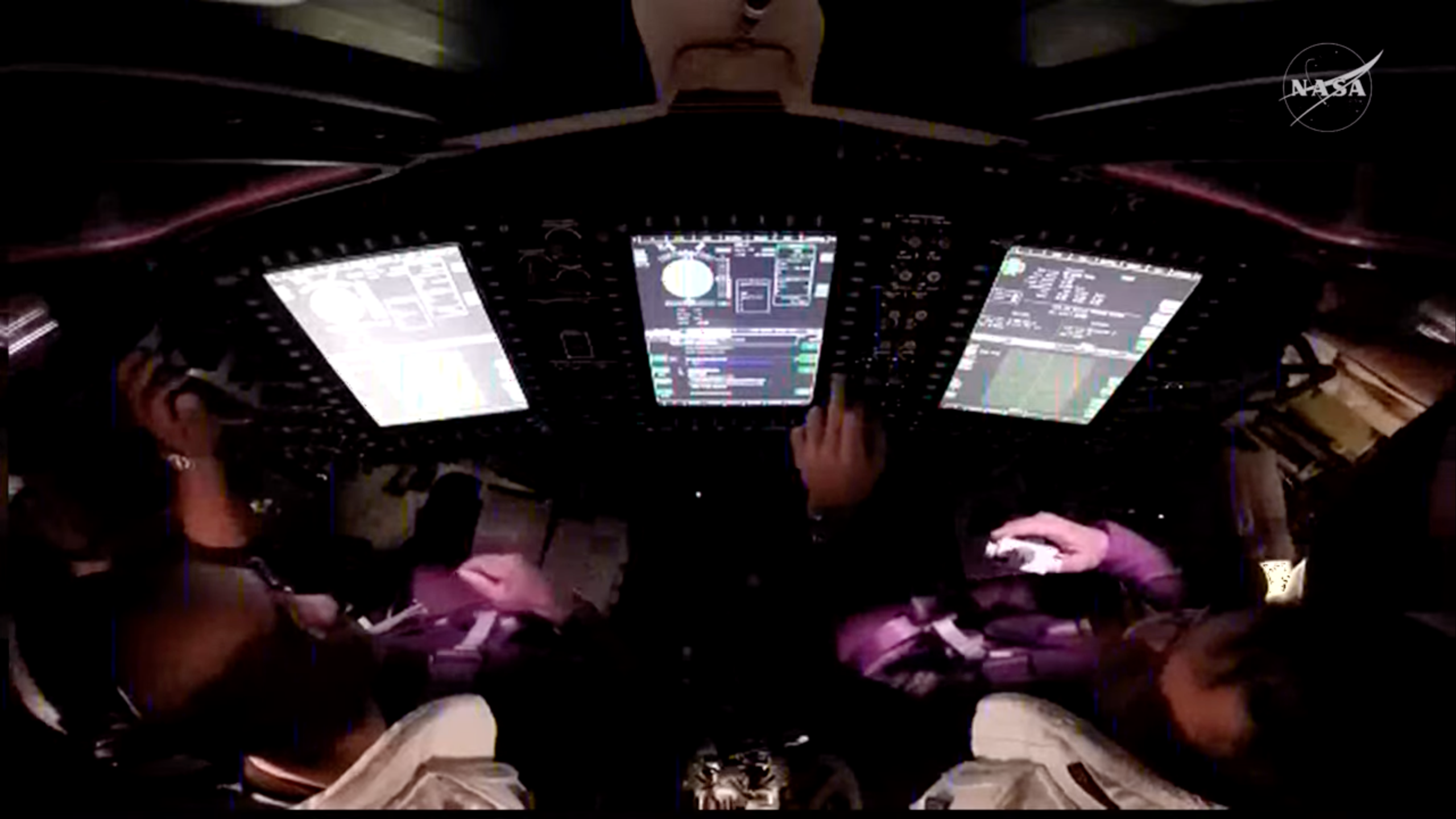
This proximity operations demonstration is intended to simulate docking with another spacecraft in orbit, which will be necessary for future Artemis missions that actually land on the Moon.
Artemis 3, scheduled for 2027, will be the first to incorporate human landing system (HLS) vehicles developed by SpaceX and Blue Origin. That adds complexity to the mission. SpaceX’s HLS, based on its gargantuan Starship rocket, could require several trips to an orbital fuel depot before heading to the Moon. Artemis 3 will test HLS performance in Earth orbit.
On Artemis 4, the first crewed landing of the campaign, the HLS will need to dock twice — once in Earth orbit at the orbital depot, and again in lunar orbit with Orion. Astronauts would transfer from Orion to the HLS and ride it to and from the lunar surface. The vehicle will also serve as their temporary habitat on the Moon.
The Artemis 2 astronauts are the first to test the Orion spacecraft's operations near other spacecraft, which could inform how NASA approaches future missions.
Throughout the demonstration, pilot Victor Glover gave detailed feedback on how the ship was handling as he made fine adjustments to its attitude, using the ICPS as a reference. In the video feed from the docking camera, the ICPS appeared as a bullseye as Integrity approached its barrel end. Later, Glover flew Integrity over to the side of the ICPS, practicing approaches to a custom-built target mounted on its side, testing the craft's handling and finding the most comfortable zoom levels on the docking camera.
Glover's early verdict on the Orion craft? A smooth ride, with its thrusters even quieter than in the simulator on the Earth, giving off a rumble that felt like "driving down a rocky road." That is in contrast to the "pops" of the thrusters heard on the SpaceX Dragon crewed capsule. Glover also commented that the quality of the docking camera in Integrity was better than the camera in the simulator.
The demonstration was expected to last about 70 minutes.
After that, the ICPS will complete its final burn and reenter the atmosphere over the Pacific Ocean.
9:05 p.m. EDT: Why did it take so long to go back to the Moon?
At the post-launch press briefing, one journalist asked NASA administrator Jared Isaacman why it took NASA 54 years to return to the Moon, and why it has been so challenging. Isaacman gave two reasons, the first of which was the decrease in NASA’s budget post-Apollo. The second was the lack of competition — until now. Competition “is a great way to mobilize the resources of a nation and concentrate on something extremely challenging, and that's what we did in the 1960s,” he said. “Competition can be a good thing. We certainly have competition now.”
At the press conference, agency officials also spoke about several mission highlights coming up. On Day 6, when Artemis 2 is expected to break Apollo 13’s human spaceflight record for distance from Earth. The mission’s trajectory is also expected to take it directly into the Moon’s umbral shadow, allowing the crew to witness a total solar eclipse and observe the Sun’s corona. And agency officials said they intend for the crew to capture a sequel to one of the most iconic photographs ever taken — Apollo 8’s “Earthrise.”
8:15 p.m. EDT: The post-launch press briefing is starting. "After a brief 54-year intermission, NASA is back in the business of sending astronauts to the Moon," said Administrator Jared Isaacman in his opening remarks.
Isaacman also noted a communications issue that cropped up: Roughly 51 minutes into the flight during a planned handover between communications satellites, there was a temporary partial loss of comms. The crew could hear Mission Control, but Mission Control could not hear the crew. On NASA's live broadcast, the CAPCOM could be heard calling to the crew, appending messages with the phrase "in the blind" — letting the crew know they could not hear them.
There were no issues with the vehicle itself, communications have been restored, and NASA is working the issue, Isaacman said.
7:25 p.m. EDT (T-plus 49:00): Perigee and apogee raise
The interim cryogenic propulsion stage (ICPS) just fired its single RL10 engine to conduct what is called a perigee raise, lifting the lowest point in its elliptical orbit. The engine burn came as the craft exited Earth’s shadow off the coast of Madagascar and soared into its first sunrise on orbit. “The sun is rising on Integrity,” said Wiseman, referring to the Orion crew capsule by its nickname.
Placing Integrity in a safe high-Earth orbit will put it on the proper trajectory for a translunar injection (TLI) burn that sends it to the Moon.
John Honeycutt, who manages NASA’s SLS program, in March described the perigee raise and TLI as some of Artemis 2’s more treacherous phases.
In about one hour, the ICPS will fire again, this time for 20 seconds to lift the highest point of the Orion capsule’s orbit. It will remain in this orbit until the TLI burn on flight day two.
The apogee raise will put Integrity outside the range of traditional navigation and communications systems. It will instead rely on NASA’s Deep Space Network, an international array of massive satellites that enable long-distance calls from orbit and far beyond.
About 90 minutes after that, the ICPS will separate from Integrity, having completed its job. The astronauts will then take manual control and practice maneuvering toward and around the vehicle—now a target—for about 70 minutes.
7:01 p.m. EDT (T-plus 26:00): Orion has unfurled four nearly 23-foot-long wings, which are covered in solar arrays to augment the power from its propulsion system. The Apollo missions relied solely on finite supplies of hydrogen and oxygen aboard the spacecraft.
The wings, manufactured and installed by the European Space Agency (ESA) and Airbus, will power the entire spacecraft including its service module, which provides propulsion, thermal control, electrical power, and air and water for the crew.
6:44 p.m. EDT (T-plus 8:03): The four SLS core stage engines throttled down for main engine cutoff (MECO), and Orion has separated from its orbital courier along with the SLS interim cryogenic propulsion stage (ICPS) — an upper stage mechanism responsible for adjusting the capsule’s orbit.
The ICPS will steer Orion, establish communications with mission control in Houston, and chill its engine in preparation for a series of burns, raising the spacecraft to what NASA considers a safe, high-Earth orbit. John Honeycutt, manager of NASA’s SLS program, in March described one of these burns — the perigee raise maneuver — as one of Artemis 2’s more perilous phases.
6:38 p.m. EDT (T-plus 3:18): The launch abort system has been jettisoned. An onboard camera sent back views of Earth's limb as the craft was passing 5,000 mph (8,000 km/h) at a distance of 78 miles downrange.
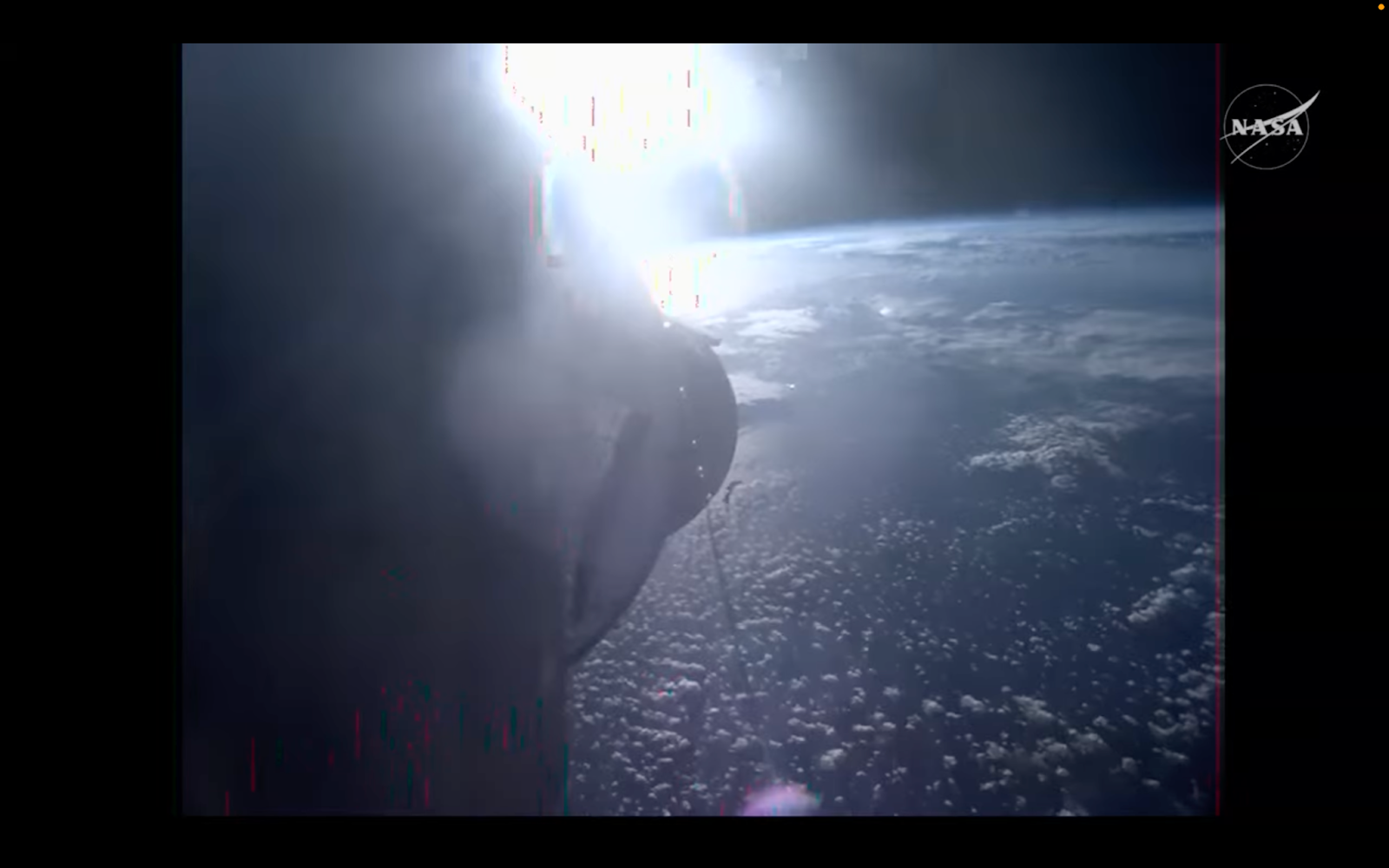
6:37 p.m. EDT: Getting to orbit
The SLS produces a tremendous amount of thrust to boost Orion to a highly elliptical Earth orbit, where it will spend the next 24 hours or so adjusting its trajectory for translunar injection — the final push that sends it on the approximately four-day journey to the moon. The ascent will take about eight minutes.
During the countdown, teams loaded the SLS core stage with more than 750,000 gallons of supercooled liquid oxygen and liquid hydrogen propellant. About one second before launch, its four RS-25 engines fired, each producing 2 million pounds of thrust.
At T-0, SLS activated its twin solid rocket boosters — the largest such structures in history, producing about the same thrust as 25 airliners firing at full throttle. That’s about 17 percent more thrust than the Saturn V rocket that launched the Apollo astronauts.
Combined, the boosters and engines give SLS enough juice to clear the launch tower. About one minute into flight, the rocket broke the sound barrier. Seconds later, it hit Max Q — the point of peak aerodynamic stress as it pushes through the dense lower atmosphere.
After completing their job, the boosters were jettisoned along with the launch abort system (LAS). They are expected to splash down north of the Bahamas.
6:36 p.m. EDT: “Roger, roll pitch,” one of the astronauts said. The roll maneuver entails rotating the SLS along its vertical axis to adjust its attitude and set it on the proper orbital trajectory.
6:35 p.m. EDT: Artemis 2 has lifted off and cleared the tower.
6:29 p.m. EDT: The crew access arm has retracted from the Orion capsule.
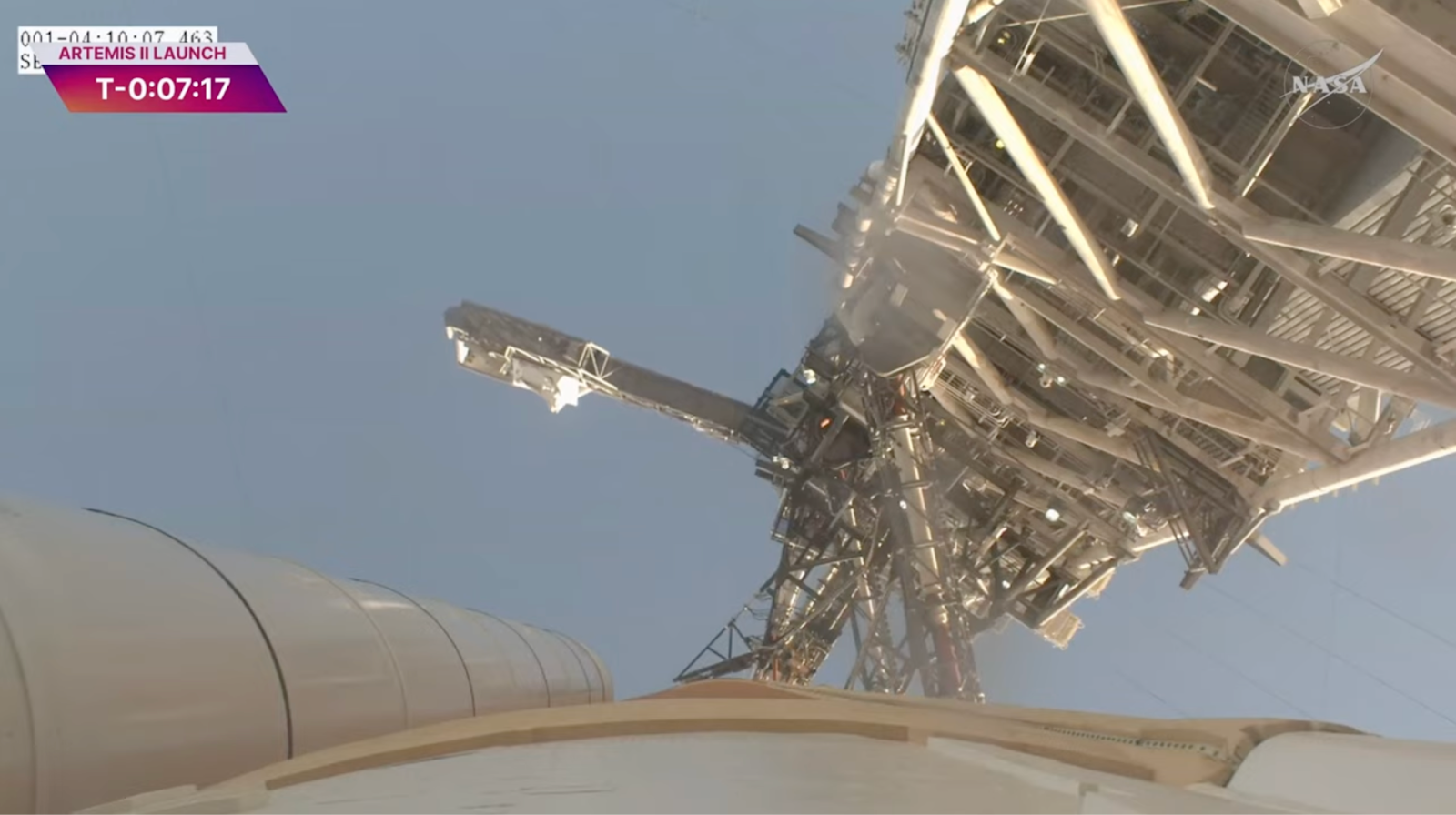
6:25 p.m. EDT: Kennedy Space Center launch director Charlie Blackwell-Thompson has conducted her go/no-go poll. Every controller and position she polled came back with a “go.”
Artemis 2 is officially go for launch, and the countdown has resumed.
6:17 p.m. EDT: The scheduled 30-minute hold at T-minus 10 minutes was extended for several minutes as controllers troubleshooted a (very) brief loss of telemetry data that amounted to just a few samples of data, according to a conversation heard on the broadcast. After a brief discussion, controllers and launch officials declared that the signal loss was not a violation of requirements and that the launch could proceed.
6:13 p.m. EDT: One of the two LAS batteries reported an "out of family" temperature, but data showed it was an instrumentation failure with the sensor. The Mission Management Team had to accept this change to the launch criteria, and they officially accepted it to proceed with the flight.
6:11 p.m. EDT: NASA Administrator Jared Isaacman, highlighted the performance of the Orion capsule as critical for this flight. In an interview just broadcast on NASA TV, he said, “I think the takeaway from this is gaining extreme comfort in the Orion spacecraft. This is very different from what we’ve done for more than a half century. The velocities that that spacecraft is going to reenter at — it’s gonna be new territory for us. We want to get our arms around that completely.”
On the Artemis 1 flight, the Orion capsule’s heat shield — the protective layer that prevents the ship and its crew from being incinerated by the heat as it reenters the Earth’s atmosphere — suffered unexpected damage. Resolving the issue was a major factor in Artemis 2 being delayed by around a year to its present launch date.
6:06 p.m. EDT: Per NASA, teams appear to have resolved an issue with one of the batteries in the launch abort system (LAS), and it is now ready for launch.
6:05 p.m. EDT: Meet “Rise,” the official Artemis 2 zero-gravity indicator. This plush mascot was designed by 8-year-old Lucas Ye, a second-grader from Mountain View, CA. Inspired by the iconic Apollo 8 Earthrise photo, Lucas’s design was selected by the crew over more than 2,600 other entries. When the SLS reaches orbit, “Rise” will begin to float, signalling to the world that the crew has reached zero gravity.

5:49 p.m. EDT: T-minus versus L-minus
To manage complex timelines, NASA uses two separate timers. The L-minus clock counts down real-world time until the launch window opens and never stops. Meanwhile, the T-minus clock serves as a checklist that follows the completion of technical milestones, pausing and restarting as needed.
5:45 p.m. EDT: The countdown is now holding at T-10 minutes, a planned 30-minute hold, putting Artemis 2 “well on the timeline” for launch Wednesday evening, said NASA’s Gary Jordan.
5:43 p.m. EDT: Per NASA’s broadcast, White Room closeouts are complete and the closeout crew is ready to leave the pad, with about 41 minutes remaining in the countdown. With the astronauts secured in Orion, a built-in 30-minute countdown hold is scheduled to begin shortly.
5:38 p.m. EDT: With under an hour to go before launch, the NASA broadcast reports that another issue has cropped up. Currently, the temperature for one of two batteries on the Launch Abort System (LAS) — the 44-foot tower on top of the Orion capsule — is out of acceptable range. In the case of an emergency early in the ascent where Orion needs to separate from the SLS rocket, the LAS has three rocket engines that can generate 400,000 pounds of thrust to pull the capsule and crew to safety. The battery needs to pass a final check at T-minus 6 minutes. The launch team is currently investigating whether the temperature sensor is faulty, or whether the temperature is in fact out of range.
5:32 p.m. EDT: Weather conditions have improved for today’s launch window, from 80 percent to 90 percent “go” for launch. The initial weather forecast came out three days ago.
5:26 p.m. EDT: How does the Artemis 2 vehicle compare to the Apollo missions?
NASA’s Space Launch System (SLS) rocket and Orion crew capsule, the two spacecraft supporting early Artemis missions, are quite different from what flew in the Apollo era.
Orion has about 30 percent more habitable space than the Apollo crew module, which was designed for three rather than four astronauts. It also adds modern hygiene, fitness, privacy, and galley areas that were absent on its predecessor, giving the crew a more comfortable ride.
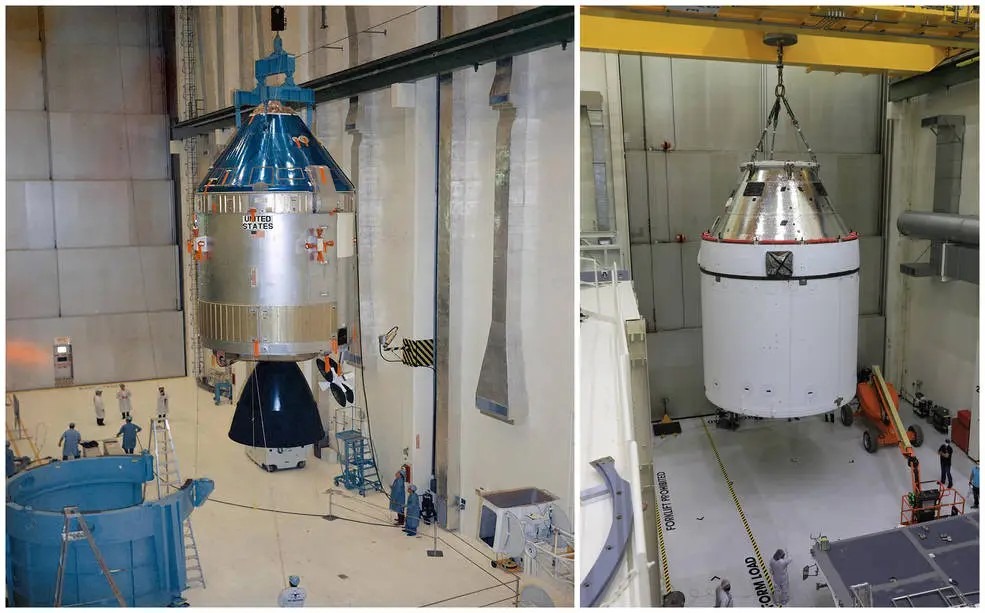
Per NASA, Orion’s computing system is about 75 percent lighter and 20,000 times faster than Apollo’s single flight computer, which required analog inputs. Orion’s “glass cockpit” contains digital screens and interfaces that allow its trajectory to be adjusted in real time, allowing it to fly uncrewed—like it did on Artemis 1 in 2022—or autonomously.
Orion is also more durable than the Apollo module. Whereas Apollo relied solely on finite supplies of hydrogen and oxygen propellant, Orion’s four solar array wings will unfurl to augment its fuel and provide power to the entire vehicle. Its components are also more hardened for radiation, enabling 21-day missions. Apollo maxed out at about 14 days.
The crew portion of the spacecraft has 12 reaction control thrusters. The service module—built by a European consortium led by Airbus—has a main engine, eight auxiliary engines, and 24 reaction control thrusters for added control.
To deliver Orion to Earth orbit, NASA’s SLS will generate more than 8.8 million pounds of thrust at launch—17 percent greater than Apollo’s Saturn V.
SLS stands about 322 feet tall, slightly shorter than Saturn V. But its twin five-segment solid rocket boosters are the largest of their kind in history. Each produces about 3.6 million pounds of thrust, equivalent to 25 airliners firing at full throttle. Northrop Grumman developed them by modifying space shuttle boosters.
The four RS-25 engines powering the SLS core stage also come from the space shuttle program and have been upgraded to produce about 2 million pounds of thrust each. That will power the spacecraft through an approximately eight-minute ascent to orbit.
Artemis 1 was the first time SLS and Orion flew together. Artemis 2 will be the first time they fly with crew.
5:20 p.m. EDT: The closeout crew at the launch pad has sealed the hatch door on the Orion crew capsule with a little over an hour until launch.
5:18 p.m. EDT: In an update from the NASA broadcast, the range is now a “go” for launch — to cheers from the on-site crowd. In a win for institutional knowledge, a long-time worker at Kennedy retrieved a piece of shuttle-era kit that helped to verify the functionality of the flight termination system, according to the broadcast. UPDATE: At a post-launch press conference, NASA Associate Administrator Amit Kshatriya appeared to correct this information, saying that while there had been discussion about bringing over equipment from the VAB, the ground team was able to solve the issue on the spot.
5:10 p.m. EDT: Who are the crew?
The Artemis 2 astronauts bring plenty of expertise to the table.
Three of them, NASA astronauts Reid Wiseman and Victor Glover and CSA astronaut Jeremy Hansen, are seasoned aviators here on Earth.
Wiseman, the mission’s commander, is a 27-year Navy veteran who was deployed at sea when NASA picked him to be an astronaut. He has flown the F-38, F-18, and other fighter jets and served as a flight engineer for 165 days aboard the International Space Station (ISS) in 2014.

Glover is also a Navy aviator, having logged thousands of hours across more than 40 aircraft including as a test pilot for the F/A‐18 Hornet, Super Hornet, and EA‐18G Growler. In 2020, he piloted the first crewed SpaceX Dragon mission to the ISS.
Like Wiseman and Glover, mission specialist Jeremy Hansen — who hopes to be the first Canadian to fly around the Moon — is a fighter pilot, having commanded the CF-18 for the Canadian Armed Forces. In 2013, Hansen lived underground for six days with European astronauts and in 2014 served as an aquanaut for NASA, spending a week at an undersea laboratory off the coast of Florida.
Mission specialist Christina Koch’s terrestrial career did not take her to the skies, but she already has a storied history with NASA. Koch served in several roles for the space agency before setting the record for longest spaceflight by a woman in 2019, spending 328 consecutive days in space.
On Artemis 2, Koch has the opportunity to fly farther from Earth than any woman in history.
4:34 p.m. EDT: The first potential obstacle for tonight’s Artemis 2 launch has surfaced. Officials say that the team overseeing the launch range — the corridor through which the rocket will be traveling on its way to orbit — is dealing with an issue related to the flight termination system (FTS). This is the system that would send a self-destruct command to the SLS rocket if it veers off course, and NASA needs to destroy the rocket to protect the public. According to an update on the NASA broadcast, a technician has retrieved a piece of space shuttle-era kit from the Vehicle Assembly Building to help troubleshoot the FTS. The countdown has not been paused, but the range is currently no-go for launch; they have roughly two hours before the scheduled launch, during which they’ll continue to troubleshoot the issue.
4:00 p.m. EDT: The Artemis 2 crew have boarded the Orion spacecraft at the top of the Space Launch System rocket on Kennedy’s Launch Pad 39B. Technicians are currently preparing for the closure of the hatch — at which point the crew will be cocooned in the ship for the next 10 days until a planned splashdown off the southern California coast.
So far, the countdown has proceeded according to schedule with no delays — a marked contrast with earlier launch attempts and the previous Artemis 1 mission. NASA remains on target for lift-off when today’s launch window opens at 6:24 p.m. EDT.
Weather continues to be favorable for the launch, with the major concern being a potential excess of cloud cover and high winds. NASA avoids launching into rain and certain cloud types that could trigger lightning that strikes the rocket. Earlier this afternoon, forecasters at NASA and the U.S. Space Force were predicting 80% favorable conditions through the launch window.