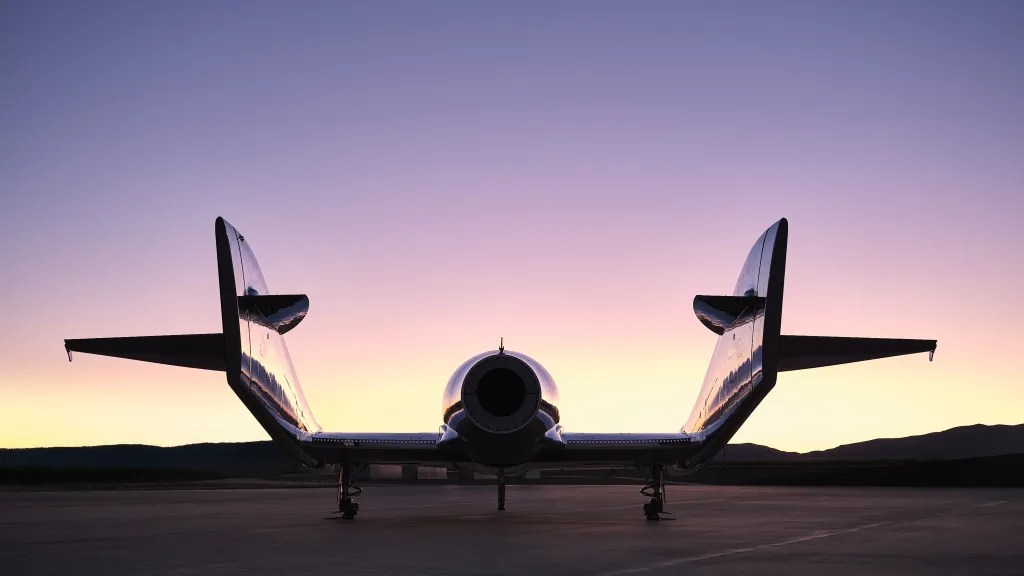
Virgin Galactic on Friday extended the deadline for the public to name one of its next-generation spaceplanes, giving space enthusiasts until Thursday to cast their votes.
Virgin Galactic, which offers suborbital expeditions for paying customers, launched its first commercial mission in June 2023 and has not flown one since 2024, when it retired its earlier SpaceShipTwo-class spaceplane, VSS Unity. The company is now building two “Delta-class” vehicles and will allow the public to put its stamp on one of them.
The vote is open to people around the world, so long as they are over the age of 13.
The competition began earlier this month, allowing voters to choose one of four finalist names submitted by Virgin Galactic employees and ticket-holding customers: Horizon, Explorer, Ascend, and Apeiron.
The first three candidates are fairly self-explanatory. The word “apeiron” comes from ancient Greek philosophy and is often translated as “unlimited,” “boundless,” or “infinite.”
“It captures what astronauts actually see from above: a view so vast that borders dissolve and the divisions we live inside fall away,” Virgin Galactic said of the latter name. “Human spaceflight is still in its opening chapter, and we don’t yet know how it will change us or what new understanding it will unlock.”
Per a news release shared with FLYING via email, Virgin Galactic said it received a “phenomenal number of responses” coming from people in more than 120 different countries.
The company said the name selected by the public will belong to its second Delta-class spaceplane. The first, which it said Friday is preparing for flight testing, has already been named.
When will it fly?
Virgin Galactic had been targeting a resumption of commercial service this year, but CEO Michael Colglazier said earlier this month on the company’s second-quarter 2026 earnings call that it will be pushed to February, due to delays in the build of the first Delta-class vehicle. Colglazier said a second spaceplane will join the first around March 2027.
The CEO added that Virgin Galactic has seen strong demand for passenger bookings, with plans to move from a price of $750,000 per seat to a higher price point this fall. It returned VSS Unity to the skies earlier this year for a series of glide flights that it said would set the stage for its next-generation spaceplanes.
Chief financial officer Doug Ahrens said the company hopes to achieve a cadence of 10 or more flights per month by mid-2027. He estimated that each Delta vehicle will cost about $60 million to produce but have potential to generate up to $1.4 billion in lifetime contribution margin.
Unlike Unity, which achieved a peaked cadence of about one flight per month in mid-late 2023, Delta class vehicles are designed for up to two flights per week. Like its predecessor, the vehicles will seat up to six passengers and a pilot.
A “mothership” or carrier plane will take off from a runway at Spaceport America in New Mexico and lift the Delta vehicles to an altitude of about 50,000 miles. It would then release the spaceplane for a 60-90-minute suborbital tour before it lands at the same runway used by the mothership.
Unity surpassed the FAA and U.S. military-defined boundary of space at about 50 miles. But it fell short of the Kármán line at about 62 miles, which is the World Air Sports Federation-defined (FAI) boundary of space that is commonly accepted by the international community. Virgin Galactic has not made clear whether Delta class vehicles will pass the Kármán line.
Blue Origin has taken a few customers beyond the boundary using its New Shepard. The company, Virgin Galactic’s chief competitor in the space tourism industry, said in January that it would halt commercial operations for at least two years in order to allocate more resources toward NASA’s human lunar spaceflight program, for which it is a contractor.
That means Virgin Galactic could be the only company flying customers to the edge of the atmosphere in 2027.
Editor’s Note: A version of this story first appeared on FLYING
Jack Daleo is a staff writer at Flying Magazine covering advanced air mobility, including everything from drones to unmanned aircraft systems to space travel — and a whole lot more. He spent close to two years reporting on drone delivery for FreightWaves, covering the biggest news and developments in the space and connecting with industry executives and experts. Jack is also a basketball aficionado, a frequent traveler, and a lover of all things logistics.