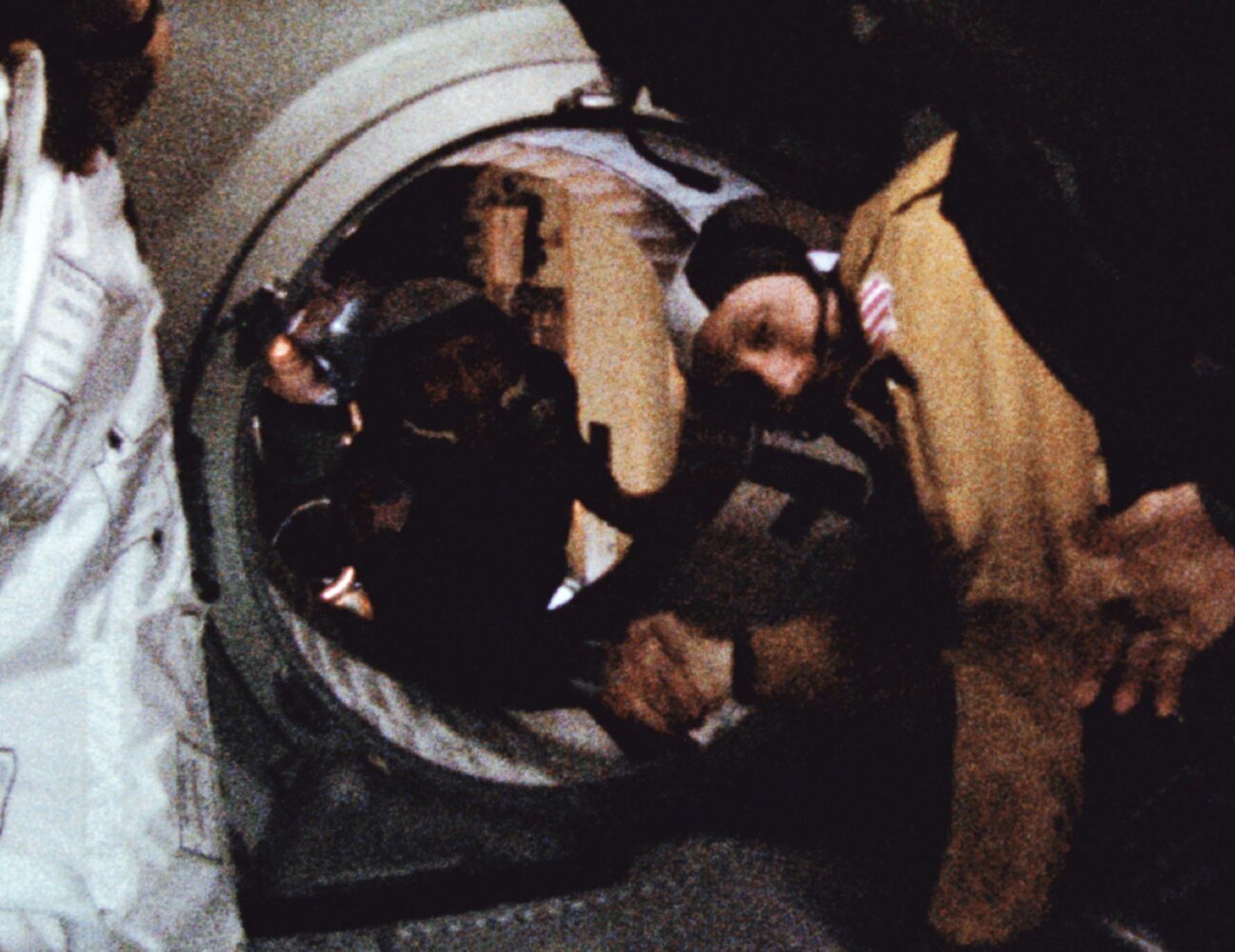
The Apollo-Soyuz mission, which occurred 50 years ago this month, was the culmination of a series of fitful attempts at possible international cooperation on human spaceflight. But before one astronaut and one cosmonaut met in an airlock in orbit over the Earth, there were wiretaps and hot dogs, language lessons and vodka toasts. And though the iconic image of that airlock handshake still resonates in the space community, the future of U.S. cooperation with what is now the Russian Federation is decidedly murky.
Nyet then Da
As early as 1962, the two space-faring superpowers — America and the U.S.S.R. — discussed possible cooperation. President John F. Kennedy had even suggested in a 1963 speech to the United Nations a joint lunar mission. Finally, by 1970, the Soviet Academy of Sciences agreed to a meeting after NASA proposed a joint mission.
President Richard Nixon pinned hopes on the mission to help thaw the Cold War. According to NASA’s official program history, The Partnership: A History of the Apollo Soyuz Test Project, Nixon’s foreign policy guru, Henry Kissinger, told NASA officials in 1971 of the ongoing effort to establish a joint mission: “As long as you stick to space, do anything you want to do. You are free to commit — in fact, I want you to tell your counterparts in Moscow that the president has sent you on this mission.”
By 1972, the two countries had established the Apollo-Soyuz Test Project (ASTP) and agreed to launch the joint mission three years later. The countries hoped to not only reap benefits from scientific and technical cooperation, but also from political cooperation. The mission would be a precedent for future joint efforts and even possible future space rescues.
Planners, engineers, and ground-support personnel — and the spacefarers — had to cope with radically different approaches to spacecraft, according to multiple accounts of the mission. NASA turned to audio visual division deputy chief and senior photographer Will Taub, who had made a hobby of pursuing technical details of Soviet craft. His drawings helped initial planning considerably, according to historians. Sometimes with ease, sometimes with difficulty, the two space agencies came together and formed working groups on communications and tracking, life support and crew transfer, mission planning, control and guidance, and mechanical design. The Americans were led by Glynn Lunney, while the Soviets were led by Konstantin Bushuyev.
America would use the complex, astronaut-centered Apollo capsule once destined to go the Moon, left over when Nixon canceled lunar missions after Apollo 17. The Soviets had the simple, robust Soyuz that was less reliant on the astronauts flying the vehicle, but lacked back-ups and failsafes. One failure on a Soyuz usually ended a mission. Both sides found fault in the other’s design.
Much of the focus of mission planning centered around how to rendezvous, dock, and find a way to alter the cabin environments in a timely fashion. For example, the two craft utilized wildly different cabin atmospheres: NASA had a pure oxygen composition at one-third atmospheric pressure, while the Soviets replicated the air and pressure we have here on Earth. A description of the mission at the California Science Center, which has the ASTP command module on display, explains the complexity of the solution eventually reached: “Prior to docking with the Apollo command module (that was linked to the docking module), the Russian crew lowered their cabin atmospheric pressure from a full atmosphere to two-thirds atmosphere. After docking with the Soyuz, the American crew transferred from the Apollo spacecraft into the docking module and closed the hatch behind them. They added nitrogen to the pure oxygen environment which raised the pressure inside the docking module from one-third atmosphere to two-thirds atmosphere and resulted in a gaseous composition that matched the Russian Soyuz spacecraft. The astronauts could then safely open the hatch between the docking module and the Soyuz.”
Fellow spacefarers
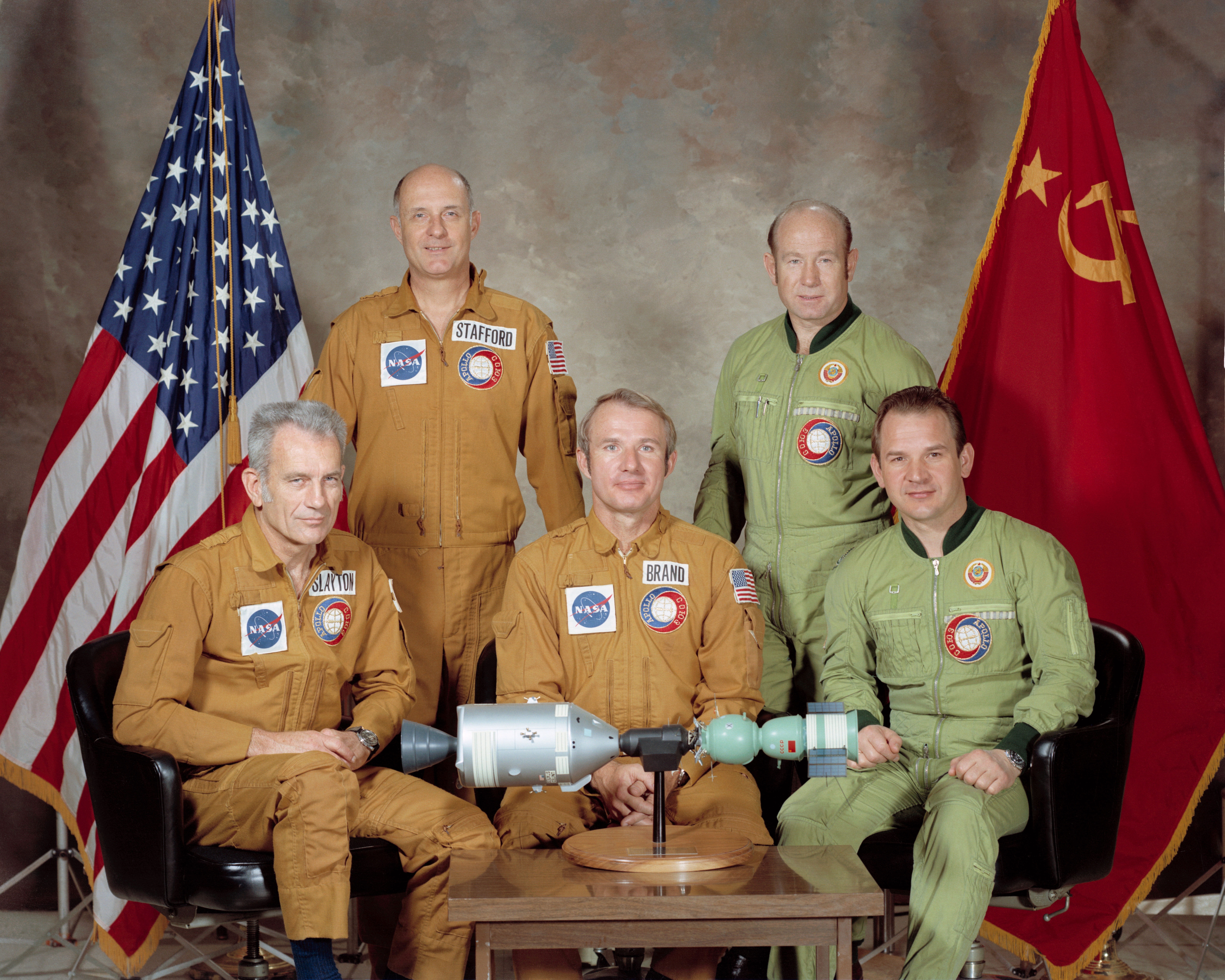
The Americans selected for the mission were commander Tom Stafford and two rookie astronauts, Vance Brand and Donald “Deke” Slayton. Slayton was to have flown years earlier in the Mercury program but was grounded for a heart problem. But now his health checked out and he was finally going to space. The cosmonauts were Valeriy N. Kubasov and the first space-walker, Alexi Leonov.
According to crew accounts and the 1976 summary of the mission written by Walter Froelich, the language barrier was significant. Finally, the crews hit on the approach: In joint settings, the Americans would speak Russian while the Russians spoke English. Leonov often joked that Stafford’s accent meant he was speaking “Oklahomski.”
Meanwhile, support personnel, including valued translators, worked hard on giant bilingual technical documents that set out how two mission controls would communicate and what technical procedures each craft needed to follow. Joint training was held both at the Johnson Space Center in Houston, and at Yuri Gagarin Cosmonaut Training Center (or Star City) near Moscow. For the first time, astronauts visited Soviet space facilities, and they insisted on seeing the actual Soyuz vehicle that would fly. (Soviet openness would extend to the public as it broadcast mission events live for the first time.) The Americans coped with lengthy vodka-drinking and joked about the lack of hotel amenities, knowing that wire taps would capture their complaints. According to Bob Crippen, who was part of ASTP support before he flew the space shuttle, the wife of one NASA official said loudly in her room, “I sure wish I had water in the room.” The next day, she did. The hours of training were occasionally punctuated by snowball fights at Star City cosmonaut center.
Leonov recalls how annoyed the Soviets would become when Americans failed to show up for meals. He was surprised at the how little supervision the Apollo crew had for diet and exercise. When the cosmonauts trained in Houston, they had the opportunity to become familiar with a food called the hot dog and enjoy muggy Texas BBQs. They drank American beer and donned cowboy hats.
The handshake in space
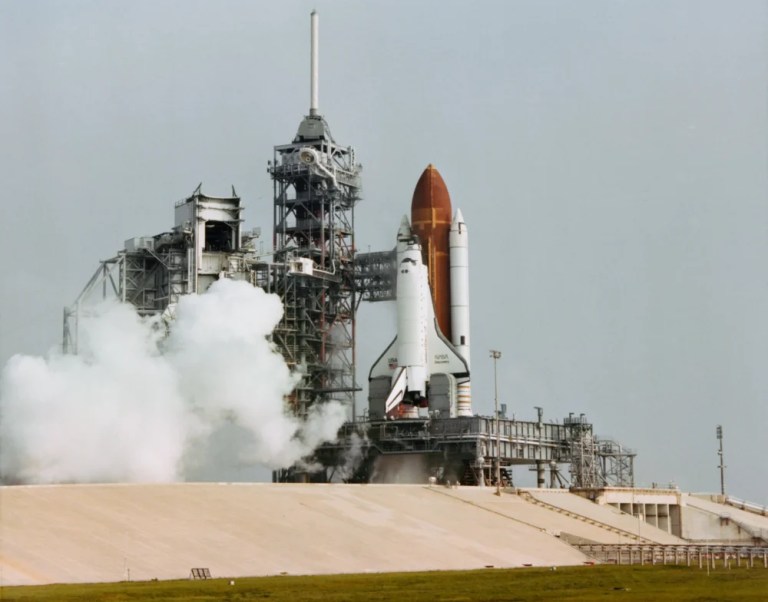
After months of training, it was go-time. Finally, the rockets and the crews and hundreds of support personnel were ready.
Both craft launched on July 15, 1975. But to account for orbital mechanics, the Apollo and Soyuz crews lifted off at different times. The launches were flawless, although historians Asif Siddiqi and Dwane Day wrote in a 2020 article for The Space Review that declassified documents “clearly show a great deal of anxiety among Soviet management that the engineers would essentially screw up and delay the Soviet side of the flight, thus embarrassing the Soviet Union on the international stage.”
Finally, the two ships docked on July 17. About three hours later, the hatches were opened. “Come in here and shake hands,” Stafford said, and he and Leonov shook hands on television, both men sharing big smiles. Not surprisingly, there were also bear hugs. The handshake took place over the city of Metz, France, according to The Partnership.
The televised handshake was in part thanks to an all-nighter aboard the Soyuz spacecraft. Discovering prior to docking that the Soyuz TV camera did not work, Kubasov and Leonov had to take apart “a major part of our orbital section in order to gain access” to the TV wiring, Leonov recalls. They did that instead of sleep. Afterwards, Soviet citizens wrote to the space agency that they needed the two cosmonauts “to come and fix their television sets.”
The rest of the mission involved crews exchanging places between the craft and sharing meals (including tubes of borscht jokingly labeled as vodka). The men also admired drawings of the crews done by Leonov, a talented artist.
They also conducted scientific experiments, a fact that’s often lost in the sheer symbolism of the moment. Highlights include the first detection of an extragalactic pulsar and the first detection of extreme ultraviolet stars — four in total, one of which was a very hot white dwarf. Froelich also points to the mission’s “first separation of live biologic materials in space by electrophoresis,” which uses electrical currents to move molecules around. Leonov also recounted an exercise involving welding in space. The ships even created an artificial eclipse in order to study the Sun.
On July 18, the crews separated and the hatches were closed, though they continued to experiment with docking maneuvers the next day. According to Leonov, the Soyuz capsule was almost seriously damaged when Slayton accidentally fired a thruster, which jarred both vehicles toward the docking mechanism. Fortunately, the issue was quickly resolved and the Soviets’ mission ended without incident, with Soyuz landing on July 21 while Apollo stayed in orbit for three more days.
It was mostly smooth sailing until the end for Apollo — according to Stafford and other accounts, a vent was accidentally left open during reentry, allowing toxic gases from the capsule’s thrusters to enter the cabin. All three men felt their eyes and throats burn, and Brand even lapsed into unconsciousness twice. The close call could have been far worse, but the men did end up staying in a hospital for two weeks after the flight.
Overall the mission garnered mostly positive attention, according to accounts, though skeptics worried that the Soviets would steal American know-how and others thought it a waste of money. One paper in Bogata said it was “the end of the Space Race.”A West German paper called it “a glittering soap bubble,” but there were literal signs of change: In Houston, at the media center, signs were displayed in English and Russian.
Afterglow and aftermath
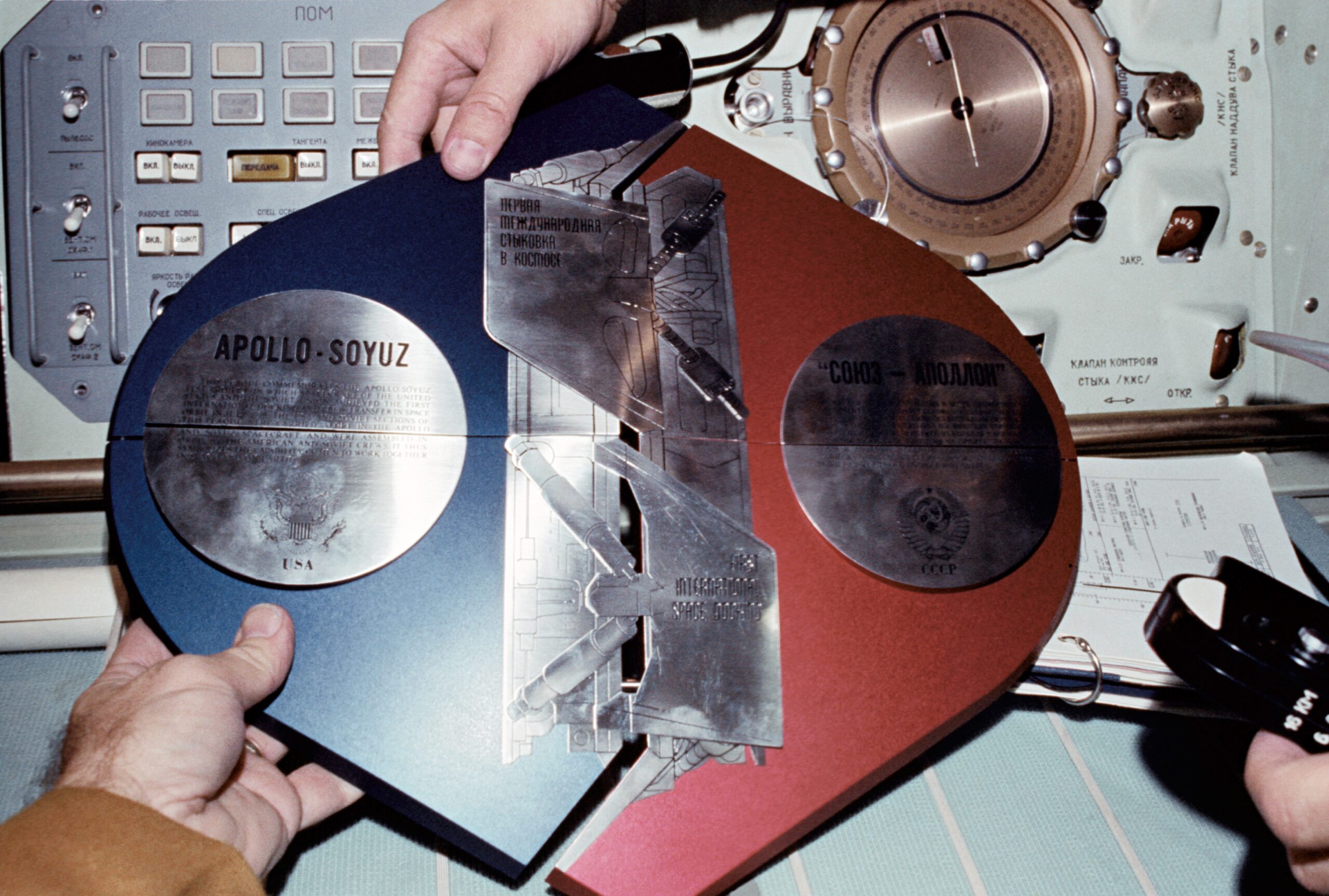
It’s not clear how much the Soviets spent on ASTP, but according to research in The Space Review and from NASA, the U.S. doled out nearly a quarter of a billion dollars.
Was it money well spent? Hopes for détente symbolized by the handshake in space and the post-mission tours were torched as quickly as a heat shield, as historians such as Thomas Ellis have described. Geopolitics got in the way of future space cooperation, as well as the failure of the Nixon Administration to continue human spaceflights. William Burrows writes that the mission “did little or nothing to stop the deterioration in relations.” Historian Micheal Neufeld tells Astronomy it was “a Cold War one-off détente circus.”
But, on a personal level, the mission’s goals worked: Stafford and Leonov became friends for life. Briefly, the Soviets considered a second ASTP mission and cooperation on solar system exploration, according to Siddiqi and Day, though it did not happen.
Americans did not fly to space again until the space shuttle in 1981, but that program would be pivotal in reestablishing U.S. and Soviet (later, Russian) joint missions. And when the Soviet Union broke up in 1991, American and Russian interests once again aligned. The old Soviet program was in tatters — with former government bureaus becoming private companies — and the U.S. worried that rocket technology might fall into the wrong hands. Meanwhile, NASA had noticed the Soviet experience with space stations, including, for example, Salyut, and looked to future collaboration on that front.
Stafford played a pivotal role in delegations discussing flying Americans on the shuttle to the Mir space station. Crippen says that Stafford really “spearheaded” Russian involvement, alongside NASA administrator George Abbey, according to space expert John Logsdon.
ASTP’s legacy also includes the docking mechanism, which was used to connect Mir with the space shuttle. A derivation of the design is still part of the International Space Station, which has been the long-standing site of global cooperation despite earthly conflicts.
As spacefaring nations face an uncertain future for the ISS as well as fitful hopes for a lunar return and even a Martian sojourn, it might be worth remembering that a willingness to work together can yield results — and perhaps some of those cannot be valued in dollars or rubles alone.
Only time will tell if Leonov was right when he said during an in-flight press conference, “Together we have begun an irreversible thing. The machine of Apollo-Soyuz is operating now and no one can stop it.”