Why are craters perfectly round even though meteorites are irregularly shaped?
Steven Riser
Conyers, Georgia
To answer your question, let’s have some fun. First, watch as I throw this irregularly shaped rock down at an angle onto a smooth mudflat. The rock strikes the flat and, in the process, splatters mud in all directions. Now let’s venture over to the affected spot and examine the result: an elongated hole around the rock’s impact point. The elongation is as much a result of the impact angle as of the rock’s nonspherical shape. But notice the rock: Apart from being dirty and a bit the worse for wear, it has undergone no alteration from the impact.
Now, let’s go to the Moon 108 million years ago. When a 5- to 6-mile-wide (8 to 10 kilometers) asteroid slammed into the lunar surface at a speed exceeding 45,000 mph (72,400 km/h), it vaporized on impact, along with much of the material within the impact area. Conditions in that region were fiery, but when the area cooled, the 53-mile-wide (85 km) hole that would one day be known as Crater Tycho remained. One of the Moon’s most prominent features, note how elegantly circular it is — even though, as you point out, the asteroid that caused it was likely irregularly shaped.
So, why does a rock striking mud form an elongated hole, while an oddly shaped asteroid produces a circle? Simply because the two formation processes are entirely different. Whereas a rock remains intact when it hits the mud, the asteroid vaporizes. It is the explosion, rather than the asteroid itself, that forms the crater. And since the material from the explosion is ejected equally in all directions, the resultant hole will almost always be circular and, on average, about 10 to 20 times the diameter of the body that formed it.
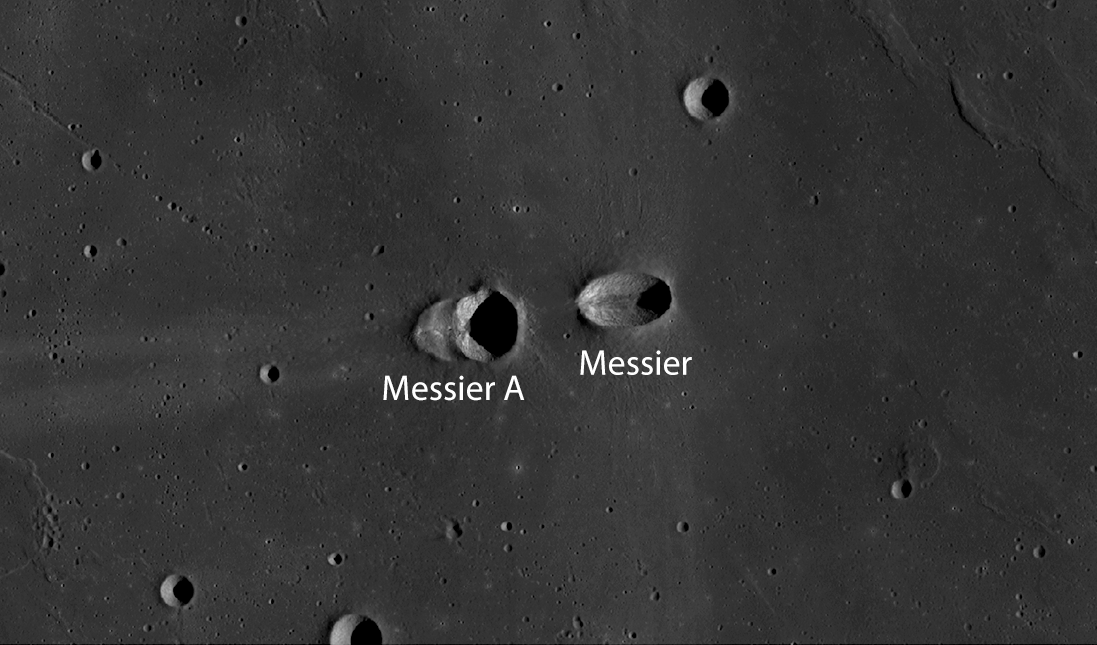
That having been said, you might find the occasional elongated crater, produced when an impactor strikes a surface at a very shallow angle. In this instance, the part of the asteroid touching the surface might have exploded, while the section at the other end was torn away and created a secondary impact, resulting in an elongated crater or a double crater. A good example is the elongated double lunar crater known as Messier and Messier A; planetary astronomers estimate that the body which produced this double crater might have struck the Moon at an angle of less than 5° relative to the lunar surface.
Edward Herrick-Gleason
Astronomy Educator, St. John’s, Newfoundland and Labrador