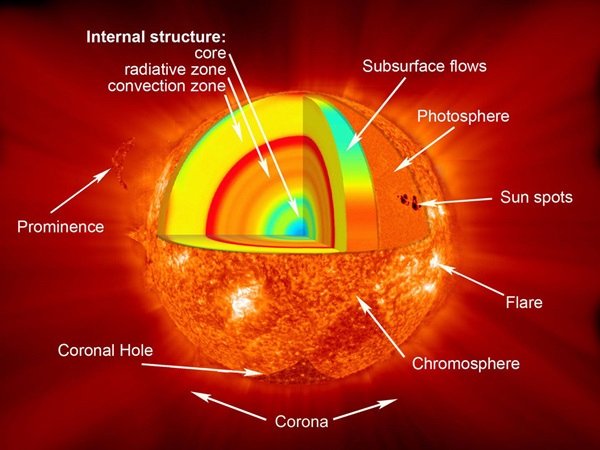
In a star’s core, all atomic nuclei have been separated from their electrons, so each hydrogen atom is really just a proton and thus holds a positive charge. The positive charges repel, and without some external force pushing on those protons, they will not get close enough to join.
You can think of temperature as a measure of how fast particles are moving on average. Some particles will travel slightly faster than average, some more slowly. If two protons travel fast enough, they can bump into each other with enough force to overcome the repulsion between them.
The temperature at the Sun’s core is quite high, roughly 15.7 million kelvins (28.2 million degrees Fahrenheit). This temperature results from the inward force of gravity of the Sun’s entire mass. Still, even at 15.7 million K, it is hundreds of times too “cool” for the protons to bump into each other with enough force to join.
This was the piece of the puzzle that challenged early physicists. They eventually discovered that the temperature at the Sun’s core is just a starting point. A process called “quantum tunneling” takes care of the rest.
As its name suggests, this is a quantum-mechanical effect that doesn’t relate to any experience from our day-to-day lives. Quantum tunneling gives a small chance, even if it’s an extremely unlikely one, that if two protons collide enough times, they eventually will join. If you have enough of these tiny-probability cases, therefore, some of them actually will happen. This means that after a few more cycles of this quantum-tunneling-initiated reaction, and other reactions that follow, you will have a shiny new helium nucleus.
University of Michigan, Ann Arbor