Hardy bacteria could survive the trip from one planet to another, hidden among the debris from an asteroid impact, a new study suggests, providing possible evidence for a theory that the seeds of life arrived on Earth from outer space.
In a paper published March 3 in PNAS Nexus, a team of researchers tested whether the bacteria Deinococcus radiodurans, which thrives in the high deserts of Chile, is capable of surviving the crushing pressures generated when an asteroid strikes Mars and hurls debris into space. D. radiodurans is an extremophile — an organism adapted to extreme conditions that would be inhospitable for most forms of life. By smashing the bacteria between steel plates to simulate an impact ejection event, they found it not only could survive the initial impact, but potentially the journey to another planet as well.
“We have shown that it is possible for life to survive large-scale impact and ejection,” said Lily Zhao, a graduate student in the Ramesh Laboratory at Johns Hopkins University and lead author, in a press release. “What that means is that life can potentially move between planets. Maybe we’re Martians!”
Could life hitch a ride?
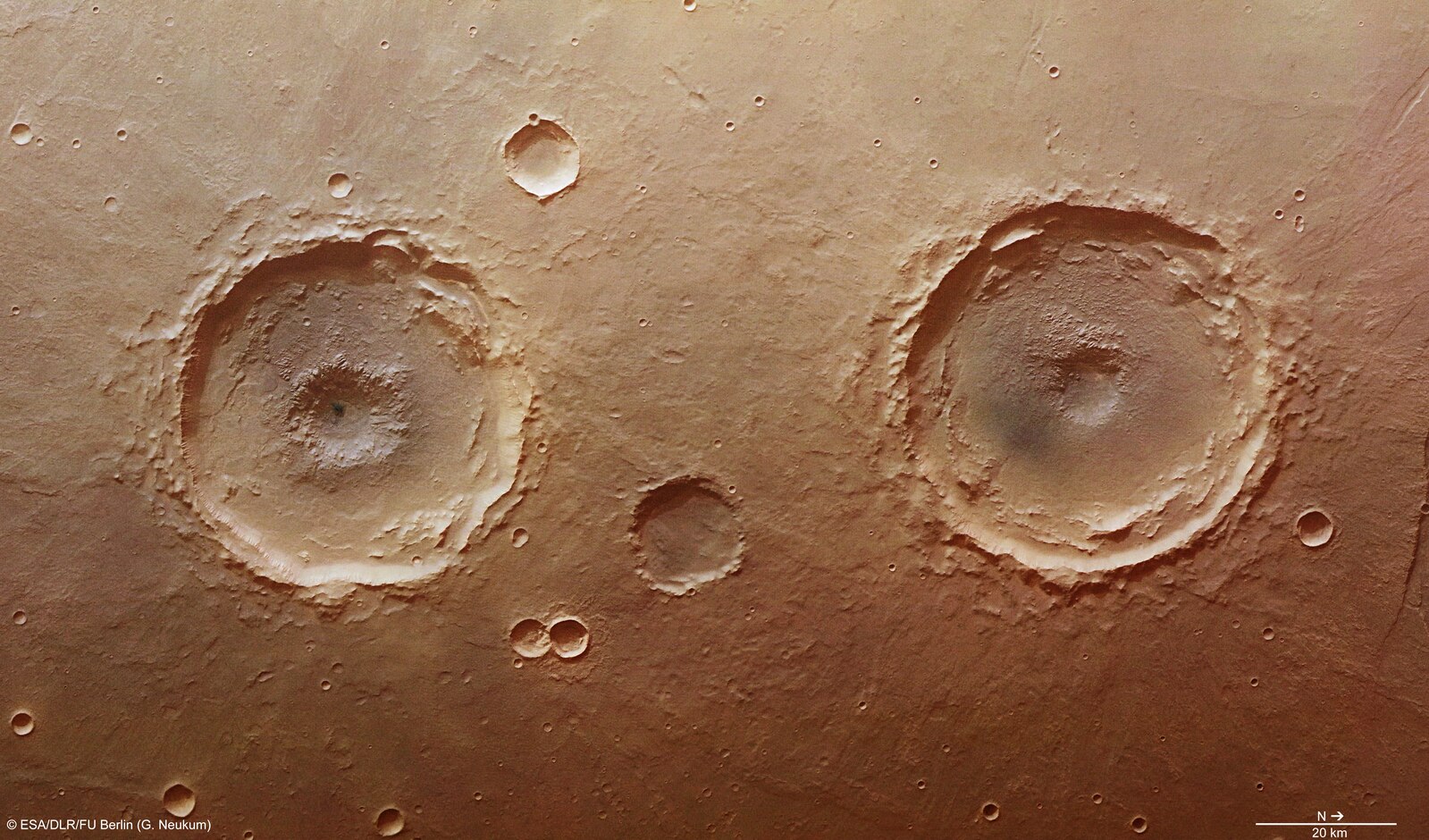
Asteroid impacts are common occurrences across the solar system — the crater-pocked surfaces of Mars and the Moon bear testament. Sometimes those violent events can hurl material off a planet’s surface and carry it to another. Nearly 300 meteorites from Mars, for example, have been found on Earth.
Scientists have long wondered whether life might be capable of hitching a ride on such material and spreading between planets — an idea known as panspermia, which dates back to the Greek philosopher Anaxagoras in the 5th century B.C.E., and was later championed by British astronomer Sir Frederick Hoyle.
The theory proposes that the seeds of life can travel through space carried by comets, interstellar dust, or other material. A specific subset of that theory, lithopanspermia, asks a narrower question: Could life survive inside rocky debris, like a meteorite ejected by an asteroid impact, and land intact on another planet?
Scientists have tested the lithopanspermia hypothesis before, but those experiments largely used microorganisms common to Earth. Most of the data collected came from Bacillus subtilis spores and Escherichia coli. But as the paper notes, “because of the extreme environments that are encountered in other locations in the Solar System, microorganisms found in extreme environments (extremophiles) are better candidate model organisms.”
The right organism for the job
For the new study, the Johns Hopkins University team chose Deinococcus radiodurans as their model organism. The desert bacterium is more than capable of thriving in extreme conditions that would kill most life: cold, dryness, and intense radiation, all of which it would face during an interplanetary journey. It also has a thick, structured cell envelope that the researchers believed might help it withstand the mechanical violence of an impact, making it an ideal candidate.
“We do not yet know if there is life on Mars,” said K.T. Ramesh, senior author and professor of science and engineering at Johns Hopkins University, in the press release, “but if there is, it is likely to have similar abilities.”
But how do you test the violent environment created by an asteroid strike and ejection?
According to the paper, recent simulations suggest that debris ejected from Mars would experience pressures of up to 5 Gigapascals (GPa). For context, if you swam to the bottom of the Mariana Trench — the deepest point in Earth’s oceans, nearly 36,000 feet down — you’d experience pressure of around one-tenth of a Gigapascal.
The team’s approach was surprisingly simple. They loaded the samples between two steel plates and then slammed a third steel plate into the microbe sandwich. The third plate was fired from a gas-powered gun and struck the samples at speeds reaching around 300 mph (483 km/h), generating pressures between 1 and 3 GPa. The team kept increasing the pressure in an attempt to kill the microbes, but the equipment failed before they could succeed.
“We expected it to be dead at that first pressure,” Zhao said in the press release. “We started shooting it faster and faster. We kept trying to kill it, but it was really hard to kill.” In the end, it was the steel configuration holding the plates that fell apart before the bacteria did.
After each impact, the team recovered the bacteria and assessed survival rates, examined cells under an electron microscope for structural damage, and analyzed genetic activity to understand how the microbes responded at a molecular level.
Hard to kill
The results, according to the authors, were striking. At 1.4 GPa, the bacteria showed a survival rate of approximately 95 percent. That figure held at 1.6 GPa, before dropping to roughly 90 percent at 1.9 GPa and then approximately 60 percent at 2.4 GPa. The team also attempted a shot at 2.9 GPa, but the results were inconclusive, with survival estimated at less than 10 percent but too imprecise to quantify exactly. At 2.4 GPa — the highest pressure with reliable data — cells began showing ruptured membranes and internal damage alongside survivors that appeared structurally intact.
According to the paper, the survival rates observed for D. radiodurans are orders of magnitude higher than those previously recorded for other microorganisms tested under comparable pressures, such as E. coli and Shewanella oneidensis.
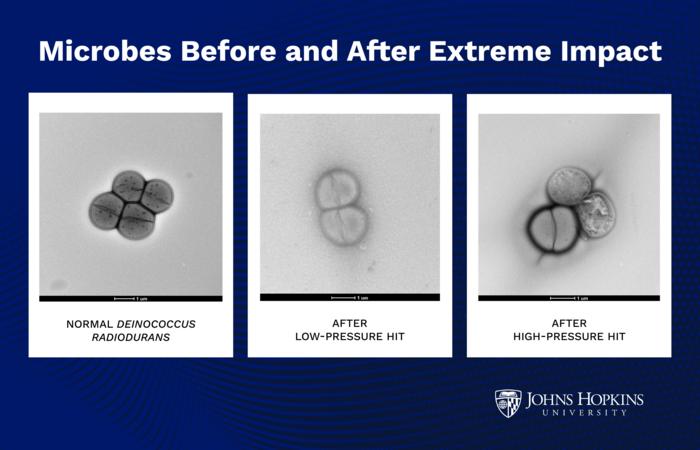
Researchers fired steel plates at samples of Deinococcus radiodurans to simulate the pressures of a martian ejection event, then examined the survivors for structural damage and analyzed their genetic material. The bacteria proved remarkably difficult to kill — surviving nearly every shot at 1.4 GPa and 60 percent of shots at 2.4 GPa. At the higher pressure, some cells showed ruptured membranes and internal damage, but the majority remained intact. Credit: Johns Hopkins University
The genetic analysis added another layer to the picture. At 2.4 GPa, the bacteria showed a strong stress response. It ramped up activity in the genes associated with DNA repair while dialing down the pathways for growth and reproduction. The authors interpret this as the cells prioritizing damage control over other biological functions. This mirrors patterns seen in other experiments when D. radiodurans is exposed to high doses of ionizing radiation.
Rethinking planetary protection
The findings also have implications for space exploration. Scientists already consider whether accidentally transported microbes could survive on a planet they visit, and current protocols require strict contamination controls for missions to bodies like Mars.
But this study suggests we shouldn’t just consider the planet itself, but nearby worlds as well. Ejecta from Mars, for example, could reach its moon Phobos much more easily than it could reach Earth, meaning microbes from a Mars mission could potentially cause complications for its moons too — bodies not currently subject to the same restrictions.
“We might need to be very careful about which planets we visit,” Ramesh said.
The researchers say their findings suggest that lithopanspermia is physically possible — that a microorganism could survive the most violent part of the journey between planets. The team notes that D. radiodurans has already been shown in earlier research to withstand the radiation, cold, and desiccation of interplanetary travel, meaning the full trip — ejection, transit, and arrival — may be survivable for at least some microorganisms.
Whether life has actually moved between planets, however, remains an open question that this study alone cannot answer.
Editor’s note: An earlier version of this story incorrectly identified lead author Lily Zhao as a researcher at the University of Chicago. Zhao is a graduate student in the Ramesh Laboratory at Johns Hopkins University who recently defended her dissertation. The story has been corrected.