That’s right — Laser SETI will be the first ever all-sky-all-the-time SETI survey.
A Look at Laser SETI
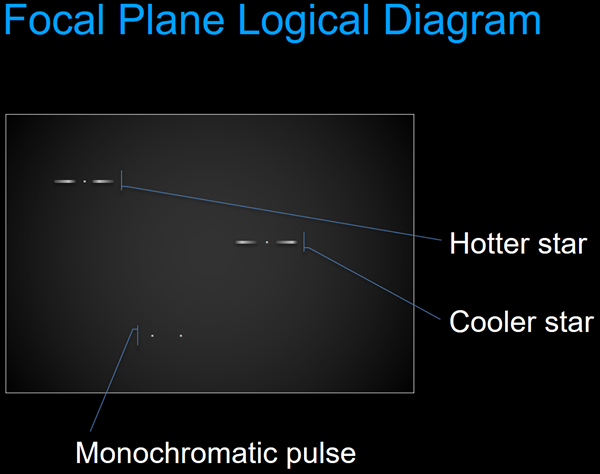
Laser SETI is currently undertaking a fundraising campaign, following two years of initial development to design the software and camera systems needed to watch the entire sky all the time. The project focuses on using cost-effective equipment: Two of the system’s three components are off-the-shelf technology, coupling a commercially available CCD camera with a 24mm f/1.4 DSLR lens. Each camera has a field of view 72 degrees across, resulting in an effective coverage of over 1,700 square degrees! That’s about 4 percent of the entire night sky and 5,600 times larger than previous optical SETI experiments. That’s wide enough that only 4 cameras are required to cover an observatory’s field of view, which is 120 degrees across and one-sixth of the entire night sky. Each camera splits the light it receives with a spectroscopic grating in front of the lens to allow observers to identify the wavelength of any signals received and discard signals that aren’t a single color of light.
The cameras are read out so quickly (more than 1,000 times a second) that they “smear” the data they receive vertically, but Laser SETI ensures no information is lost by coupling two cameras together in different orientations to cover each section of sky. This way, a source can still be pinpointed, despite the smearing effect of each camera. Then, by building multiple observatories at key points around the globe, Laser SETI can cover the entirety of the sky with truly continuous observations.
The campaign is up and running now, with a month left for backers to contribute to this groundbreaking SETI project.
Following the project’s initial deployment, the program aims to have at least six (and ideally 14) observatories in strategic locations to ensure no part of the sky is missed at any time due to factors such as weather. Just as important, they would overlap in such a way that they would “co-observe” events. This provides not only more statistical confidence in a single tiny flash, but physical confirmation as well, since the two sites would see the same point on the sky at different angles and observe a slight but measurable delay in the arrival times of the signal. This is very much like how the LIGO observatories produced compelling evidence of gravitational waves.
Why Laser SETI?
Scanning the whole sky all the time is no simple task. Before now, SETI searches have generally been able to achieve one of those things, but not the other. Facilities can either cover large chunks of the sky, spending a short time (less than a minute) looking at each patch, or observe smaller portions of the sky continuously, sacrificing broader spatial coverage in the hopes of catching a signal from a specific direction.
SETI searches have also typically operated on a vital assumption: Any extraterrestrial civilization that wants to get our attention will be broadcasting some kind of signal continuously. All we have to do is reach the right point in the sky as we scan through space in our surveys, and the signal will be there.
But what if it’s not the case? According to engineer Eliot Gillum, a Laser SETI project scientist and director of the Optical SETI program, “Whatever ET is doing, if it’s bright but intermittent, all previous and current searches very likely won’t find it.”
After all, why should aliens necessarily keep their signals powered up all the time, just so we can find them? Why should those signals repeat so we have a greater chance of hearing them? What if the signals they’re sending out aren’t actually meant to make contact with other worlds? Case in point: Despite the fact that humans have been broadcasting radio waves into space for a century, those signals aren’t specifically meant to reach other species. And although we have sent signals with such intent into space, they’ve been very few, short, discrete messages — not continuous ones, because those are expensive in both time and equipment.
But there’s also another option. Projects like Breakthrough Starshot, which uses laser light as a form of propulsion, will send out brief, powerful flashes. Its purpose is to send a spacecraft to our nearest neighboring extrasolar planets, but the beam would be so bright it would be visible at much farther distances. Those laser flashes could serve as messengers of our presence to other civilizations. And if alien worlds are pursuing similar beamed energy propulsion technologies, their laser flashes might reach us. But signals like those pulses will be short, intermittent, and may not repeat for long stretches of time (if ever).
This is why Laser SETI is so vital. It can produce convincing evidence for pulses ranging from nanoseconds to minutes, and Gillum says it doesn’t require an alien civilization to know we’re here or repeatedly try to contact us. Laser SETI will instead scan the entire sky continually so that when a signal reaches us, whether it’s intentionally been sent our way or passes Earth by pure chance, we’ll receive it, and we’ll know it for what it is: proof of life elsewhere in the universe.
You can visit the Laser SETI Indiegogo campaign page to find out more, including the nifty swag you could get if you’re interested in contributing to the project.
Special thanks to Eliot Gillum for his contributions to this story.