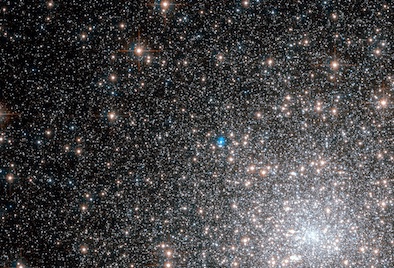
Globular cluster M15 in Pegasus is the “hey, let me show you this one” autumn object for amateur astronomers north of the equator. It’s also known as NGC 7078.
M15 lies some 34,000 light-years from Earth and appears 18′ across. It has a true diameter of 175 light-years and contains more than 100,000 stars. Among them are two X-ray sources, designated Messier 15 X-1 and X-2. This cluster outshines our Sun by more than 320,000 times.
From a dark site, sharp-eyed observers can spot this magnitude 6.3 globular with their naked eyes. If you try to find it this way, don’t be confused by the magnitude 6.1 star only ¼° to the east. A telescope will confirm your sighting because even the smallest will show that M15 looks fuzzy. Its relatively large apparent size means the cluster covers nearly one-third as much sky as the Full Moon.
Finding M15 is easy if you use Theta (θ) and Epsilon (ε) Pegasi as pointers. Just draw a line from Theta through Epsilon and continue another 4°.
At magnifications around 100x, even a 4-inch scope will resolve dozens of stars around M15’s strikingly bright core. Look for the chains of stars that wind out from its central region. Through this size telescope, these star patterns cause some observers to describe M15 as slightly oval.
If you have an 11-inch or larger telescope at your disposal, you can try for the challenge object inside M15: Pease 1 (circled). In 1928, American astronomer Francis Gladheim Pease discovered this object — the first planetary nebula to be found inside a globular cluster — on a photographic plate taken with the 100-inch Hooker Telescope at Mount Wilson Observatory. Use an eyepiece that yields 200x or more and a nebula filter at a dark site with good seeing. Don’t forget the finder chart.