Looking for a sky event this week? Check out our full Sky This Week column.
January 6: The Pleiades and the Hyades
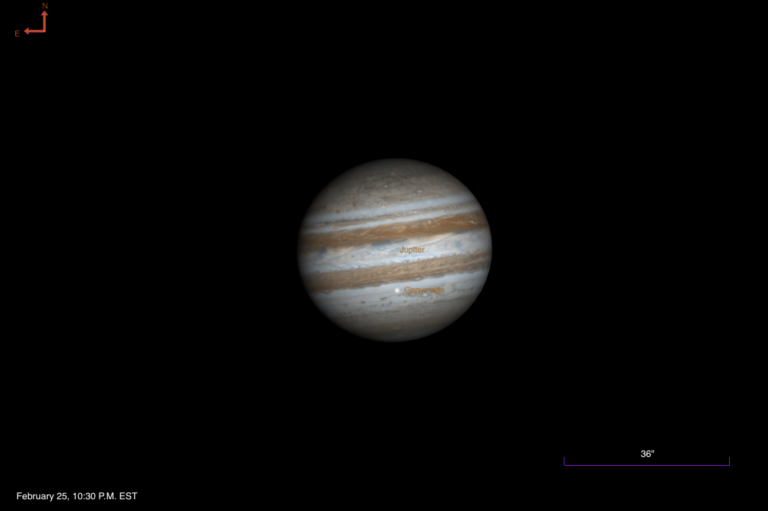
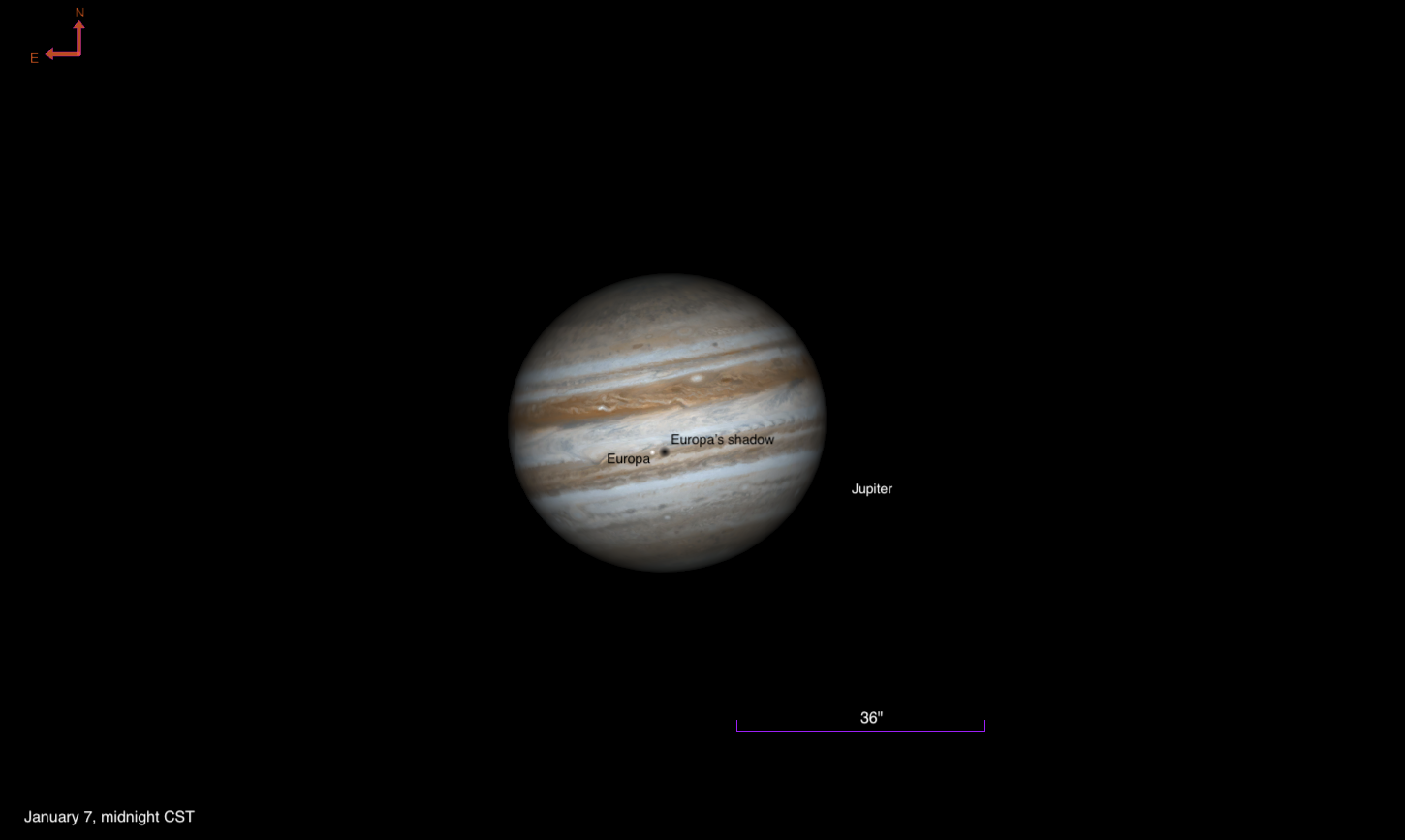
The icy moon Europa and its shadow transit the disk of Jupiter this evening as the planet nears opposition in less than a week. This close to opposition, the moon and shadow are barely separated, with less than 10 minutes between the start of their transits.
Because we are watching before opposition occurs, Europa’s shadow appears first, followed by the moon. After opposition, the moons will precede their shadows, so now is your last chance to watch the shadow lead. (Plus, stay tuned for a special event the morning of opposition next week, when Callisto and its shadow transit simultaneously!)
Jupiter is now rising around the time the Sun sets; by 11:15 P.M. EST, shortly before Europa’s transit begins, the planet is high in the east, to the right of the star Pollux in Gemini. Shining at magnitude –2.7, Jupiter is unmissable, much brighter than either Castor or Pollux — or even Sirius, the brightest star in the sky, which lies in Canis Major.
Zoom in on Jupiter with a telescope around this time, and you’ll see two moons to its east and two to its west. On the eastern side, Europa is closer — and closing in for its transit — while Callisto lies farther east. On the western side, Io is closer, with Ganymede farther west.
Europa’s shadow appears on Jupiter’s eastern limb beginning at 11:35 P.M. EST, followed by the moon itself crossing onto the disk just seven minutes later. By midnight CST (now 1 A.M. EST on the 8th in the Eastern time zone) Europa and its shadow are roughly central on the disk. While the dark spot of the shadow will be relatively easy to spot through a telescope, the small, bright moon itself might be lost against the glare of the cloud tops.
The two continue to cross the disk for another 90 minutes, until the shadow disappears from the eastern limb by 2:30 A.M. EST (now early on the 8th for all but the Pacific time zone). Again Europa follows seven minutes later, ending its transit by 2:37 A.M. EST.
Sunrise: 7:22 A.M.
Sunset: 4:51 P.M.
Moonrise: 9:58 P.M.
Moonset: 10:09 A.M.
Moon Phase: Waning gibbous (74%)
*Times for sunrise, sunset, moonrise, and moonset are given in local time from 40° N 90° W. The Moon’s illumination is given at 10 P.M. local time from the same location.