
Key Takeaways:
- The article outlines predawn astronomical observations for December 16 and December 18, 2025, focusing on the Moon and Mercury.
- On December 16, a 6-percent-lit waning crescent Moon appeared 10° from magnitude –0.5 Mercury in the southeast predawn sky, with Mercury exhibiting 82 percent illumination.
- The positional dynamics indicated the Moon would pass south of Mercury and Antares, followed by Mercury passing north of Antares, in the days immediately after December 16.
- By December 18, the Moon's illumination decreased to 2 percent and it was positioned approximately 7° to Mercury's lower right, with Mercury presenting 84 percent illumination within Ophiuchus.
Looking for a sky event this week? Check out our full Sky This Week column.
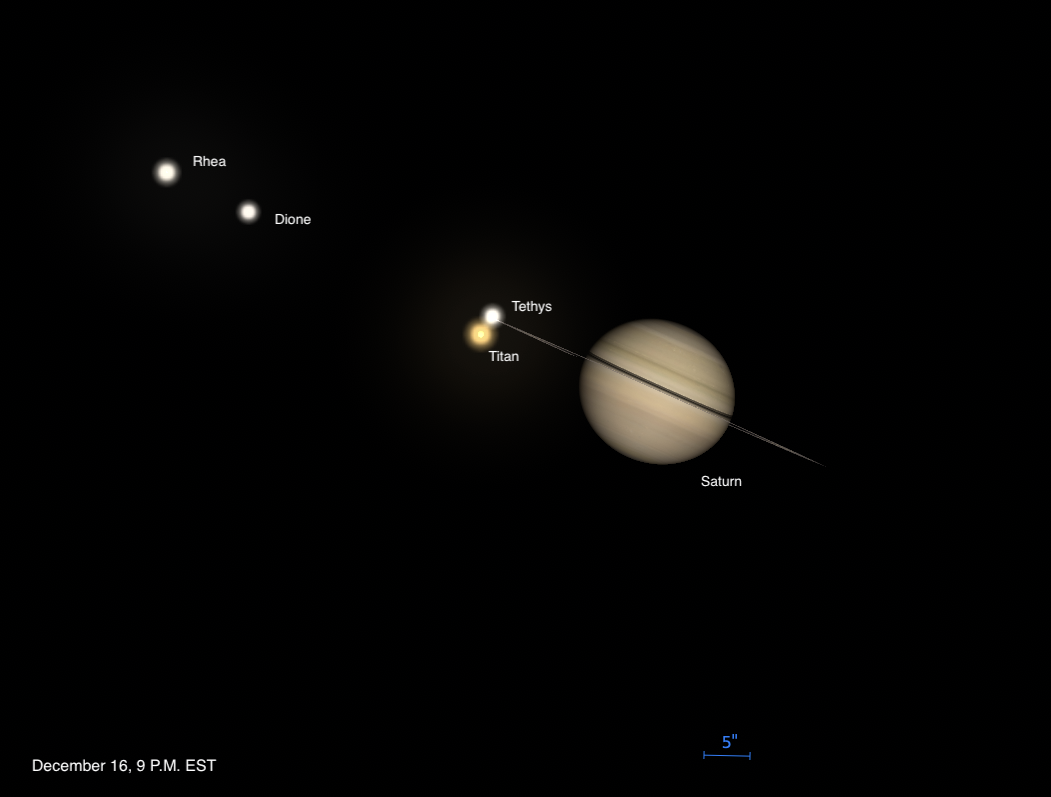
December 16: Titan and Tethys dance
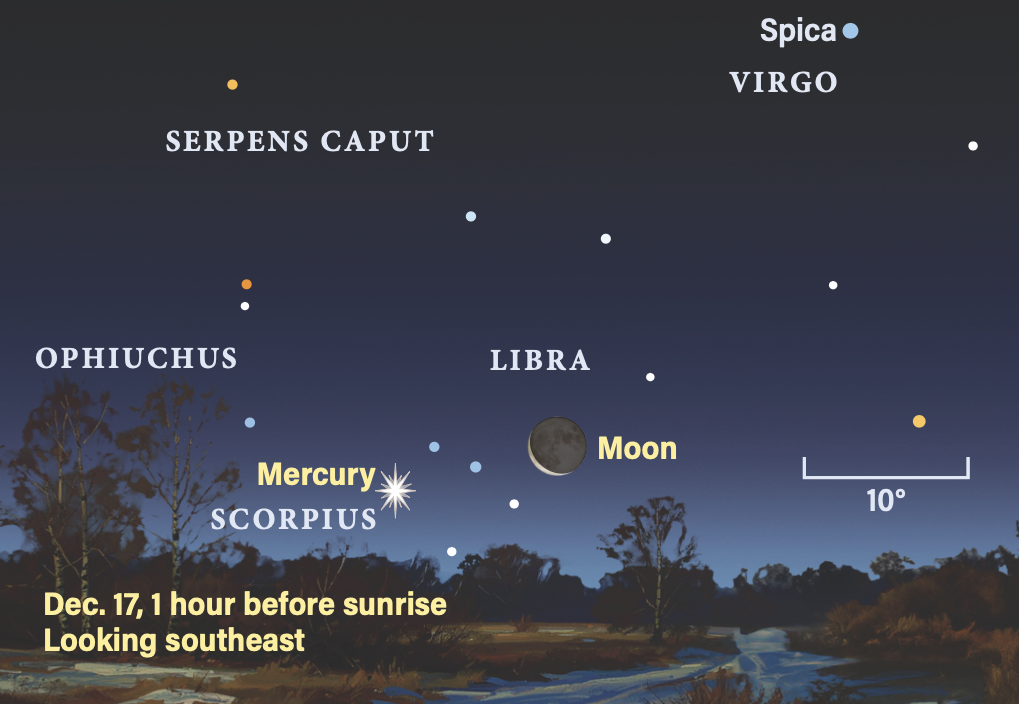
The morning sky brings a lovely scene as the crescent Moon joins bright Mercury in the southeast before sunrise. The pair stands 10° apart in the predawn sky, about 9° above the horizon by 6:45 A.M. local time. The Moon is in southeast Libra, visible as a 6-percent-lit waning crescent at this time with only a sliver of its western limb illuminated. Our satellite sits to the upper right of Mercury; the planet is in far eastern Scorpius, preparing to move into Ophiuchus (where it will reside by tomorrow morning). For now, the claws of Scorpius sit between the Moon and Mercury.
Through a telescope, magnitude –0.5 Mercury appears 6” wide and is 82 percent illuminated. If you have a clear southeastern horizon, keep an eye out for Antares, Scorpius’ 1st-magnitude alpha star, as it rises around 6:30 A.M. some 6.5° to Mercury’s lower right.
The Moon will pass south of Mercury and Antares tomorrow morning, a few hours before Mercury passes north of Antares during the daytime.
Sunrise: 7:14 A.M.
Sunset: 4:35 P.M.
Moonrise: 2:14 A.M.
Moonset: 1:10 P.M.
Moon Phase: Waning crescent (3%)
*Times for sunrise, sunset, moonrise, and moonset are given in local time from 40° N 90° W. The Moon’s illumination is given at 10 P.M. local time from the same location.
Revisit the morning sky December 18 to compare it with yesterday and see just how dynamic our solar system can be. Mercury rises this morning around 6 A.M. local time, with the Moon following later around 6:20 A.M., just after Scorpius’ heart, the red-hued star Antares.
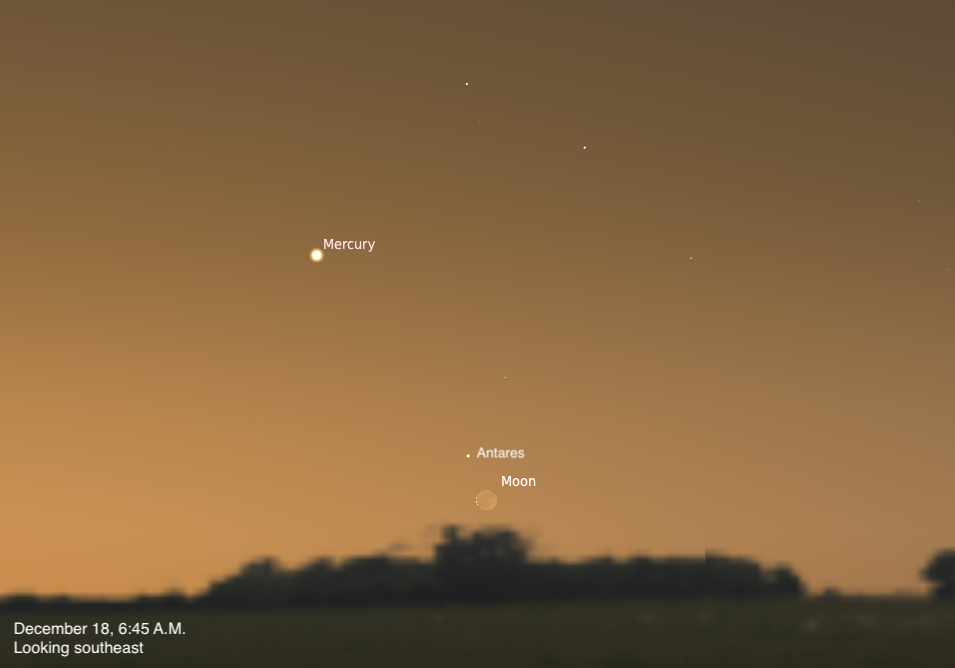
The Moon is now just 2 percent lit — potentially a challenge to view with the naked eye, but its slim crescent should look lovely though binoculars or a telescope. Look for earthshine lighting up the darkened regions of the nearside, as sunlight bounces off Earth and illuminates the portions of the Moon already experiencing night.
Magnitude –0.5 Mercury is now nearly 7° to the Moon’s upper left, in far southwestern Ophiuchus. The planet is now 84 percent lit; a small change from yesterday.