
Key Takeaways:
- On November 6, the Moon will transition into Taurus, subsequently occulting stars within the Pleiades cluster, visible in regions of Alaska, Asia, and Europe, and passing 5° north of Uranus.
- Concurrently, Titan will undergo a telescopic transit across Saturn, commencing at dusk for observers on the East Coast and concluding just prior to 9:30 P.M. EST.
- Additional Saturnian moons, Dione and Rhea, will also transit Saturn's disk; however, their visual detection against the planet's brilliance is limited or necessitates specialized imaging techniques.
- During these observational opportunities, Saturn will be conspicuous at magnitude 0.8 in the southeast, with the Moon presenting a 96% illuminated waning gibbous phase.
Looking for a sky event this week? Check out our full Sky This Week column.
November 5: November’s Full Beaver Super Moon
The Moon crosses into Taurus shortly after 5:30 A.M. EST this morning, November 6. After both have set for those in the contiguous U.S., the Moon will make its way across several stars in the Pleiades in an occultation visible from parts of Alaska, Asia, and Europe.
The Moon will then pass 5° north of Uranus at noon EST and rises east of (after) the Pleiades this evening.
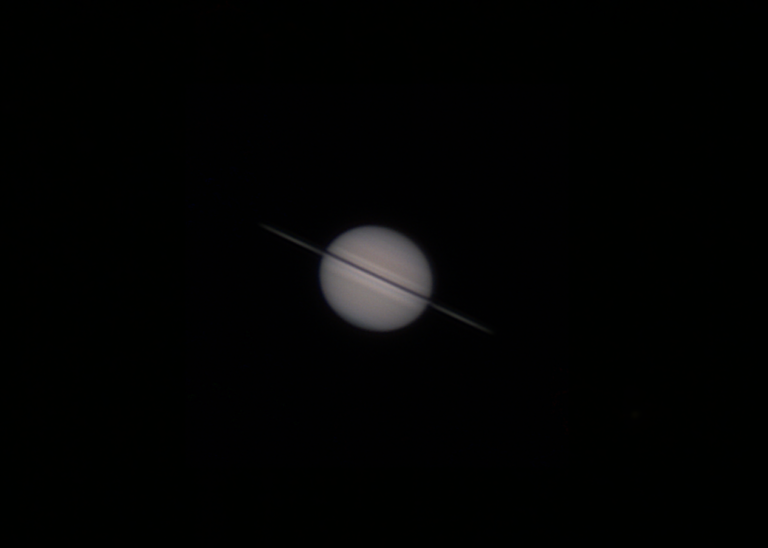
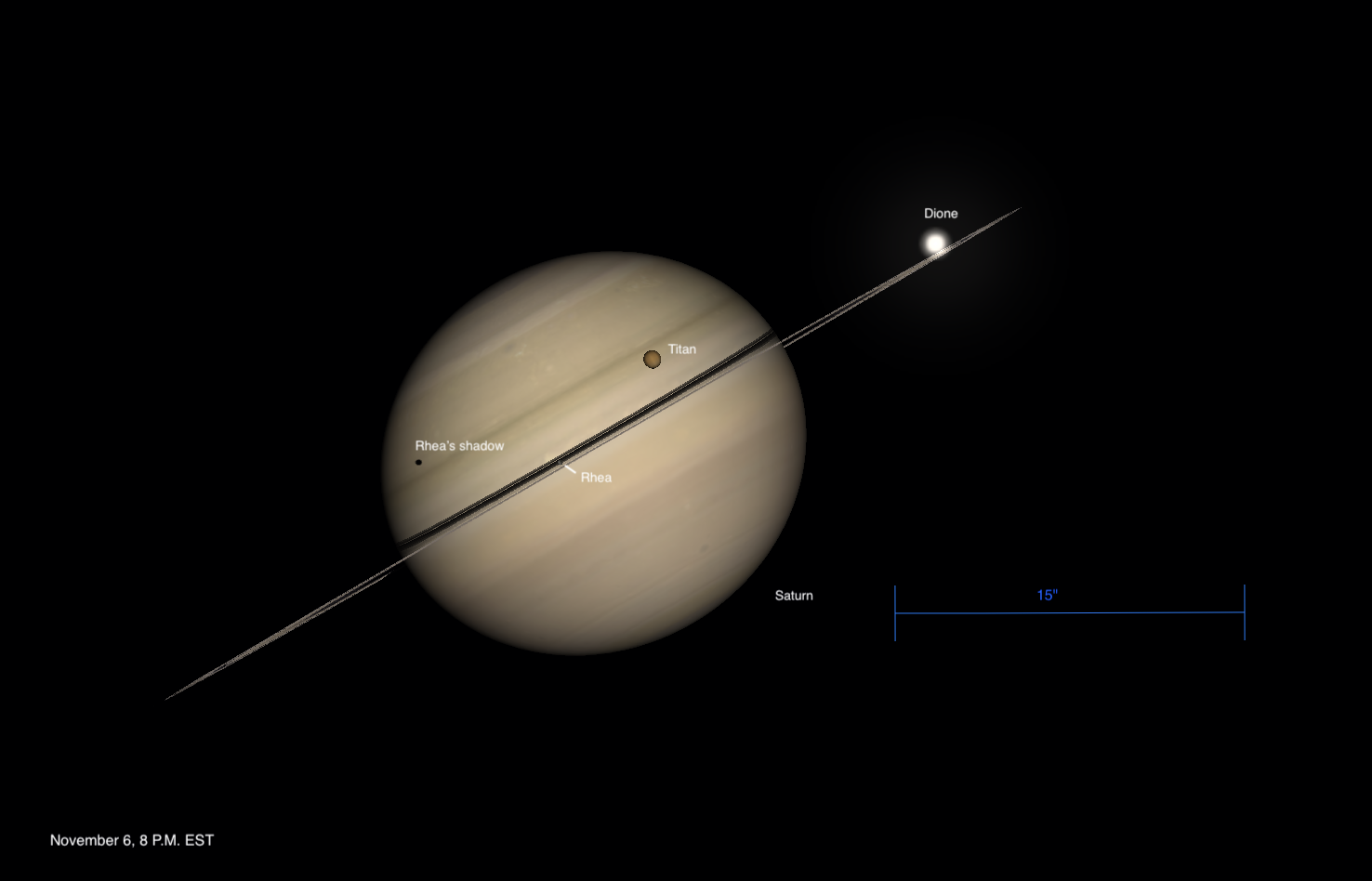
Meanwhile, Titan transits Saturn tonight, with the event underway as darkness falls on the East Coast. By the time the sky is dark, you’ll see Saturn 30° high in the southeast, glowing at magnitude 0.8 (the brightest light in that region). You’ll need a telescope to watch the transit.
Titan is moving from east to west; it reaches halfway across the disk just before 7 P.M. EST. It finally reaches the western limb just before 9:30 P.M. EST and takes more than 15 minutes to move fully off the disk, given the large size of this moon.
Although Titan is the only moon you can see transiting against the glare of Saturn’s cloud tops, it’s not the only satellite to do so tonight. Earlier in the evening, Dione leads Titan westward across the disk, exiting around 6:40 P.M. EST. The moon itself cannot be seen visually against the brilliance of the disk, though it and its tiny shadow may be visible in stills from high-speed video capture techniques. Similarly, Rhea begins a transit just after 6:20 P.M. EST, also invisible to the eye against the disk. Its shadow appears around 7:45 P.M. EST. Rhea’s transit ends just before 10:20 P.M. EST, when the 10th-magnitude moon is less than 3” southeast of brighter, mid-8th-magnitude Titan. If you wait an hour, Rhea will pass due south of Titan as the pair travels just north of the western side of the rings, rendering the two impossible to separate by eye.
Sunrise: 6:35 A.M.
Sunset: 4:52 P.M.
Moonrise: 5:27 P.M.
Moonset: 8:09 A.M.
Moon Phase: Waning gibbous (96%)
*Times for sunrise, sunset, moonrise, and moonset are given in local time from 40° N 90° W. The Moon’s illumination is given at 10 P.M. local time from the same location.