Looking for a sky event this week? Check out our full Sky This Week column.
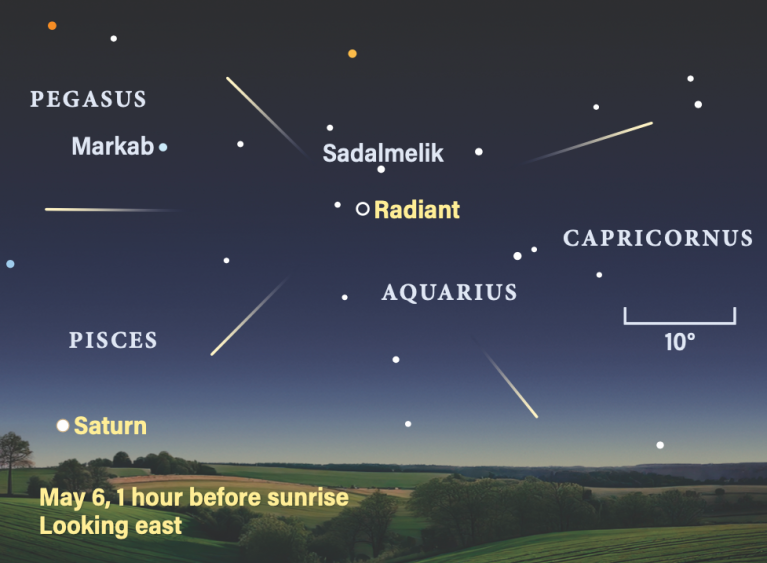
May 6: The Eta Aquariid meteor shower peaks
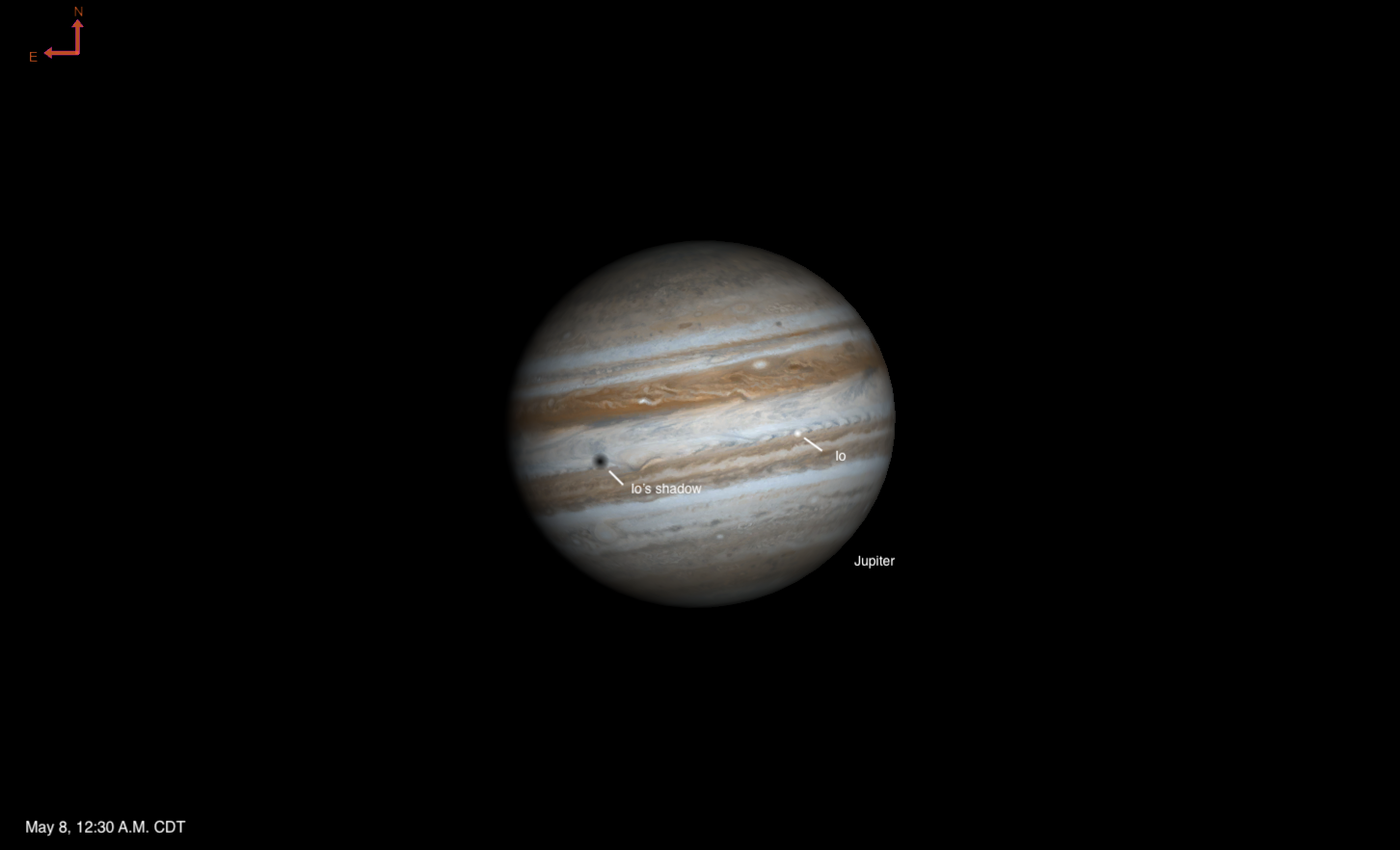
Io, the most volcanic body in the solar system, transits its parent planet Jupiter this evening, beginning just before midnight EDT tonight. Its shadow follows, offering an intriguing sight for telescopic observers.
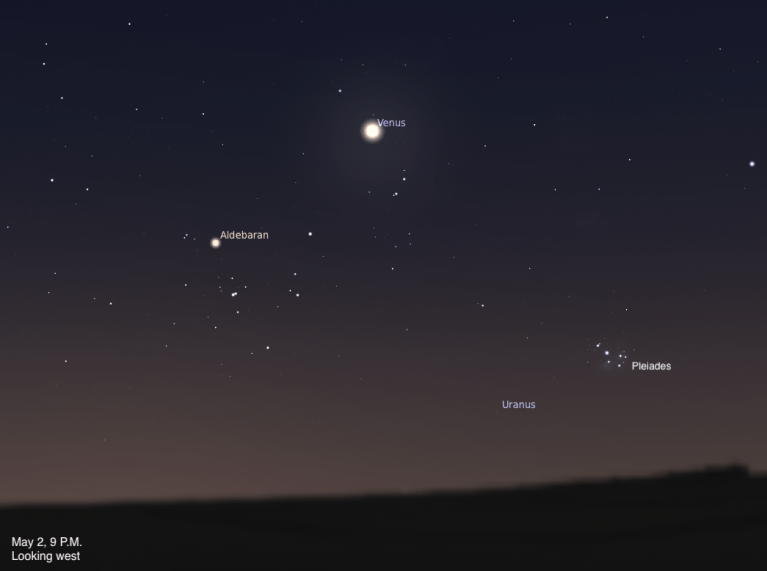
Jupiter starts the evening in the west, the brightest point of light in the constellation Gemini the Twins, above brighter Venus in Taurus. Because Jupiter sets less than an hour after local midnight, different parts of the U.S. will get to view different phases of the transit.
Lucky East Coast observers might catch Ganymede and Europa swapping places far east of Jupiter early in the evening. Around 8:35 P.M. EDT, the two moons stand in a north-south line, with Europa north of Ganymede. Prior to this time, Ganymede is farther from Jupiter than Europa. After this time, Europa is farther from the planet.
Much closer to Jupiter but still to the east is Io, closing in for its transit. Callisto lies alone to Jupiter’s west. Io reaches the eastern limb and begins to transit at 11:48 P.M. EDT. The planet will set for East Coast observers before the moon’s shadow can appear, which occurs at 11:56 P.M. CDT, visible from the Central, Mountain, and Pacific time zones only. After this, the two transit the disk together, with the planet setting across the Central time zone before Io can leave the western limb — this occurs at 12:04 A.M. MDT (now minutes into the 8th in this time zone), as the planet is getting low for those on Mountain time. Only West Coast observers will catch the shadow’s egress to close out the event, around midnight in this time zone.
Sunrise: 5:52 A.M.
Sunset: 8:02 P.M.
Moonrise: 1:30 A.M.
Moonset: 11:05 A.M.
Moon Phase: Waning gibbous (67%)
*Times for sunrise, sunset, moonrise, and moonset are given in local time from 40° N 90° W. The Moon’s illumination is given at 10 P.M. local time from the same location.