Looking for a sky event this week? Check out our full Sky This Week column.
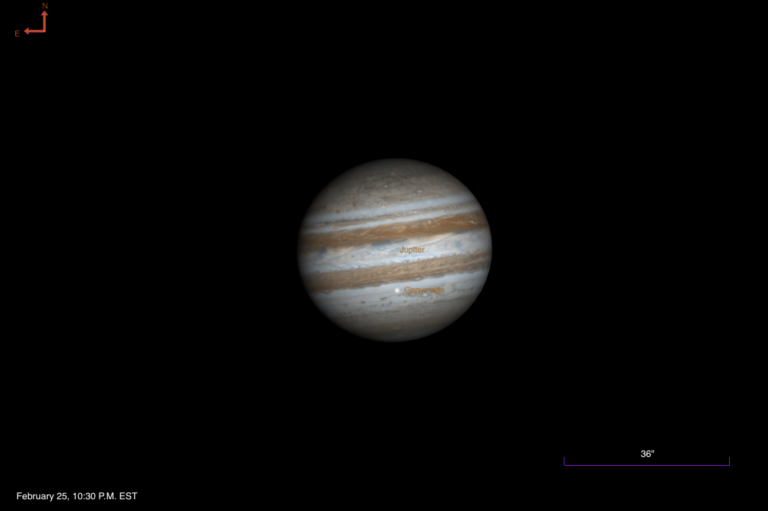
February 25: Ganymede tracks across Jupiter
As February 25th opens, Ganymede is moving away from Jupiter’s southwestern limb and its shadow is preparing to transit. The large shadow makes its way onto the cloud tops near the southeastern limb around midnight CST, four hours after Ganymede’s transit began and with Ganymede now well away from the southwestern limb. The shadow takes more than three hours to transit, disappearing around 2:20 A.M. MST, with Jupiter getting quite low in the Midwest.
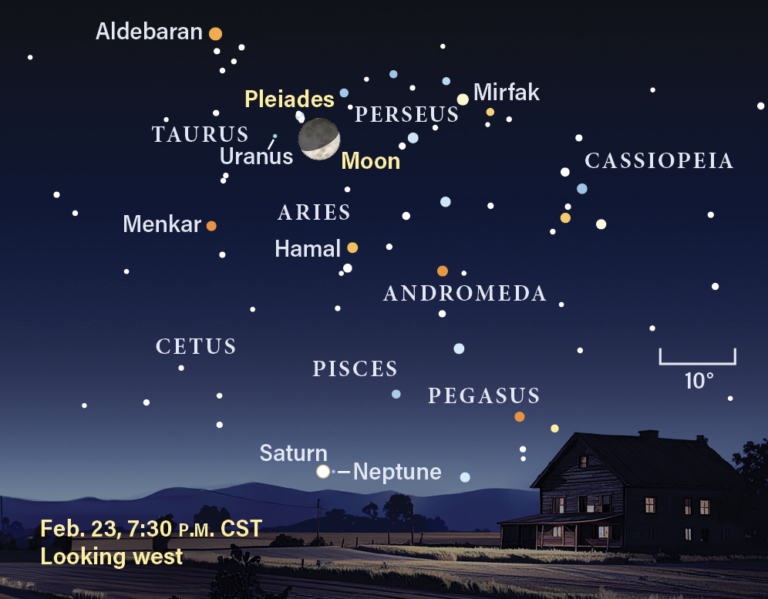
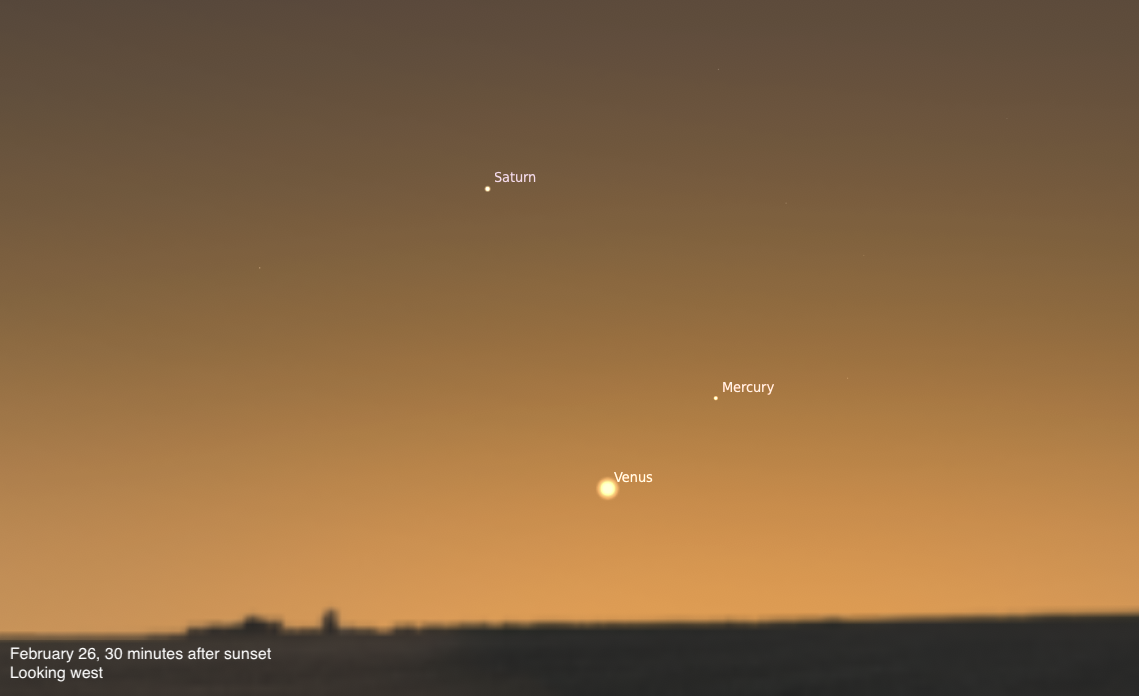
This evening, Mercury passes 5° north of Venus at 6 P.M. EST. The pair is visible together briefly after sunset, although the two planets set soon after the Sun.
Half an hour after sunset, the pair is some 6° high in the west. Venus is easy to find, blazing at magnitude –3.9, while Mercury is a dimmer point of light to Venus’ upper right, shining at magnitude 0.8. Above them (10° west of Mercury) is 1st-magnitude Saturn, which should also become visible as twilight grows.
Through a telescope — make sure to wait until the Sun is fully below the horizon — take a look at both Venus and Mercury and compare their appearances. Venus’ disk stretches 10” across and is nearly fully lit, 98 percent illuminated. Mercury, by contrast, is only 17 percent lit, displaying a lovely crescent that is nearly the same size: 9” across. Although Mercury is physically much smaller than Venus, it is currently much closer to Earth, based on the three planets’ orbits. Mercury is now only 0.75 astronomical unit from Earth, where 1 astronomical unit, or AU, is the average Earth-Sun distance of 93 million miles (150 million km). Venus is 1.66 AU from Earth, on the far side of the Sun from Earth as seen from above the plane of the solar system.
As darkness falls further, swing your telescope up to Saturn to view its lovely rings, now tilted by about 3.5° and showing off their southern side. The planet’s brightest moon, Titan, lies just northwest of the planet’s 16”-wide disk this evening.
Sunrise: 6:37 A.M.
Sunset: 5:49 P.M.
Moonrise: 12:24 P.M.
Moonset: 3:33 A.M.
Moon Phase: Waxing gibbous (79%)
*Times for sunrise, sunset, moonrise, and moonset are given in local time from 40° N 90° W. The Moon’s illumination is given at 10 P.M. local time from the same location.