Looking for a sky event this week? Check out our full Sky This Week column.
October 31: Peer into the Ghost’s Goblet
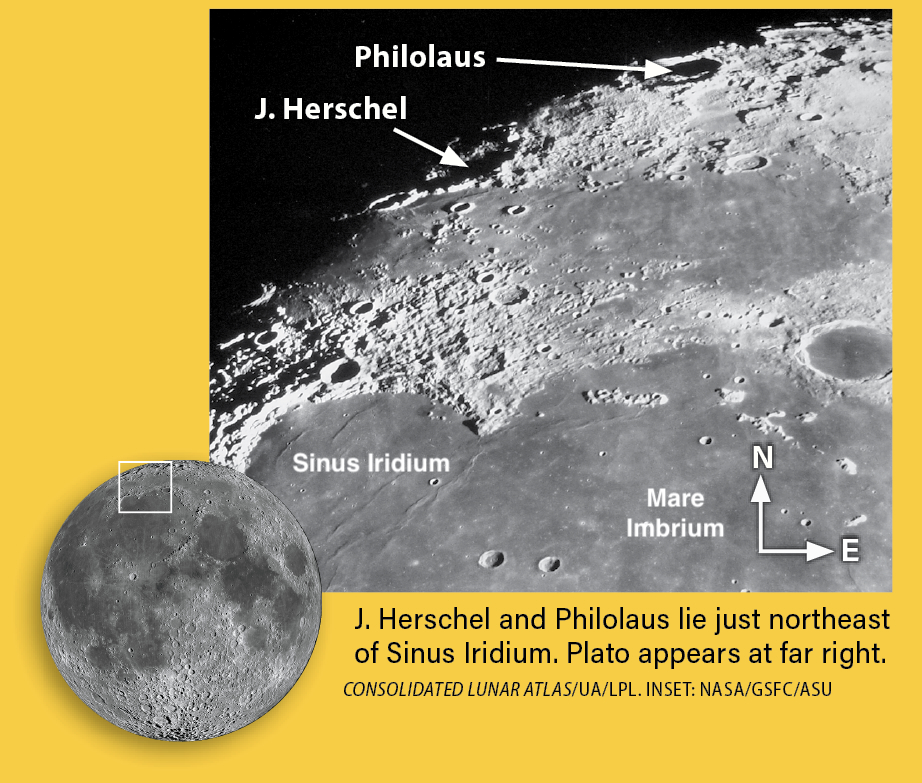
Tonight is a chance to view the remains of a huge impact crater on the Moon: Sinus Iridium, which carves out a chunk of Mare Imbrium.
You can begin viewing the Moon any time this evening, as it is already above the horizon at sunset. By 7 P.M. local daylight time, you’ll find our satellite in the southeastern sky, just to the upper right of 1st-magnitude Saturn. Zoom in on our satellite with a telescope and look toward its northwestern limb, where you’ll find the round edge of Sinus Iridium poking out of northwestern Mare Imbrium.
Stretching some 160 miles (258 kilometers) wide, Sinus Iridium’s own northwestern edge is formed by the rugged Jura Mountains. It has no southeastern rim, instead appearing to flow right into the larger Mare Imbrium. This is because lava from that overlapping “sea” flooded into Sinus Iridium several times over a period ranging from about 3.4 billion to 1.2 billion years ago.
Slightly north of Sinus Iridium, there’s rugged terrain just now coming under sunrise. Look for the craters J. Herschel and Philolaus, marked on the image for this entry. The former spans some 96 miles (155 km) and is about twice as wide as the latter, and also much older as well.
Sunrise: 7:30 A.M.
Sunset: 5:57 P.M.
Moonrise: 3:48 P.M.
Moonset: 2:41 A.M.
Moon Phase: Waxing gibbous (84%)
*Times for sunrise, sunset, moonrise, and moonset are given in local time from 40° N 90° W. The Moon’s illumination is given at 10 P.M. local time from the same location.
Daylight saving time ends Sunday, November 2, at 2 A.M. So, if you are in an area that observes daylight saving time, your clocks will “fall back” from 1:59 A.M. daylight time to 1 A.M. standard time Sunday morning.