
Key Takeaways:
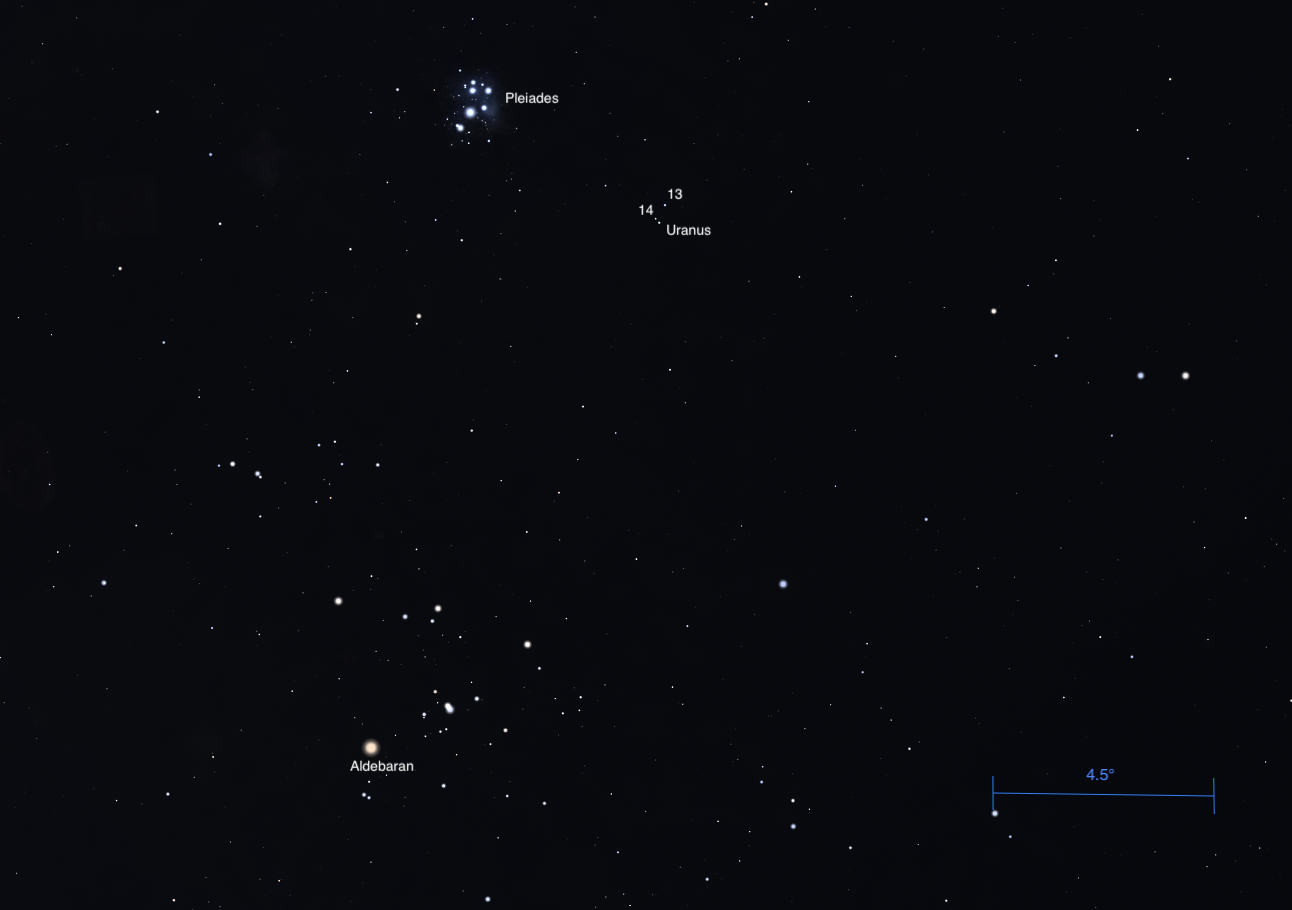
- On December 12, Uranus will be observable in western Taurus, situated 7 arcminutes due south of the 6th-magnitude star 14 Tauri, providing an identification aid.
- The Geminid meteor shower is forecast to peak on the morning of December 14, potentially yielding over 100 meteors per hour, with optimal viewing occurring in the pre-dawn hours despite a waning Moon.
- The Geminids' radiant is located near Castor in Gemini, with shower meteors originating from debris shed by the near-Earth asteroid 3200 Phaethon.
- Favorable conditions for observing the Geminid meteor shower, characterized by high rates and moonless skies, are also anticipated during the evenings of December 13 and 14.
Looking for a sky event this week? Check out our full Sky This Week column.
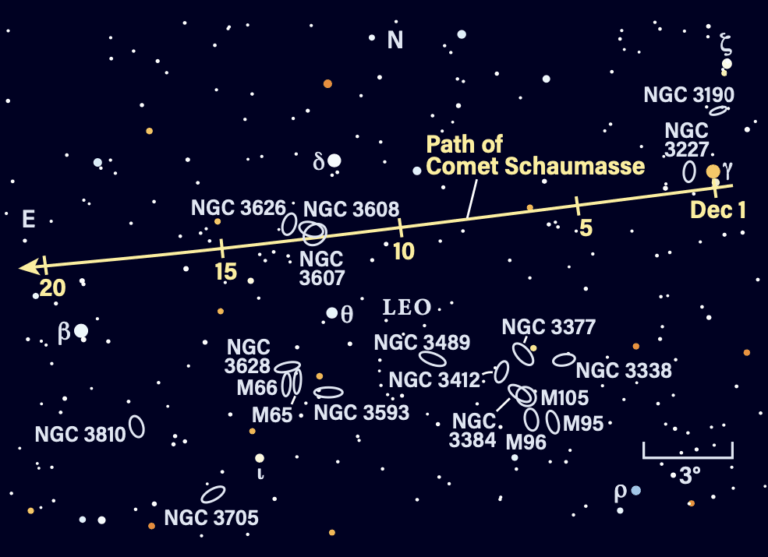
December 12: Comet Schaumasse visits some galaxies
Uranus stands due south of a similarly bright star in Taurus the Bull this evening, aiding in its identification. It’s a great time to get outside and view the distant ice giant, as you won’t need to stay up late — it’s already more than 50° high in the east by 8 P.M. local time, located in western Taurus near the Pleiades star cluster.
Starting at the bright Pleiades, use binoculars or a telescope to scan 4.5° south-southwest of the cluster to land on a pair of 6th-magnitude stars. These are 13 and 14 Tauri. And tonight, 6th-magnitude Uranus is located just 7’ due south of 14 Tau, the slightly fainter westernmost star in the pair. The trio creates a small right triangle, with Uranus and 13 Tau anchoring the hypotenuse. See if you can make out Uranus’ tiny, 4”-wide disk; it may look like a grayish, “flat” star compared to its nearby pointlike companions.
Sunrise: 7:14 A.M.
Sunset: 4:35 P.M.
Moonrise: 1:14 A.M.
Moonset: 12:48 P.M.
Moon Phase: Waning crescent (28%)
*Times for sunrise, sunset, moonrise, and moonset are given in local time from 40° N 90° W. The Moon’s illumination is given at 10 P.M. local time from the same location.
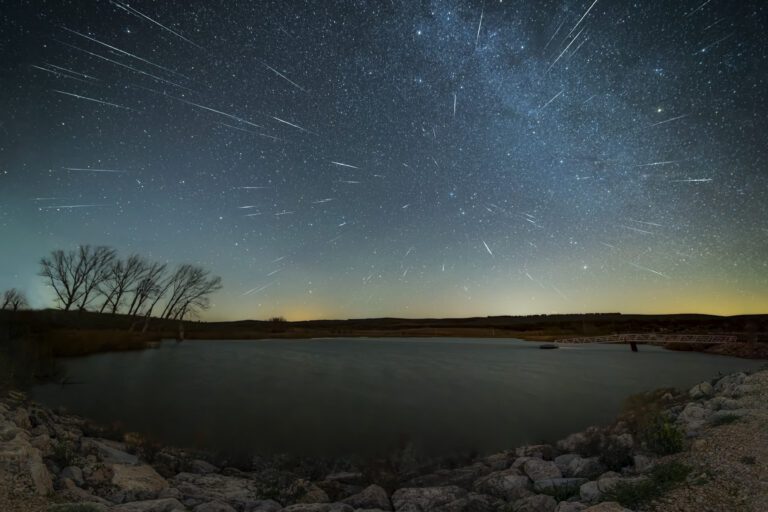
The Geminid meteor shower peaks tomorrow morning, December 14, with a waning Moon in the sky. Widely regarded as the best meteor shower of the year, the Geminids will produce more than 100 meteors per hour during its peak. Although you may not see quite this many, you can still expect to see a good show if you’re willing to brave the cold and step outside.
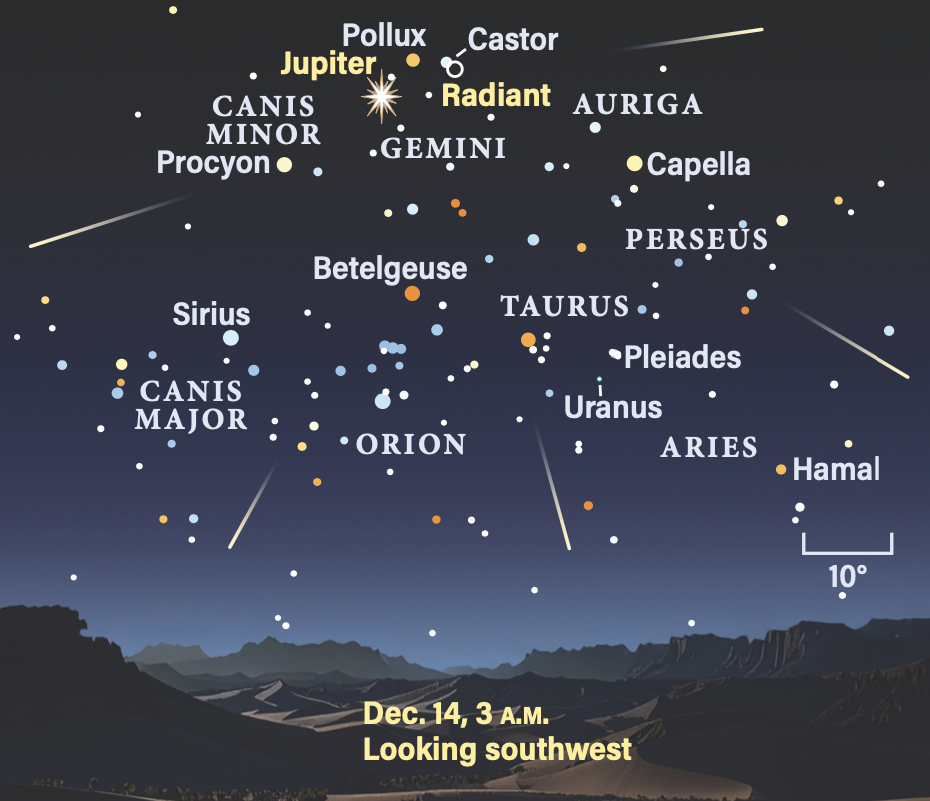
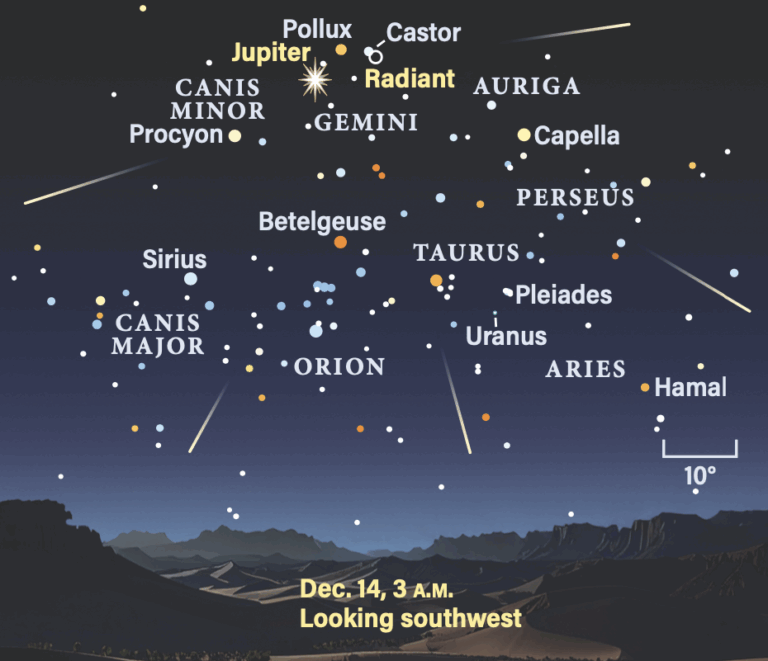
The Geminids’ radiant is located near the bright star Castor in Gemini the Twins. Jupiter is also nearby this year, shining at magnitude –2.6. The best time to watch for shower meteors is early in the morning in the hours before dawn; at this time, you’ll be standing on the leading edge of Earth as it rotates, moving into the stream of debris that produces the meteors we see. That debris was left behind by the near-Earth asteroid 3200 Phaethon, whose 1.4-year orbit is much like that of a more traditional comet and brings it within the orbit of Earth, sometimes passing close to our planet.
The heads of Gemini stand nearly 75° high in the southwest around 3 A.M. local time, with Jupiter to their left. Castor is on the right as you look up at the sky at this time, with the Geminids’ radiant just to the lower right of this star. Once you’ve found the radiant’s location, start scanning the sky some 40°–60° on either side of this region — this is where you’ll see meteors with the longest trains as they streak away from Gemini and shoot across the sky.
Although morning will be the best time to watch for meteors, evening observers will likely catch some of the show as well. Because Gemini rises around 6 P.M. in the evening, the radiant has climbed above 40° in the east by 10 P.M. local time, now with Gemini lying on its side and Castor above Pollux in the sky. Meteor rates should be high both the evening of the 13th and 14th, and without any Moon in the sky at all.