Looking for a sky event this week? Check out our full Sky This Week column.
March 8: Spiral galaxy NGC 2541
The Galilean moon Callisto disappears behind Jupiter in an occultation early this morning. The catch is that the event is only visible from the western half of the U.S., but observers farther east can still watch as the moon closes in on the planet’s limb.
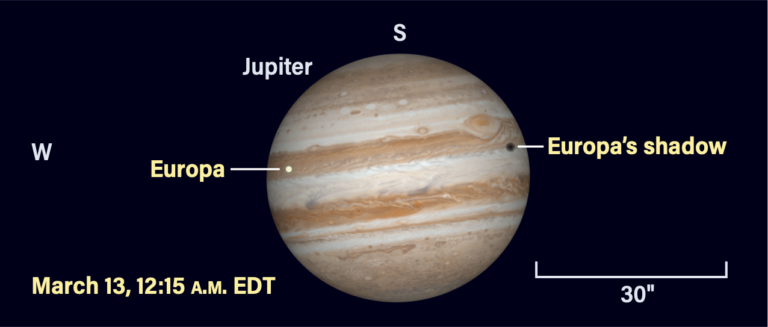
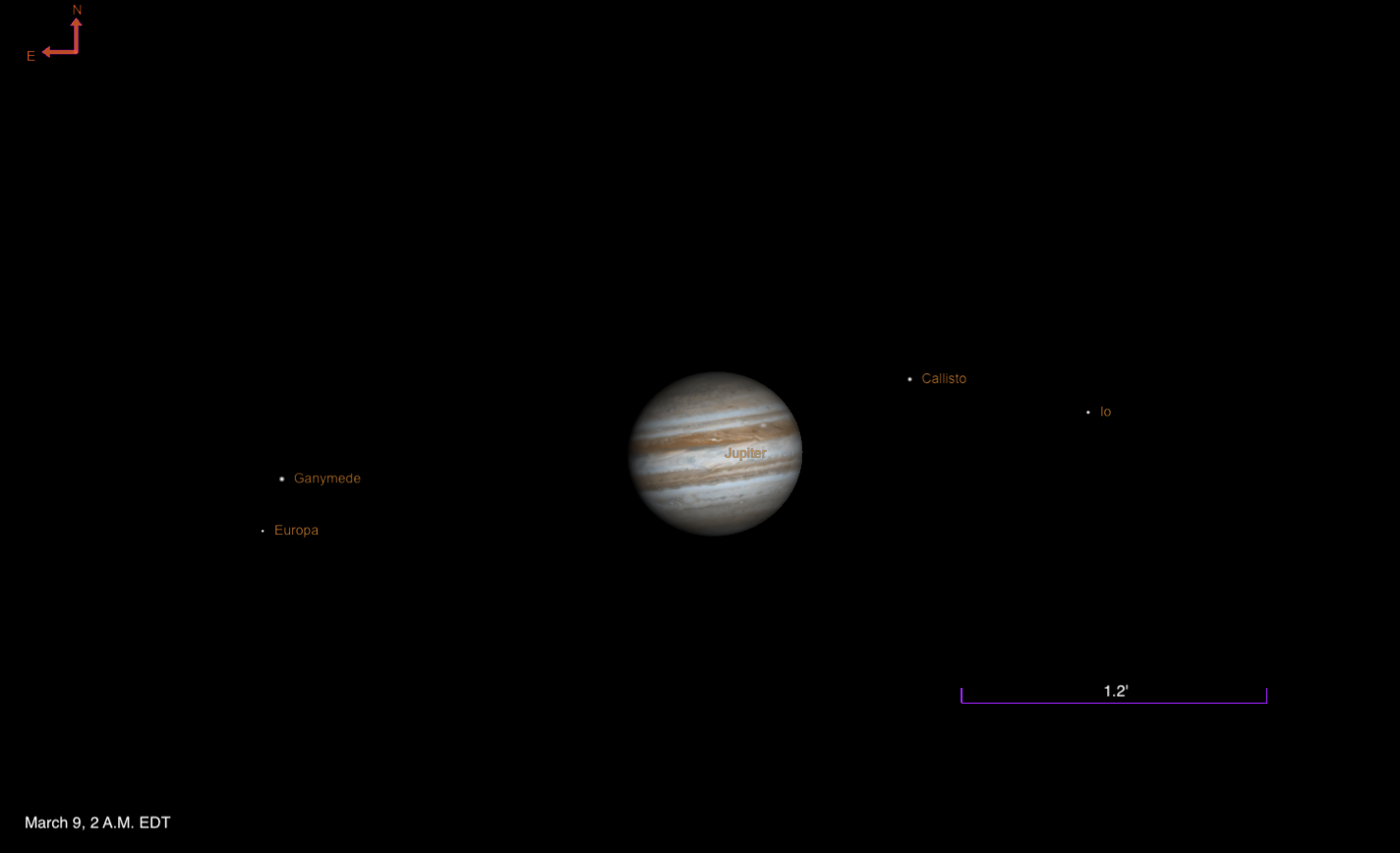
Shortly after local midnight on the night of the 8th, Jupiter is some 50° high and slowly setting in the west, among the stars of Gemini. It hangs below the two bright stars marking the Twins’ heads, Castor and Pollux. Through a telescope, its Galilean moons are arrayed with two on each side of the planet: Europa and Ganymede lie to the east, while Callisto and Io sit to the west.
As the morning progresses, the moons noticeably shift positions. For two hours after midnight, Ganymede is closer to Jupiter to the east, with Europa farther away. The two moons are moving in opposite directions, however, and Ganymede passes north of Europa shortly after 2 A.M. EDT. On the other side of the gas giant, Callisto — which is moving eastward and passed north of westward-moving Io around midnight EDT on the 8th — is now moving closer to Jupiter’s western limb by the hour. The planet sets before the moon can reach it from the eastern half of the U.S., but observers in the Mountain and Pacific time zones will see Callisto disappear behind the limb around 3:30 A.M. MDT. The planet sets even for those on the West Coast before the moon completes its journey and reappears.
Sunrise: 7:21 A.M.
Sunset: 7:01 P.M.
Moonrise: 12:26 A.M.
Moonset: 10:02 A.M.
Moon Phase: Waning gibbous (62%)
*Times for sunrise, sunset, moonrise, and moonset are given in local time from 40° N 90° W. The Moon’s illumination is given at 10 P.M. local time from the same location.
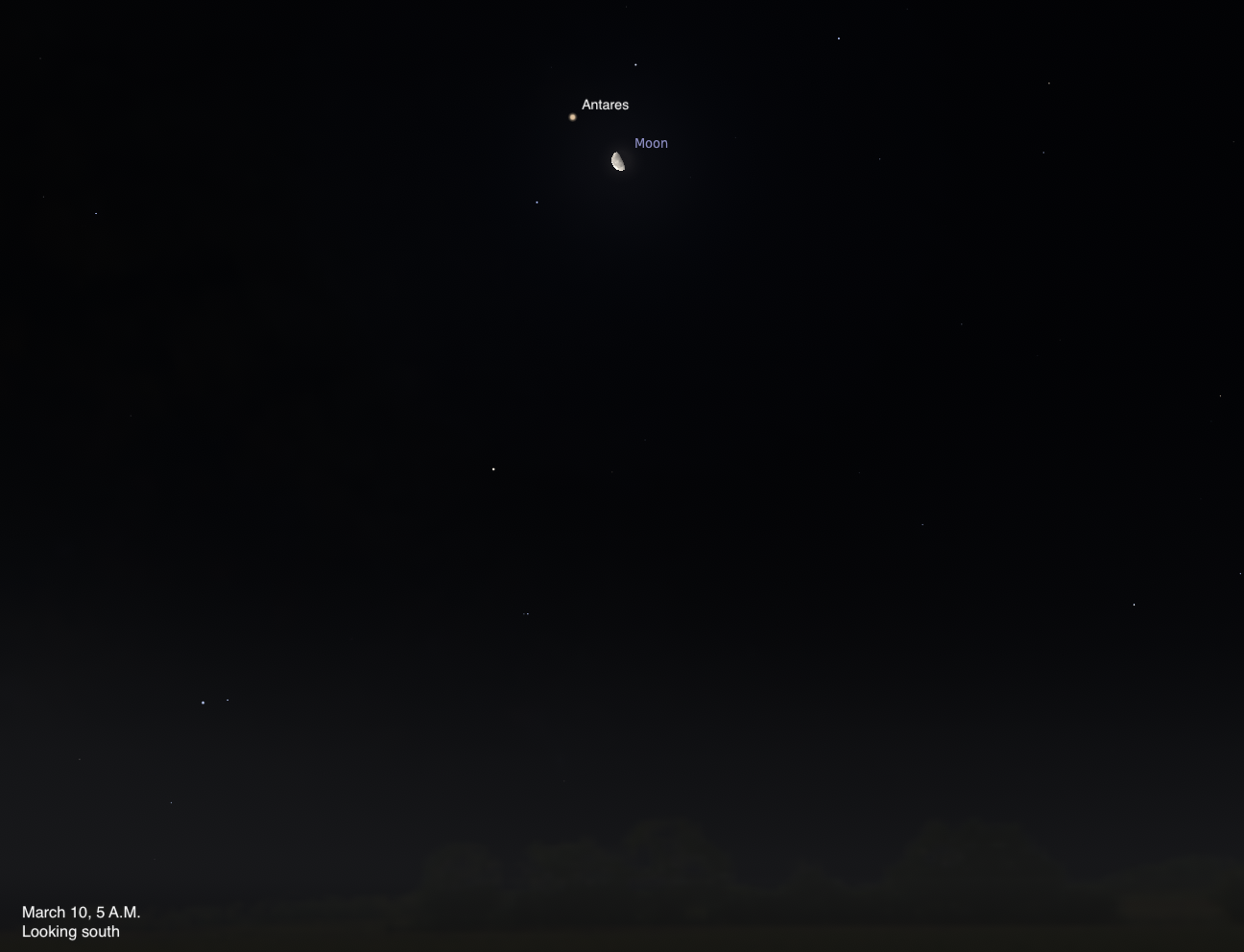
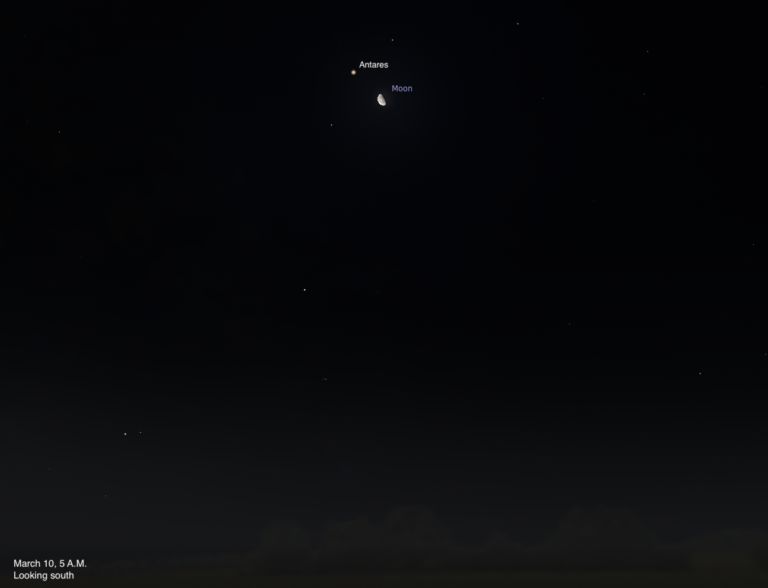
Early on the morning of the 10th, the Moon stands close to the star Antares in the constellation Scorpius. Around 6 A.M. local daylight time, the pair hangs some 20° high in the south, with all of Scorpius’ long, curving tail visible above the horizon from midlatitudes. The waning gibbous Moon is still bright, but the light of 1st-magnitude Antares just above and to Luna’s left should still be visible. Through a telescope especially, that light will appear orange or red to the eye — this star is a cool, aging red giant whose temperature is lower than that of our Sun.