Looking for a sky event this week? Check out our full Sky This Week column.
November 13: The Moon in Leo
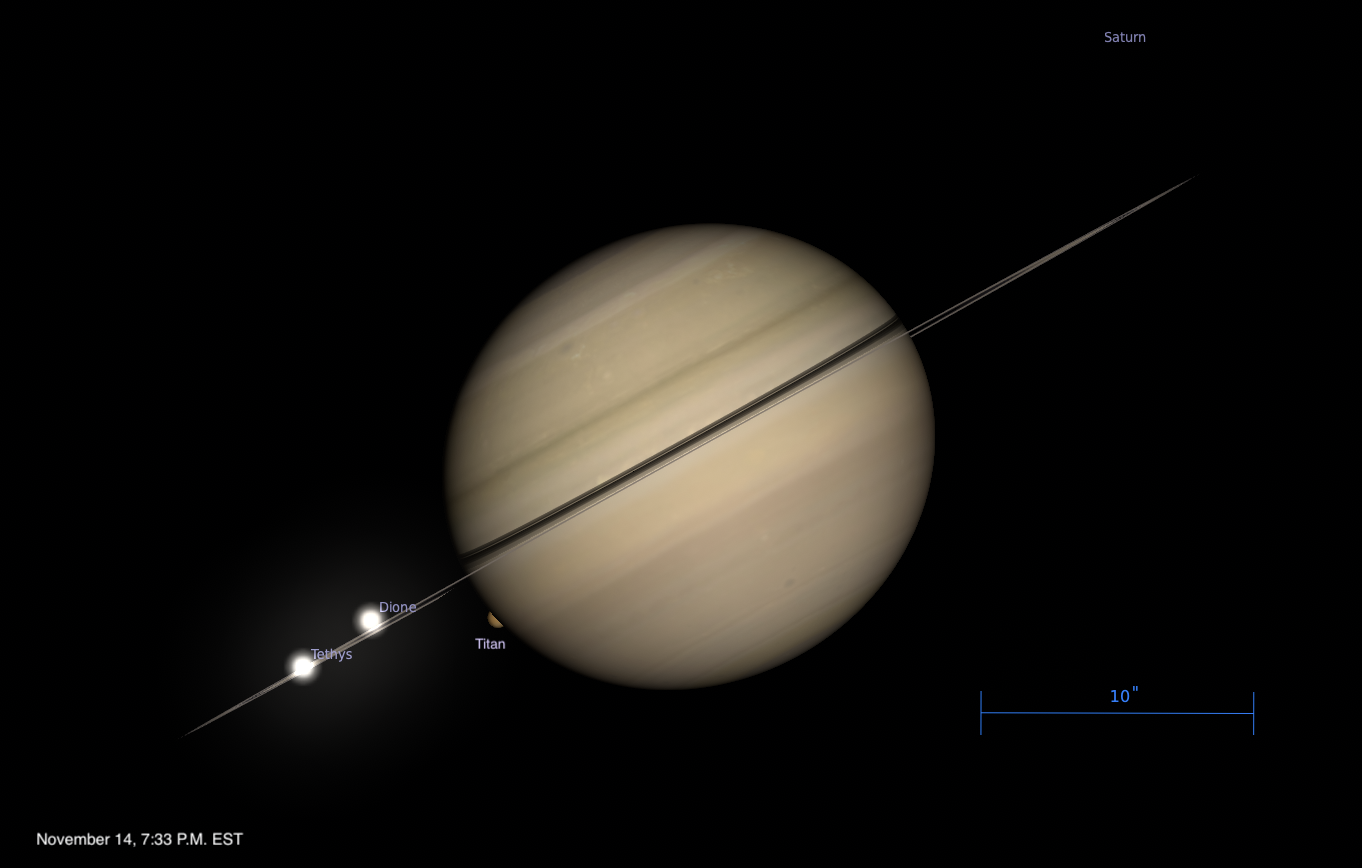
Titan is hidden by Saturn for the first part of the evening in the eastern U.S., emerging from occultation behind the ringed planet’s disk beginning at 7:26 p.m. EST. This occurs in twilight for the Mountain time zone, but in darkness farther east.
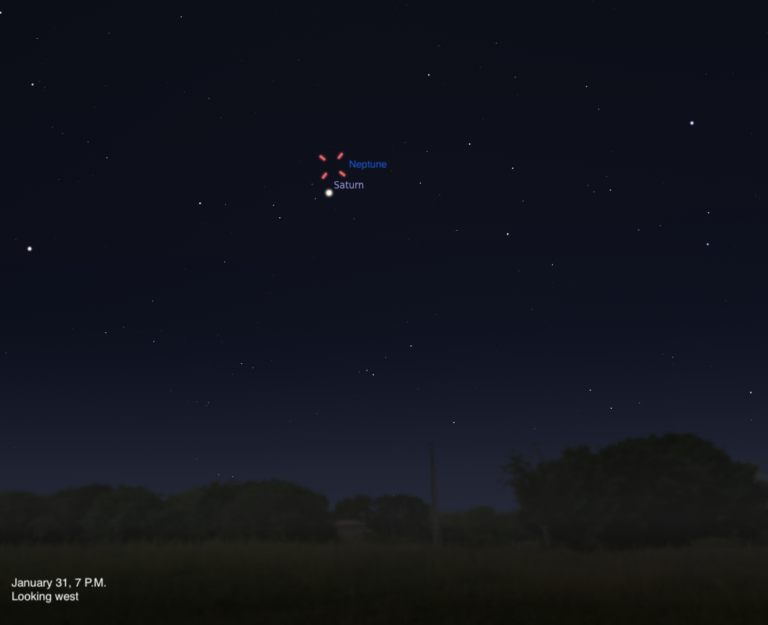
If you’re able to catch the event, plan to get your telescope set up and ready well ahead of time. First-magnitude Saturn rises before sunset and is already 40° high in the south by 7 P.M. local time (note this is after the event begins in the Central time zone). It’s located in far northeastern Aquarius and is the brightest point of light in this part of the sky, to the upper left of slightly fainter magnitude 1.2 Fomalhaut.
Titan begins to appear at 7:26 P.M. EST, taking several minutes to make its way into view. Also visible to Saturn’s east before Titan begins to emerge are 10th-magnitude Dione and Tethys; the former is closer to the planet. Both are close to the rings and begin transits shortly after Titan emerges, although they will be too faint to see by eye against the brightness of Saturn’s disk. Experienced imagers using high-speed video cameras may catch them. Tenth-magnitude Rhea is far to Saturn’s east; see if you can spot this moon as well.
Several more moons are visible but are fainter and may not appear in all telescopes. You can use a planetarium program of your choosing to identify any you think you might see.
Sunrise: 6:44 A.M.
Sunset: 4:44 P.M.
Moonrise: 1:19 A.M.
Moonset: 2:03 P.M.
Moon Phase: Waning crescent (22%)
*Times for sunrise, sunset, moonrise, and moonset are given in local time from 40° N 90° W. The Moon’s illumination is given at 10 P.M. local time from the same location.