Astronomy forum Connect with fellow astronomy enthusiasts!
Get started
Skip to content
Astronomy Magazine logo
  • Login / Register
  • Logout
  • Shop
  • Subscribe

  • News
  • Science
    • Solar System
    • Exoplanets
    • Stars
    • Milky Way
    • Galaxies
    • Exotic Objects
    • Cosmology
  • Observing
    • In The Sky
    • Upcoming Events
    • The Sun
    • The Moon
    • Planets
    • Comets
    • Deep-Sky Objects
    • Observing Basics
    • Telescopes and Equipment
    • Astrophotography
    • Gear Guide
    • This Week in Astronomy
  • Space Exploration
    • What’s Launching This Week
    • Human Spaceflight
    • Robotic Spaceflight
  • The Magazine
  • Ask Astro
  • Star Products
  • Login / Register
  • Logout
  • Shop
  • Subscribe

The Sky This Week: Observe the Moon

Against the backdrop of a Full Moon, two planets stand still and the Orionid meteor shower peaks from October 15 to 22.
By Alison Klesman | Published: October 15, 2021 | Last updated on May 18, 2023

2022Calendar

Up Next

  • Deep-Sky Objects

    Winter observing targets for small telescopes

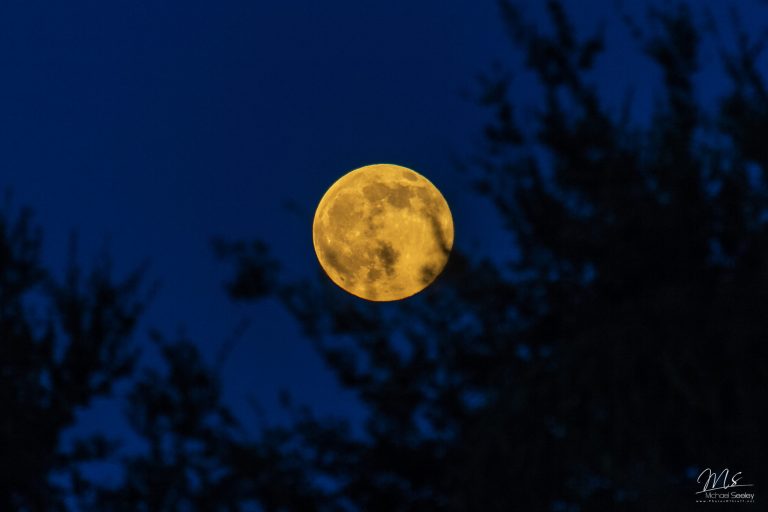
  • A golden Full Moon in a dark blue sky seen through the branches of a foreground tree.
    Observing, The Moon

    2026 Full Moon calendar: When to see the Full Moon and phases

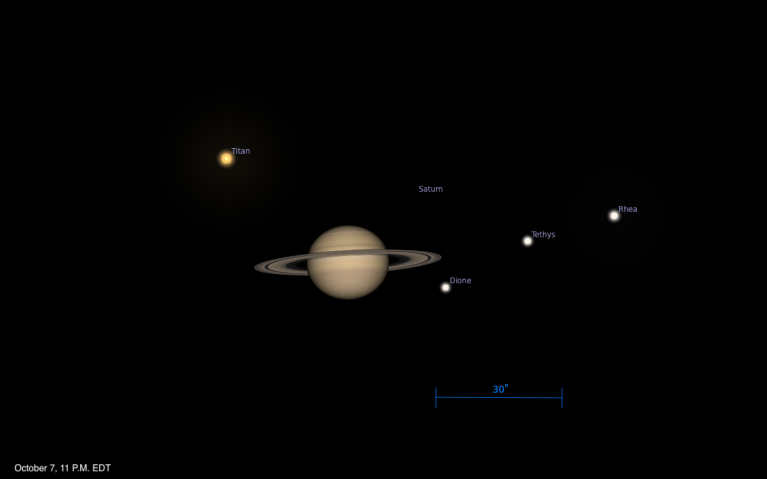
  • Telescopic simulation of Saturn and its moons, dated October 7, 2026, 11 P.M. EDT. Saturn is shown ringed at lower center with the moons Dione and Tethys labeled nearby, Rhea labeled further to the upper right, and Titan labeled at upper left. A 30 arcsecond scale bar sits at lower right.
    Observing

    The Sky Today on Wednesday, October 7: Titan passes north of Saturn

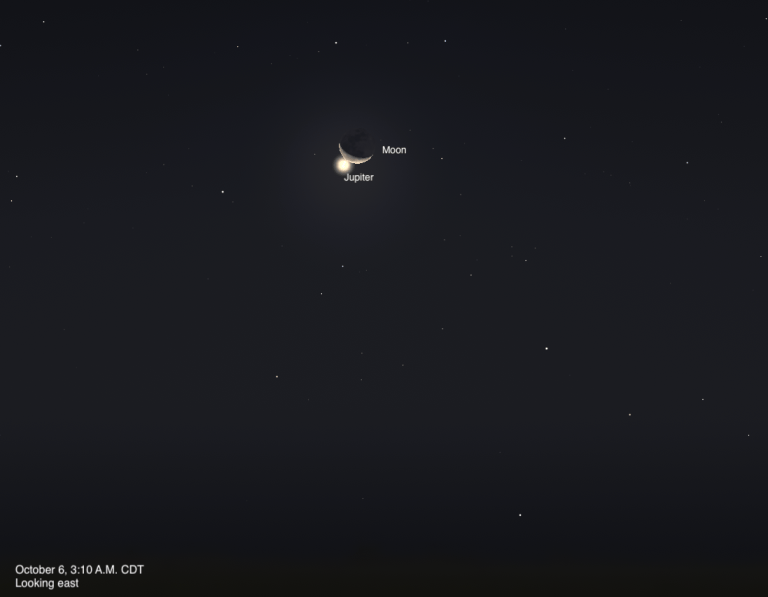
  • Simulated view of a dark predawn sky, dated October 6, 2026, 3:10 A.M. CDT, looking east. A thin crescent Moon is labeled at upper center with the bright point of Jupiter labeled just below and to the left, both set against a faint glow near the horizon with scattered faint stars elsewhere in the frame.
    Observing

    The Sky Today on Tuesday, October 6: The Moon occults Jupiter

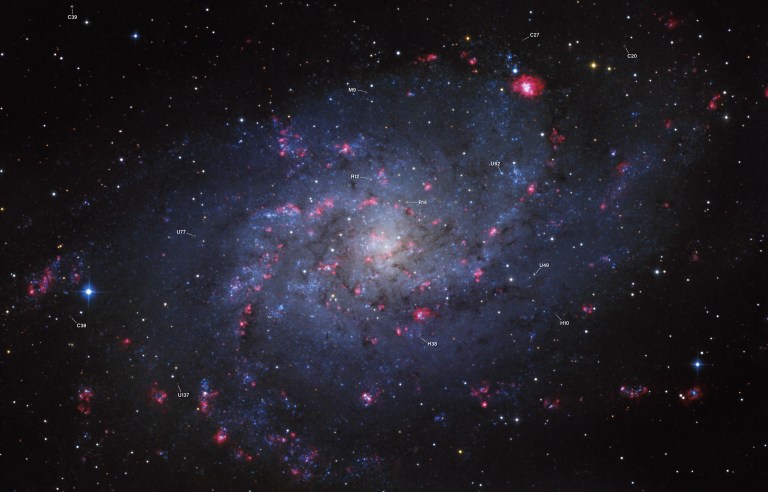
  • Annotated astrophotograph of the Triangulum Galaxy (M33), a face-on spiral with a pale blue-white core, dark dust lanes, and sweeping blue spiral arms dotted with red and pink star-forming regions, set against a dark star field. A bright blue star with diffraction spikes appears at left. Small white labels with leader lines point to star clusters labeled C20, C27, C38, C39, H10, H38, M9, R12, R14, U49, U62, U77, and U137.
    Astrophotography, Deep-Sky Objects

    Imaging star clusters in other galaxies

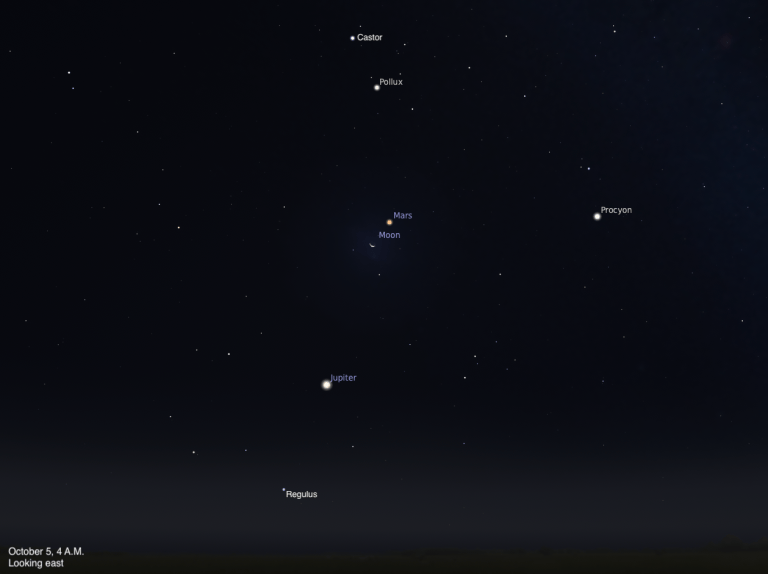
  • Simulated view of a dark predawn sky, dated October 5, 2026, 4 A.M., looking east. Mars and a thin crescent Moon are labeled close together near the center, with Jupiter labeled lower in the frame, Procyon to the right, and Castor and Pollux labeled above, while Regulus appears low near the horizon.
    Observing

    The Sky Today on Monday, October 5: The Moon, Mars, and M44

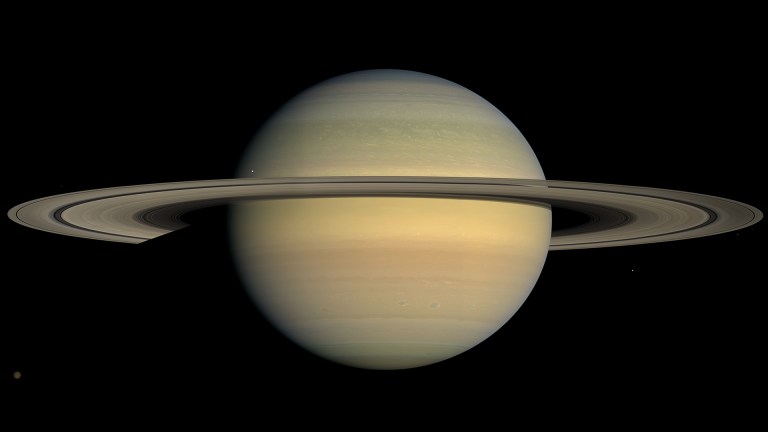
  • Photograph of Saturn against a black background, shown nearly face-on with pale cream and tan cloud bands crossing its globe and a faint orange tint near the equator. The wide ring system extends horizontally across the frame, and several small moons appear as faint points of light scattered around the planet.
    Observing

    The Sky Today on Sunday, October 4: Saturn reaches opposition

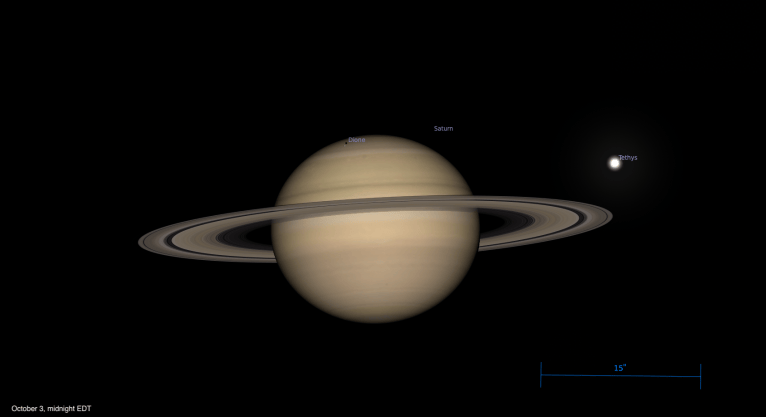
  • Telescopic simulation of Saturn and its moons, dated October 3, 2026, midnight EDT. Saturn is shown ringed at center with the moon Dione labeled faintly near the top of the planet, while the moon Tethys appears as a bright point to the right. A 15 arcsecond scale bar sits at lower right.
    Observing

    The Sky Today on Saturday, October 3: Dione transits Saturn

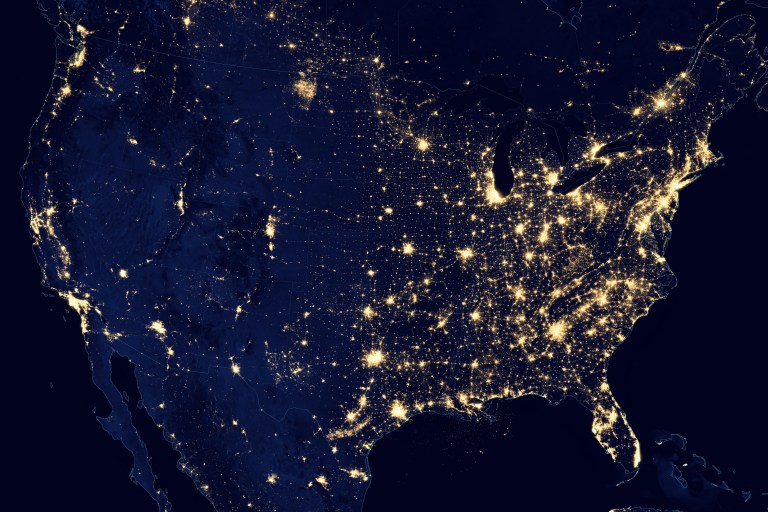
  • Satellite photograph of the contiguous United States at night, showing city lights as golden points and clusters against a dark navy landmass and black ocean. The eastern two-thirds of the country glow densely and almost continuously along the coasts and around the Great Lakes, while the western half shows sparser, more isolated clusters of light concentrated along the Pacific coast and scattered through the interior.
    Observing

    How can I reduce my personal contribution to light pollution?

Astronomy Newsletter

Get newsletters, updates and special offers via email from Astronomy.com!

Please enter a valid email address.

Astronomy magazine: 50 years and counting

Astronomy leads the astronomy hobby as the most popular magazine of its kind in the world. Get information about subscriptions, digital editions, renewals, advertising and much, much more.

Count me in

FREE DOWNLOAD

All About the Apollo Mission

Get it now
Astronomy Magazine logo
  • Facebook
  • LinkedIn
  • YouTube
  • Instagram
  • Twitter
  • About Us
  • Contact Us
  • Subscribe
  • Customer Service
  • Advertising
  • Terms of Use
  • Privacy Policy
  • Do Not Sell

@ 2025 Firecrown Media. All Rights Reserved.

More Sites from Firecrown Media Publisher logo
Scroll to Top

Sign In

New User? Create an Account

Why Sign In? Subscribers can access their digital magazine issues, and registered users can participate in our Community forums and galleries.

Please enter your email.
Please enter your password.

Lost your password?

Manage My AccountCustomer Support