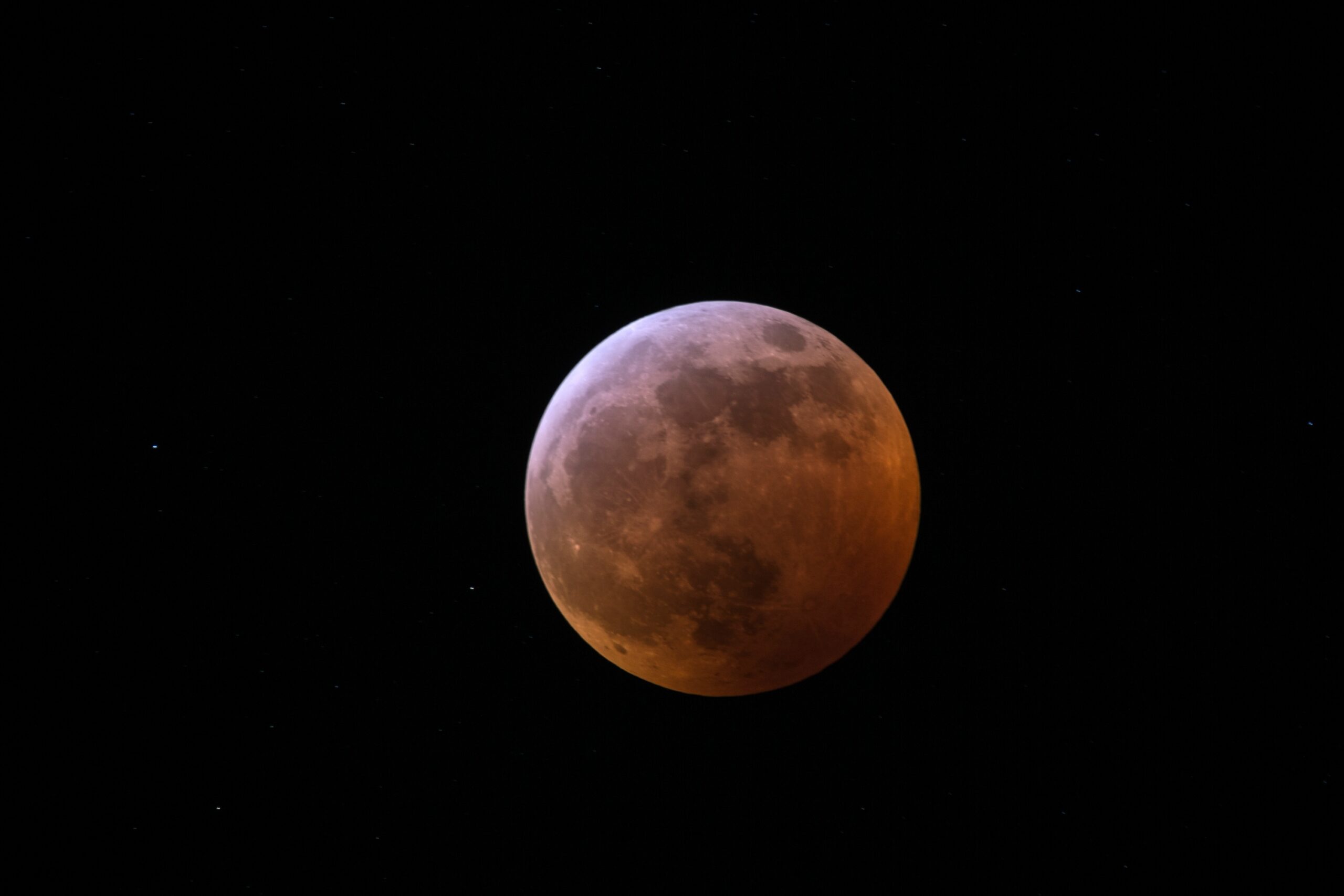
A total lunar eclipse is the highlight of the month. For planetary action, Jupiter is well placed most of the night and there are many events involving its Galilean moons. Soon after sunset, brilliant Venus appears low in the western sky. Within reach of binoculars, Uranus wanders close to stars that are easy to find south of the Seven Sisters. It’s a great time to spot this distant globe.
A total lunar eclipse is visible across the U.S., Canada, Mexico, and parts of South America the morning of March 3. It is also observable after sunset in Australia, New Zealand, Asia, and Indonesia.
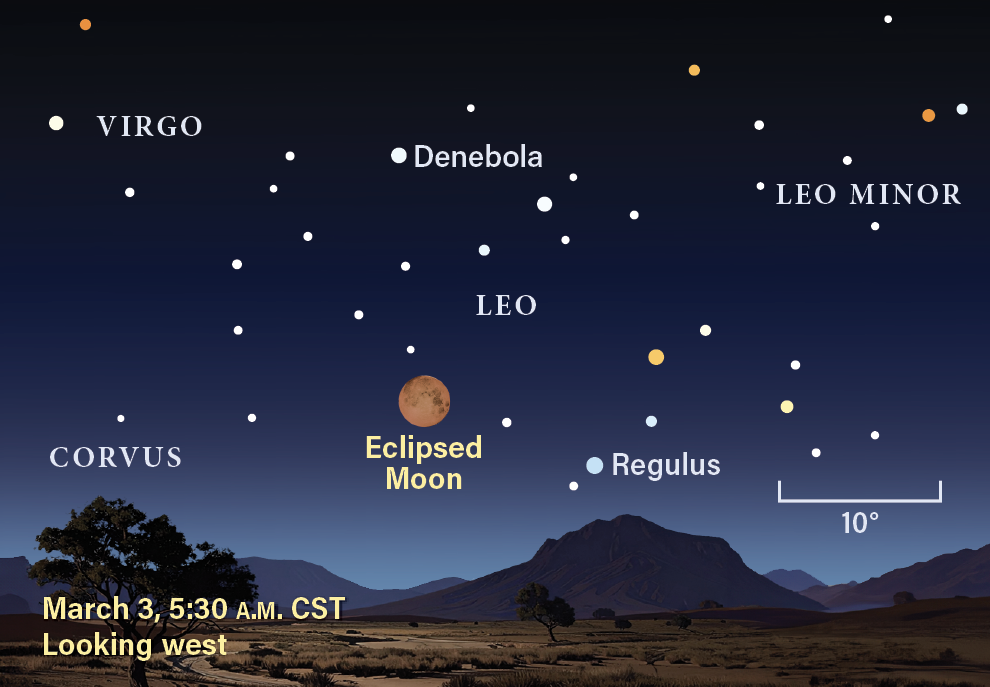
Watch the Moon rise on March 2 among the stars of Leo. Stay up past midnight into the early hours of March 3 to see the subtle penumbral shadow fall across the Moon, beginning at 3:43 a.m. EST. The partial phase begins at 4:50 a.m. EST. During the next hour, the sky darkens as the Moon moves deeper into Earth’s shadow and takes on an orange hue as totality approaches. The sky is filled with stars at the onset of totality at 6:04 a.m. EST, which lasts for 59 minutes as the Moon crosses the southern part of Earth’s shadow.
The Eastern time zone sees totality during morning twilight as the Moon sets in the west. From the Central time zone, the Moon stands about 20° high in the western sky during totality. Observers in the Mountain and Pacific times zones see the total eclipse in a dark sky. After totality in the Mountain time zone, the Moon passes through the partial phases as twilight grows. The partial phase ends at 6:18 a.m. MST.
Venus appears in the evening sky shining at magnitude –3.9, an easy target to spot soon after sunset. On March 7 and 8 it lies close to Saturn, which is a much fainter magnitude 1.0. Use Venus as a guide: Check for the close pairing 30 minutes after sunset, when Venus is 7° high. Grab binoculars — Saturn will pop into view easily. If you swing a telescope toward Venus, you’ll see a 97-percent-lit disk spanning 10″. Venus and Saturn set 70 minutes after the Sun.
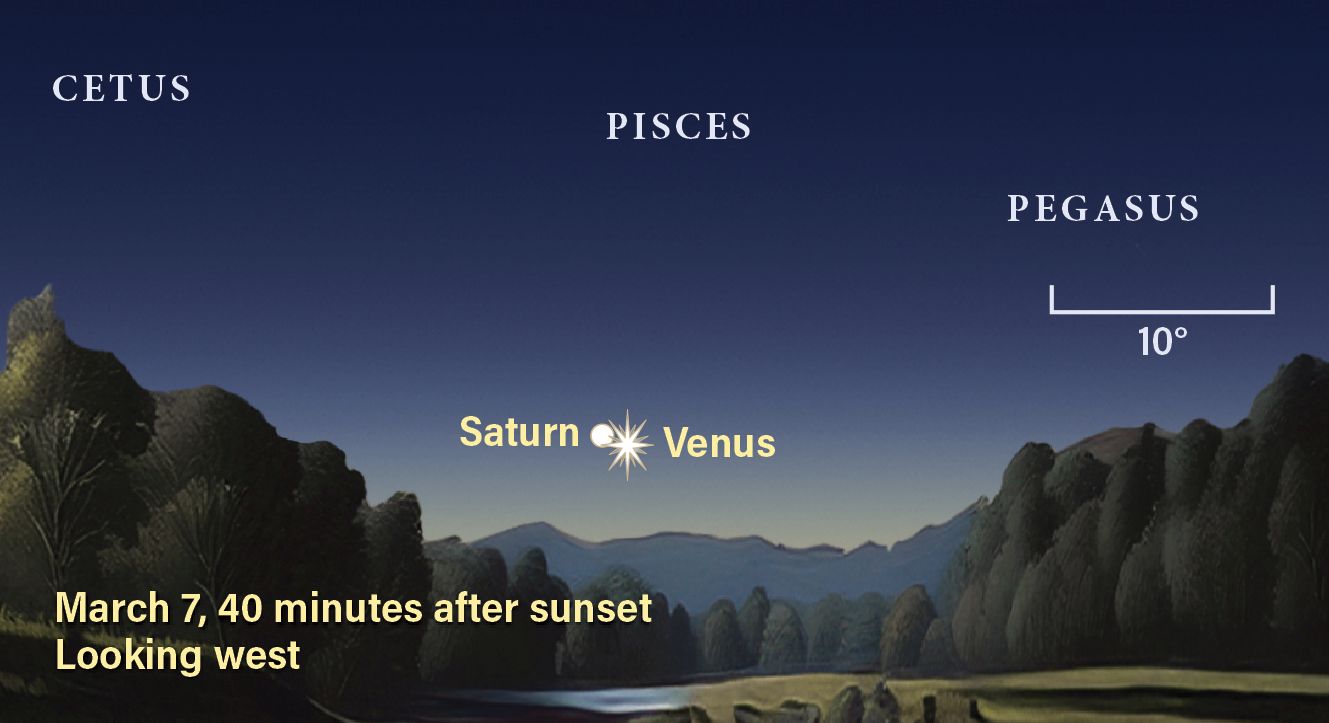
Neptune is a little more than 1° northwest of Saturn; it is not easy to see it in twilight at this low altitude. Neptune reaches conjunction with the Sun March 22. Saturn reaches solar conjunction three days later.
Venus continues to climb higher as it extends its elongation from the Sun. A slender crescent Moon joins the region March 19 and 20. On the 19th, it’s a challenge to find the one-day-old Moon some 6° to the lower right of Venus. Catch it within 45 minutes of sunset, before the Moon descends too low. On the 20th, the Moon stands 9° above Venus and is much easier to see.
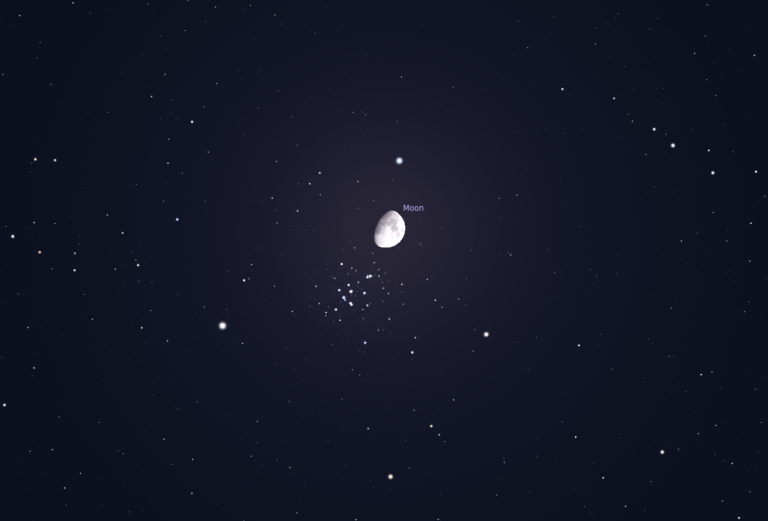
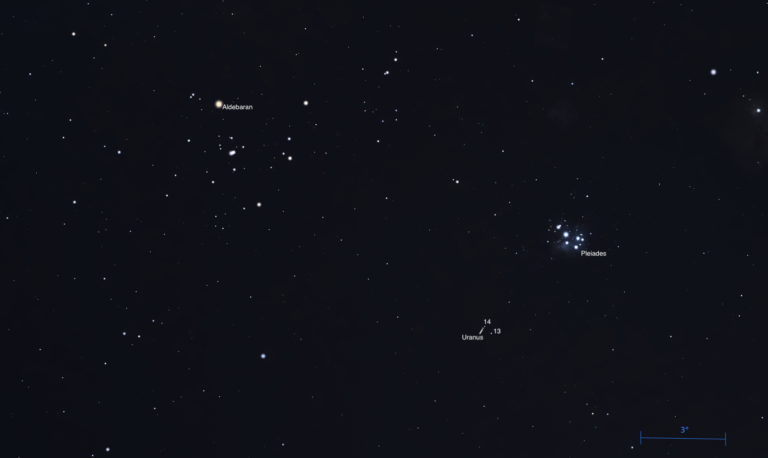
Uranus is visible just south of the Pleiades (M45) all evening. It’s a perfect month to spot the planet, due to its proximity to an easy-to-find pair of stars shining with similar brilliance. Uranus sets soon after midnight. At magnitude 5.8, it generally requires binoculars or a telescope to view, although it is technically within range of the unaided eye.
There’s a pair of stars 4.5° south of M45 called 13 and 14 Tauri. They shine at magnitude 5.7 and 6.1, respectively. As March begins, Uranus stands 0.5° southwest of brighter 13 Tau. If you can see this star with the unaided eye, you might also spot Uranus. Uranus’ motion carries it due south of 13 Tau by the 15th, when the planet stands 12′ south of this star. On the 25th, Uranus is 5′ south of 14 Tau. By the 31st, Uranus has moved to sit 14′ east-southeast of 14 Tau. Through a telescope, the tiny disk of Uranus spans 4″ and appears distinctly nonstarlike. It possess a subtle bluish-green hue.
Jupiter dominates the evening sky in the constellation Gemini. It begins March at magnitude –2.4 and fades only 0.2 magnitude by the end of the month. It’s highest in the south around 8:30 p.m. local time on March 1, and by 7:30 p.m. local daylight time on March 31. Usually there is a two-hour difference in transit time by the end of the month, but daylight saving time begins March 8. Jupiter sets by 3 a.m. local daylight time on the 31st, offering many hours of observability.
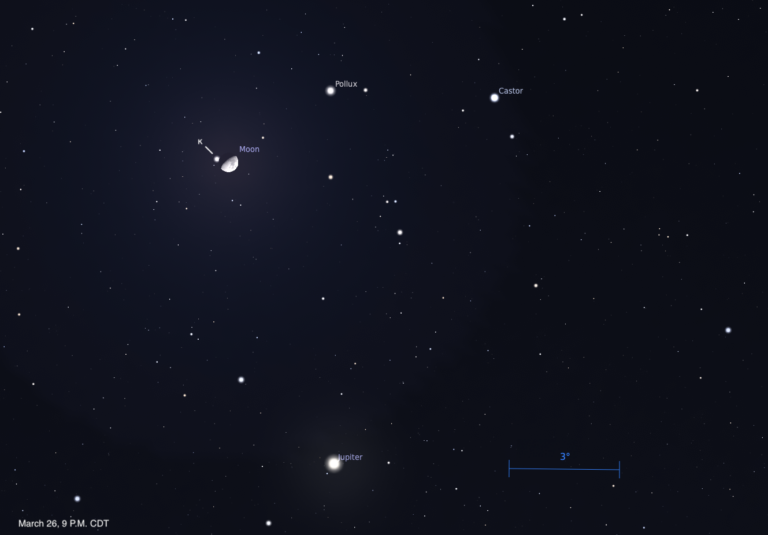
Jupiter’s motion across Gemini is westerly at first, then halts March 10 and resumes toward the east. The planet forms a triangle with 4th-magnitude Wasat and Mekbuda (Delta [δ] and Zeta [ζ] Geminorum, respectively). A waxing Moon joins Jupiter in Gemini March 25th and 26th, drawing attention.
Jupiter displays a 43″-wide disk March 1, which shrinks to 39″ by the end of the month, owing to the planet’s slowly increasing distance from Earth. Through a telescope, Jupiter offers a lot to look at. Two dark belts straddle the equator, and more subtle banding is evident if you wait patiently for calm moments of seeing — the key to success with viewing detail on any planet. Look also for the Great Red Spot, a dark oval storm on the edge of the South Equatorial Belt. It’s not always visible, but with Jupiter’s speedy rotation rate of less than 10 hours, it often wanders into view. You can follow it and other features across the disk in just a short period of time.
Io, Europa, Ganymede, and Callisto orbit Jupiter every two to 17 days, and occasionally pass in front of the planet in a transit or become hidden behind it in an occultation.
March opens with Jupiter’s largest moon, Ganymede, transiting the disk March 4/5. The event begins at 12:33 a.m. EST (the 5th in Eastern time only, late on the 4th for all other U.S. time zones). It takes a few minutes for the moon to appear fully in front of the disk. Ganymede takes over three hours to transit, leaving at 2:48 a.m. CST, about the time Jupiter sets in the Midwest.
Io orbits in a little less than two days. A transit overnight on March 6/7 begins at midnight EST on the 6th. As Io approaches the middle of the disk an hour later, watch the eastern limb for Io’s shadow, which appears at 1:05 a.m. EST (now the 7th for the eastern half of the U.S.). The evening of the 7th then finds Io approaching the western limb of Jupiter — it disappears behind the giant disk about 9:20 p.m. EST. You might think you can watch it reappear two hours later, but Jupiter’s extended shadow hides the moon as Io is eclipsed. Io finally emerges from the shadow at 12:43 a.m. EST (now the 8th in the Eastern time zone), about 20″ east of Jupiter’s limb.
This sequence repeats March 13/14. A transit of Io begins at 2:52 a.m. EDT on the 14th (note the change to DST), followed by its shadow at 2:00 a.m. MDT. The latter isn’t visible from the Eastern time zone, and Jupiter is very low for Midwest observers. The night of March 14/15, Io is occulted by Jupiter around 12:10 a.m. EDT on the 15th (in the Eastern time zone only).
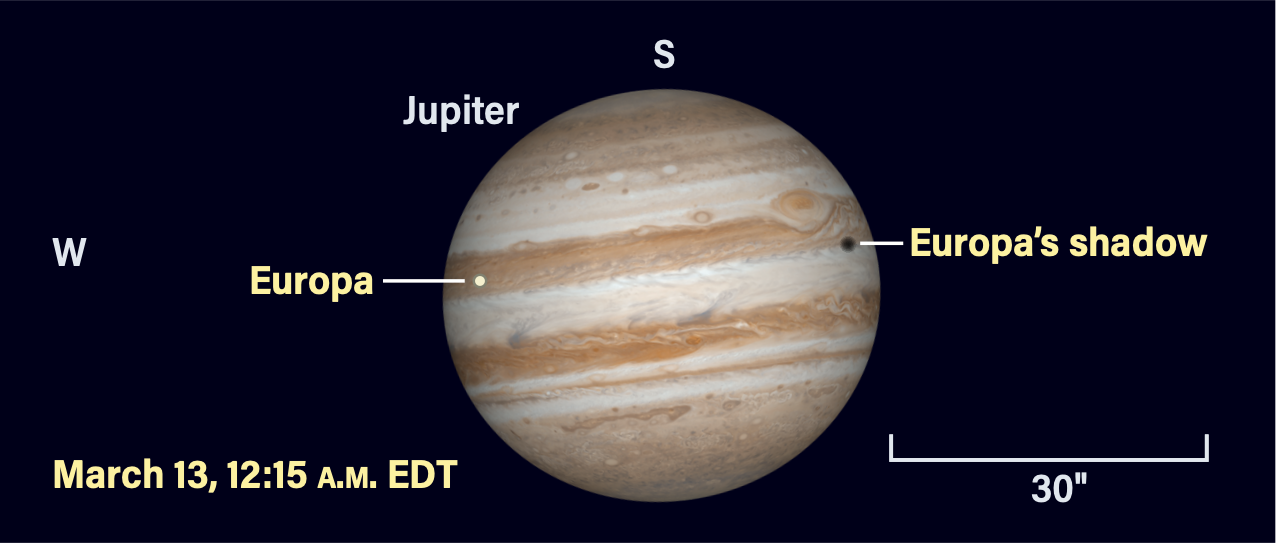
Europa transits Jupiter March 12/13, 19/20, and 26/27. On the 12th, the transit begins about 9:40 p.m. EDT and is underway as darkness falls across the Mountain time zone. Since Europa has a larger orbit than Io, it takes longer for its shadow to appear when compared to Io’s — Europa’s shadow moves onto the disk at midnight EDT. The next transit begins at 12:12 a.m. EDT on the 20th (in Eastern time only), with the next transit starting on the 27th at 2:44 a.m. EDT (still the 26th for the West Coast). In both later events, the shadow transit occurs just under 2.5 hours later, which you can observe if Jupiter is still visible.
Callisto is occulted by Jupiter March 9 about 3:30 a.m. MDT (only visible from the Mountain and Pacific time zones). Callisto’s shadow transits March 18, with Callisto more than 1′ west of the planet. Watch for the extended shadow to begin appearing around 2:05 a.m. CDT, with Jupiter very low for locations along the East Coast. Within five minutes, the shadow becomes an evident dark bite out of Jupiter’s southeastern limb. It takes about two hours to reach the center of the planet’s disk.
Finally, watch Callisto reappear from occultation at Jupiter’s northeastern limb around 1:30 a.m. CDT on March 26, with Jupiter quite low for observers in the Eastern time zone. Callisto is far enough from Jupiter that it is not eclipsed by the planet’s shadow.
Mercury reappears in the morning sky after its conjunction with the Sun March 7. On March 22, Mercury rises about an hour before the Sun and reaches magnitude 0.9. Look for it low in the eastern sky as dawn breaks. It stands nearly 5° high at 6:30 a.m. local daylight time. By March 31, it reaches magnitude 0.4 but is dipping south of the ecliptic, so its elevation doesn’t increase much and it is still about 5° high 30 minutes before sunrise.
Mars remains close to the Sun and isn’t visible this month.
The vernal equinox, when the Sun is on the celestial equator and moving north, occurs March 20 at 10:46 a.m. EST.
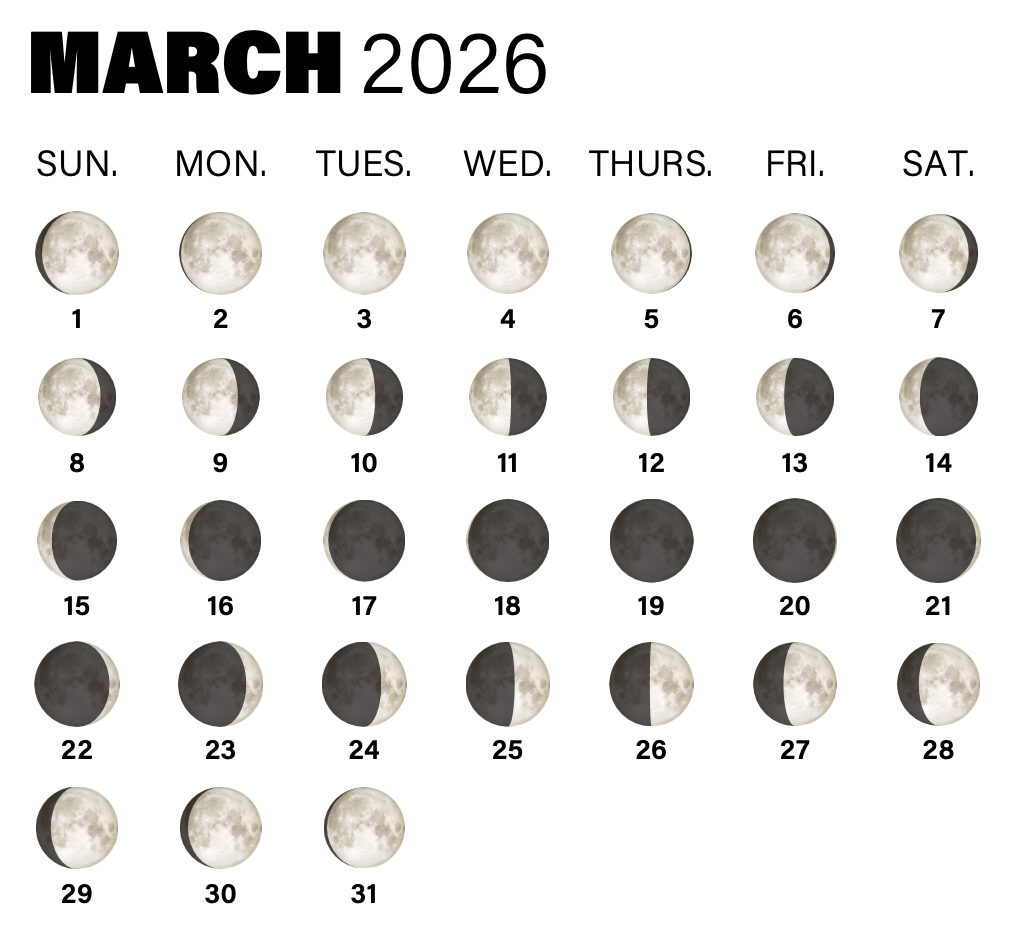
Rising Moon: Fabulous Fracastorius
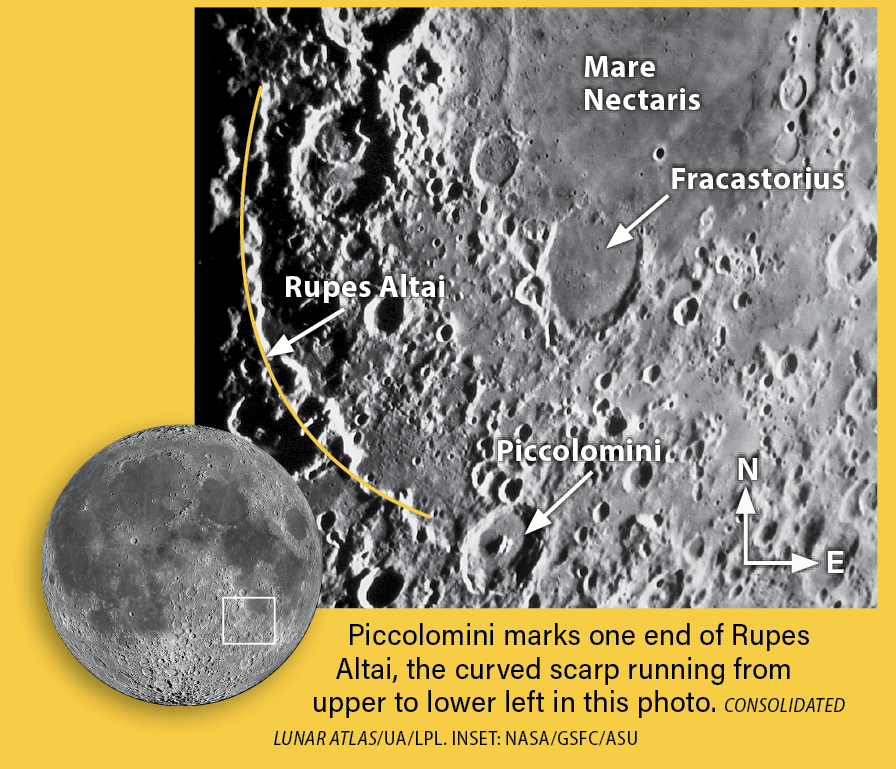
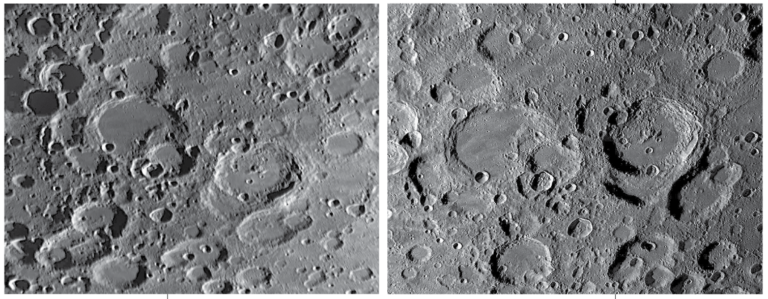
There’s much more to lunar history than newer craters erasing older features. The massive impact that carved out Mare Nectaris affected the face of cratering history for millions of years to come. Lying just south of the equator, the Sea of Nectars is fully illuminated on the 23rd. Immediately catching the eye on its west side is a trio of fantastic craters and a bright white arc of a quarter circle, the Altai Scarp (also called Rupes Altai). Perfectly centered on Nectaris, the arc is one of the remains of the fourth rim of a multi-ring basin. Can you detect the others?
The younger crater Piccolomini dangles on the end of the Altai Scarp like an earring. Spanning some 55 miles, it is large enough that it sports a complex of central peaks instead of the single one seen in the many smaller pockmarks that pepper the surroundings. Check out its walls: Like a hole dug in wet sand at the beach, a lot of material slumps into the cavity. But the south side has much more, thanks to the unstable terrain first generated by the formation of the scarp.
Intermediate in age is the broken circle of Fracastorius. Lava, like water, runs toward level ground, making it obvious that Fracastorius is tilted down to the northeast. Lunar geologists have deduced that before this last flood, a smaller but earlier surge of lava rose up through cracks in Nectaris’ floor, then solidified and sunk the central part, causing the surrounding terrain to tilt down toward the middle. Fracastorius was not given that name because it is fractured, but to honor 16th-century Italian astronomer Girolamo Fracastoro.
If you miss this occasion, similar illumination returns to the region April 21st. That’s when you can watch the peaks of the Altai Scarp and Piccolomini pop into view one by one as the evening progresses. With the Sun slowly rising over the lunar terrain, high points to the west and lower points to the east light up with each passing half-hour.
Meteor Watch: Chase fainter lights
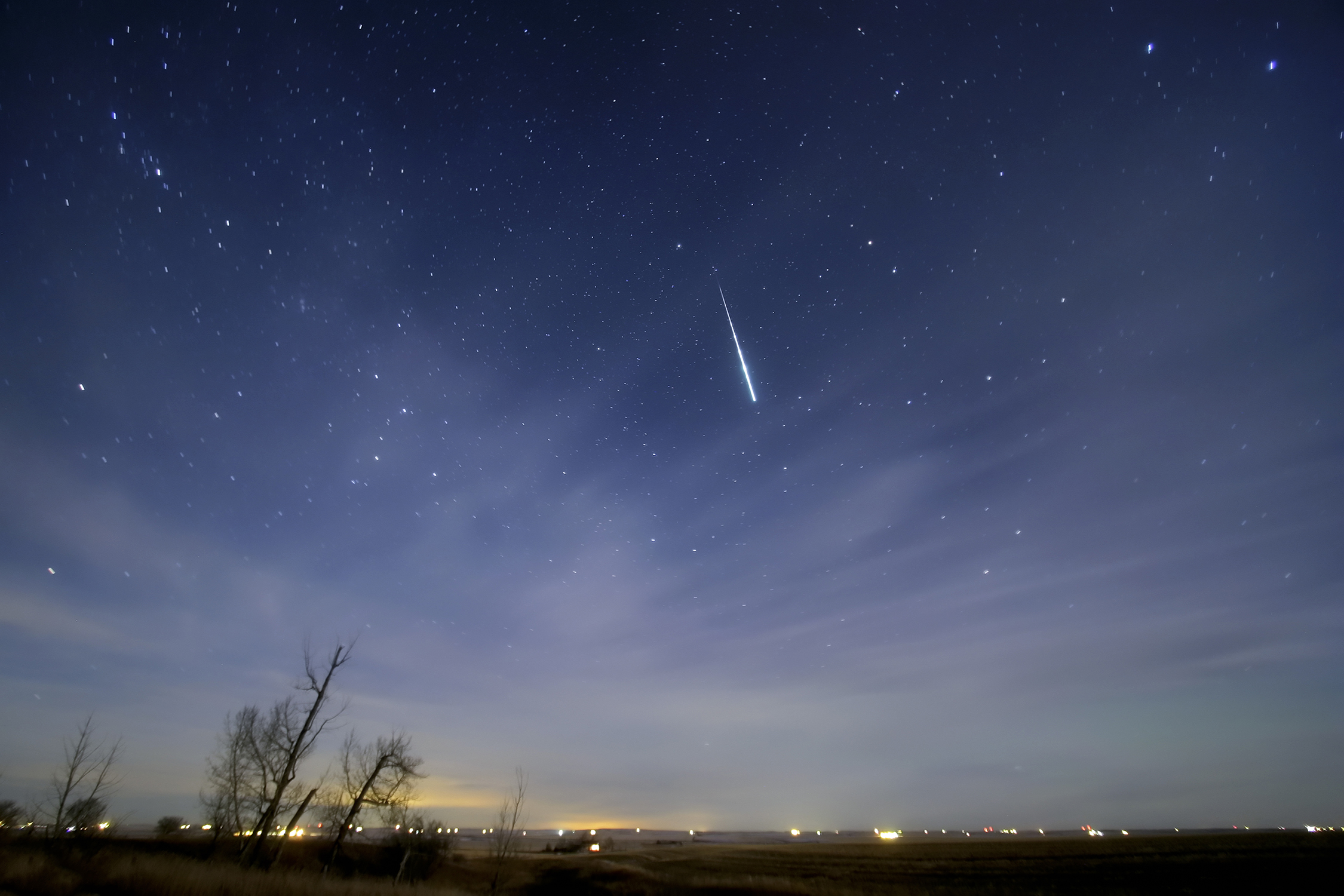
For the second month in a row, no major meteor showers occur. The background or sporadic rate generates about half a dozen meteors an hour on a moonless night with dark skies. Mid-March, around the time of New Moon, is a good time to look for them.
It’s also the second month in a row for attempting to view the zodiacal light in the evening sky. The zodiacal light is aligned with the ecliptic, Earth’s orbital plane, and passes through the constellations Pisces, Aries, and Taurus. Any time after March 8, when the waning Moon rises after 11 p.m. local daylight time, is a good time to try.
The zodiacal light comes from sunlight reflecting off the fine dusty debris littering the plane of the ecliptic, left by ancient comets. Once the low arcing glow of twilight has gone, look for a delicate cone-shaped glow extending high above the western horizon. You’ll need a very dark moonless sky with no interfering streetlights to your west. Try using peripheral vision to spot the cone of light by scanning left to right along the horizon. It’s remarkable when you see it.
Comet Search: Non-stellar marathon
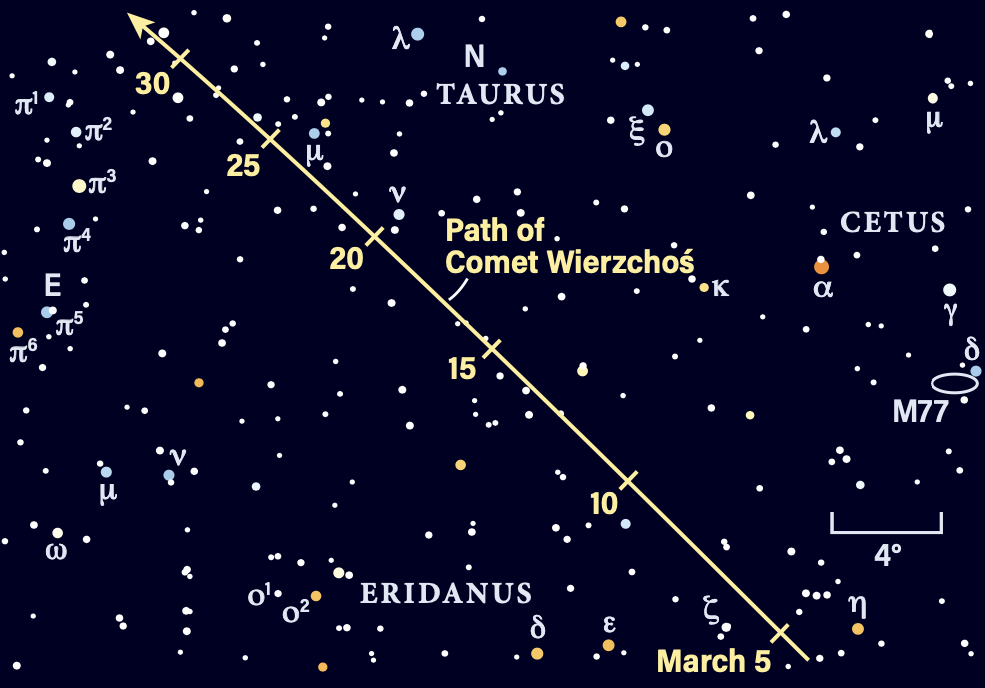
Springing upward from the southwestern horizon, C/2024 E1 (Wierzchoś) offers a long farewell after a nice showing in the Southern Hemisphere. Under a dark sky, the 8th-magnitude puffball is visible in binoculars as it leaves the shores of Eridanus for Taurus. The moonless window opens on the 5th.
Many observers will be at the eyepiece all night midmonth for the annual Messier marathon. Compare this classic comet to the Crab Nebula (M1), the bright Seyfert spiral M77, and the round globular M79. Wierzchoś’ asymmetric shape should stand out: a sharply-defined northern flank and a soft, fading southern one. During the two weeks of darkness, watch it fade to 10th magnitude as it retreats to the distant Oort Cloud.
By 1 a.m. you’ve conquered the Virgo Cluster and are primed to pick up 10th-magnitude Comet 24P/Schaumasse in Serpens. Start with 10th-magnitude globular NGC 5634 — the two might be fraternal twins. Then bump up the power to hone in on Schaumasse and the background galaxy NGC 5921. Which is brighter?
Locating Asteroids: Early blossom
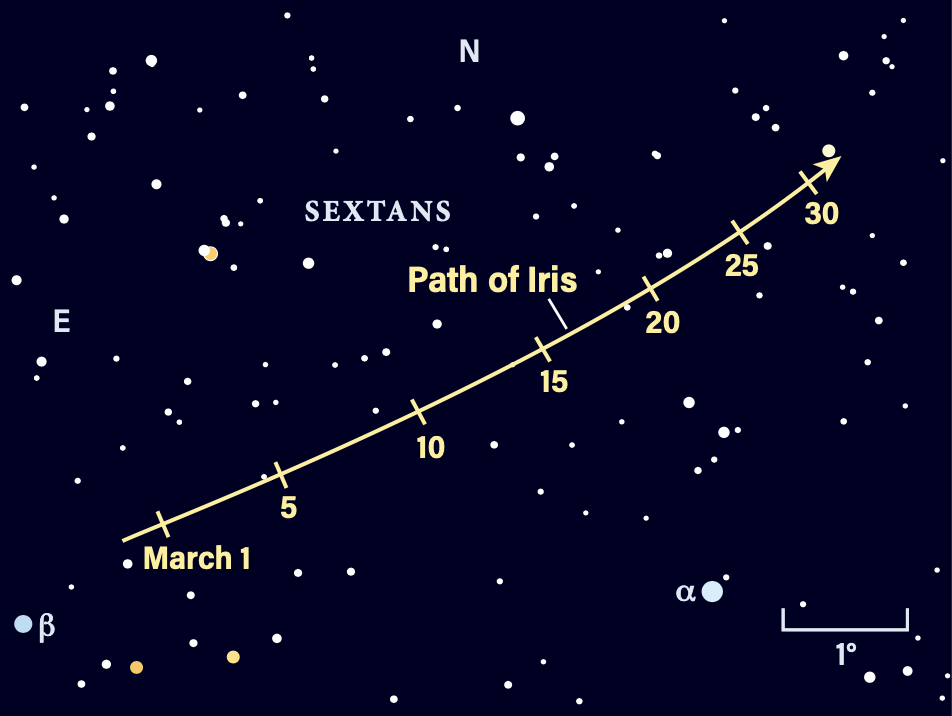
Instead of rushing to sight the retreating main-belt ruler 1 Ceres, turn east for the brighter flower of the night: 7 Iris. With blue-white luminary Regulus lighting the way, drop south a few degrees to Alpha (α) and Beta (β) Sextantis. Celestial savannah or sea, this area of the sky is far from the Milky Way, clearing the way for the 9th-magnitude asteroid to outshine most background stars.
A 3- to 4-inch scope from the suburbs can handle this dot; if you have an 8-inch SCT with a go-to mount, it will reveal Iris in 200 seconds or less. That said, waiting to see motion can be the fun part of asteroid observing. In the first week of March, Iris traces the north side of a zigzag of 9th-magnitude dots that serve to anchor a sketch of its nightly displacement. On the 14th and 19th, Iris is the slightly brighter of a wide cat’s-eyes pair, doubling the separation over a three-hour session. An unequal doublet guideposts the drift for March 20–22. On the 21st, you ought to see the change in angles in under three hours.
Fourth brightest of the main-belt asteroids, Iris was picked up by John Russell Hind in 1847, at the beginning of the second wave of minor planet discoveries that ended a nearly 40-year drought since the first four.
Star Dome
The map below portrays the sky as seen near 35° north latitude. Located inside the border are the cardinal directions and their intermediate points. To find stars, hold the map overhead and orient it so one of the labels matches the direction you’re facing. The stars above the map’s horizon now match what’s in the sky.
The all-sky map shows how the sky looks at:
10 p.m. March 1
10 p.m. March 15
9 p.m. March 31
Planets are shown at midmonth