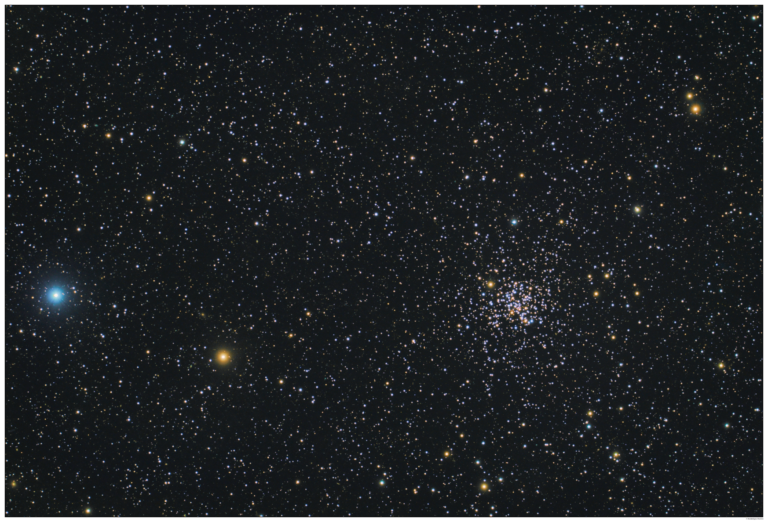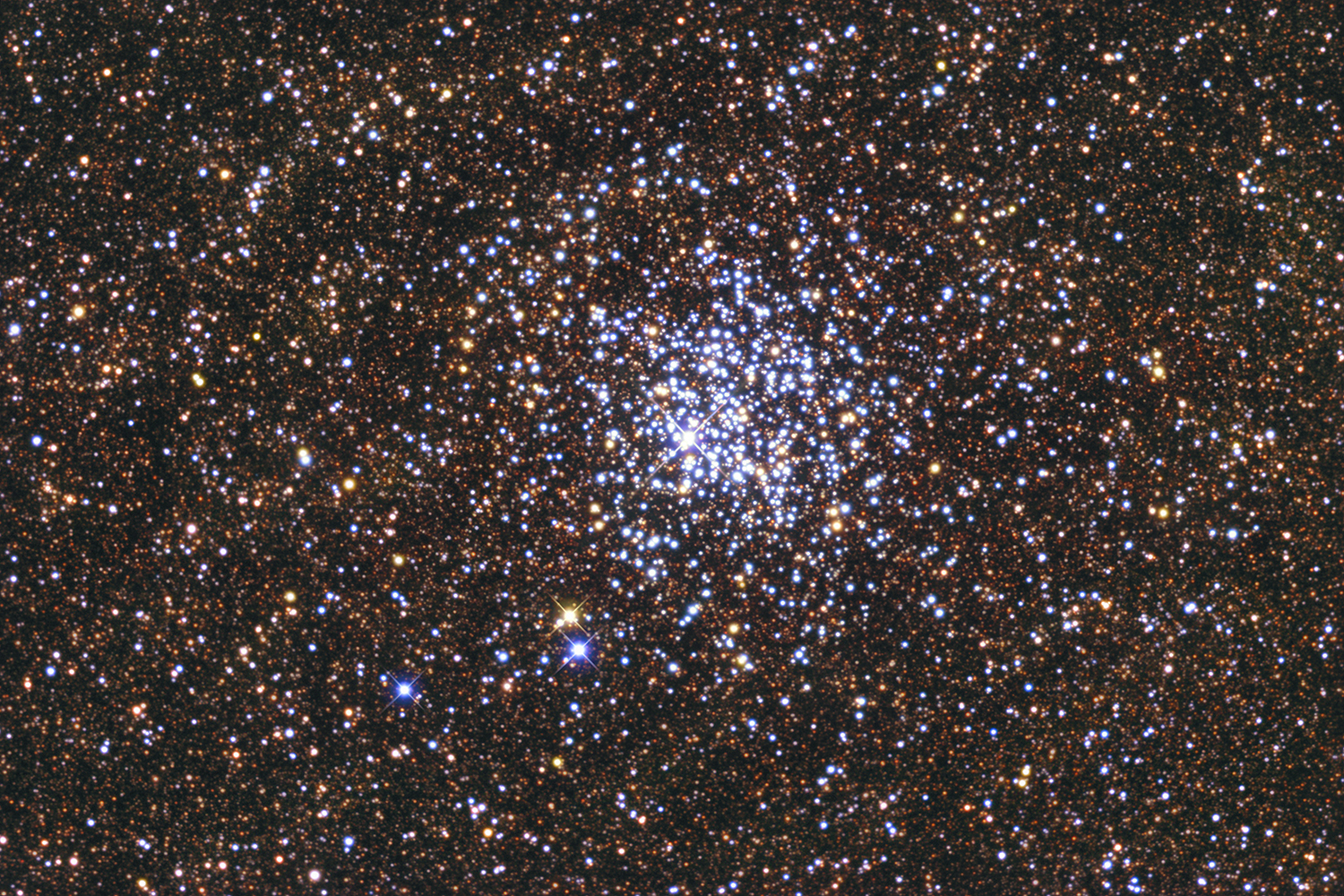
The Northern Hemisphere’s summer is — by far — the best time to view our galaxy’s rich star fields. And it’s during summer that the spectacular Wild Duck Cluster flies through the Milky Way.
German astronomer Gottfried Kirch discovered the Wild Duck Cluster in 1681. Messier made it his 11th catalog entry May 30, 1764, so observers usually call it M11.
The common name originated in A Cycle of Celestial Objects, a wonderful two-volume observer’s guide written by Admiral William H. Smyth in 1844. Of M11, Smyth wrote, ‘‘A splendid cluster of stars on the dexter chief [upper-right corner] of Sobieski’s shield. This object, which somewhat resembles a flight of wild ducks in shape, is a gathering of minute stars with a prominent 8 mag. star in the middle and two following: these are decidedly between us and the cluster.’’
Smyth’s reference to “Sobieski” indicates that M11 lies in the constellation Scutum the Shield. Astronomers have estimated the mass of the cluster at between 4,000 and 11,000 solar masses. If the upper limit is correct, it would make it one of the most massive open clusters known. It lies some 6,100 light-years away and glows at magnitude 5.8. It appears to be 13′ in diameter, which corresponds (at the cluster’s distance) to a true diameter of 95 light-years.
From a dark site, sharp-eyed observers will spot M11 with their unaided eyes as a subtle brightening of the Milky Way by following a curved line of stars of decreasing brightness. Start with magnitude 3.4 Lambda Aquilae; move to 4th-magnitude 12 Aql; finally, proceed to magnitude 4.8 Eta Scuti, which will lead you to M11.
An ideal telescope size and magnification for this object are an 8-inch scope and an eyepiece that will magnify around 75 times. More aperture and higher powers will help you resolve additional stars, but through this combo you’ll see more than a hundred stars. M11’s core, which resembles a poor globular cluster, is tightly packed, and streamers of stars and dark lanes emanate from the central region in all directions.
Now’s the time to target this celestial showpiece. Trust me, you won’t be disappointed.