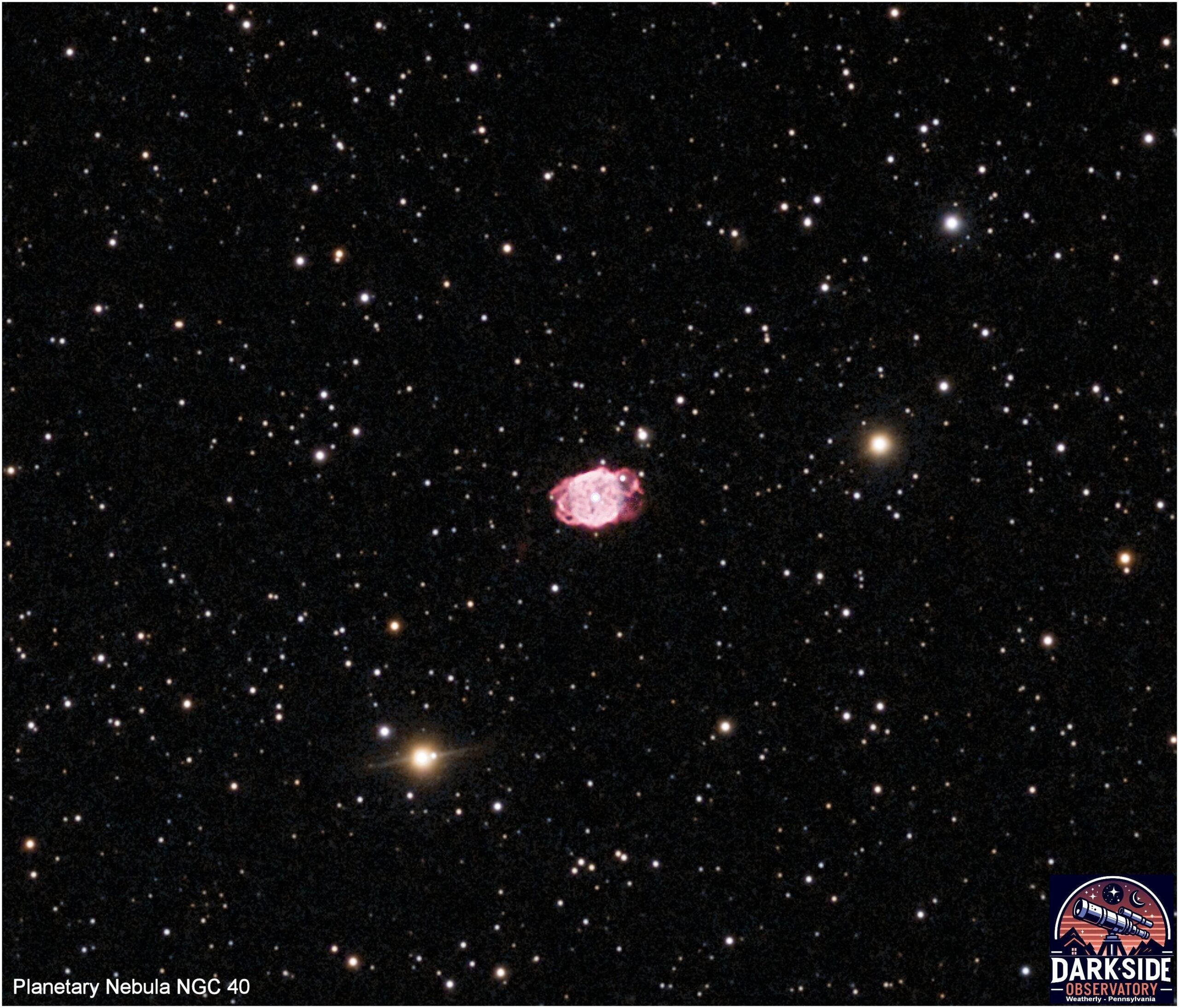
Credit: Thedarksideobservatory/WikiMedia Commons
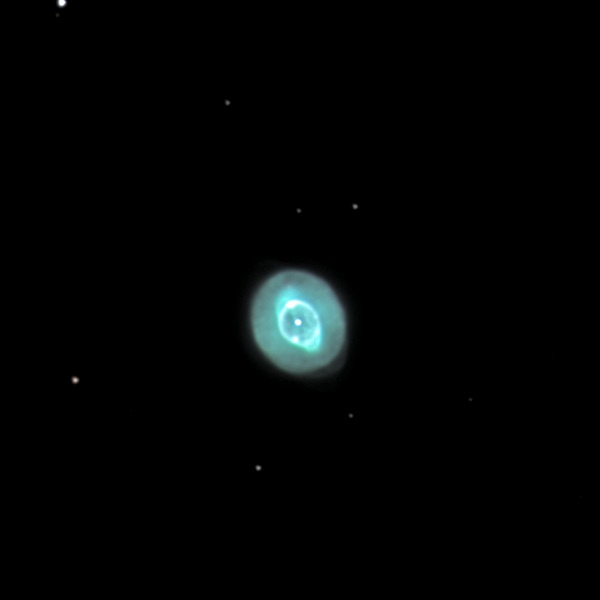
This celestial wonder sits unassumingly near the head of the northern constellation Cepheus the King within 20° of the North Celestial Pole. Despite its low overall magnitude, the Bow-tie Nebula (also cataloged as NGC 40 and Caldwell 2)makes a fine target through all telescopes because its surface brightness is high. The Bow-Tie sits 5½° south-southeast of the star marking the head of Cepheus the King, magnitude 3.2 Gamma Cephei.
As is the case with many of our celestial wonders, NGC 40 is a discovery of Sir William Herschel. He found it November 25, 1787. An object’s magnitude tells observers how bright the object appears. For objects that are not point sources, likeplanetary nebula NGC 40, integrated magnitude compares all the light from the object to the light of a single star. For the Bow-tie, then, magnitude 11 means its total light output equals that of a magnitude 11 star.
If you combine magnitude with surface brightness, you get a better description of how easily you’ll see an astronomical object. Surface brightness is given in units of magnitude per square arcsecond. A dear friend, the late Alaskan amateur astronomer Jeff Medkeff, developed a simple rule of thumb to help him determine how difficult a nebula or galaxy will be to see. He multiplied the magnitude by the surface brightness. This gave him a number (no units, just a number). The higher that number, the tougher the object will be to observe.
A 4-inch telescope at a dark site will reveal an oval disk about one-third longer than it is wide. The magnitude 11.6 central star appears bright compared to the nebula. Through an 11-inch scope, NGC 40’s disk shows several bright knots toward the southeast and northwest. Increase the magnification to 200x (if the seeing permits), and look for a dark cavity between the shell and the central star.
I rate this planetary as one of the most surprising in the sky. It never fails to delight when I show it to other observers. So, head out sometime soon and take a look at the Bow-tie Nebula. Good luck!