The sky is full of strange galaxies. A century ago Edwin Hubble discovered this, and a slew of researchers in the past century have cataloged these strange and troubled objects, perhaps most importantly Halton Arp with his Atlas of Peculiar Galaxies.
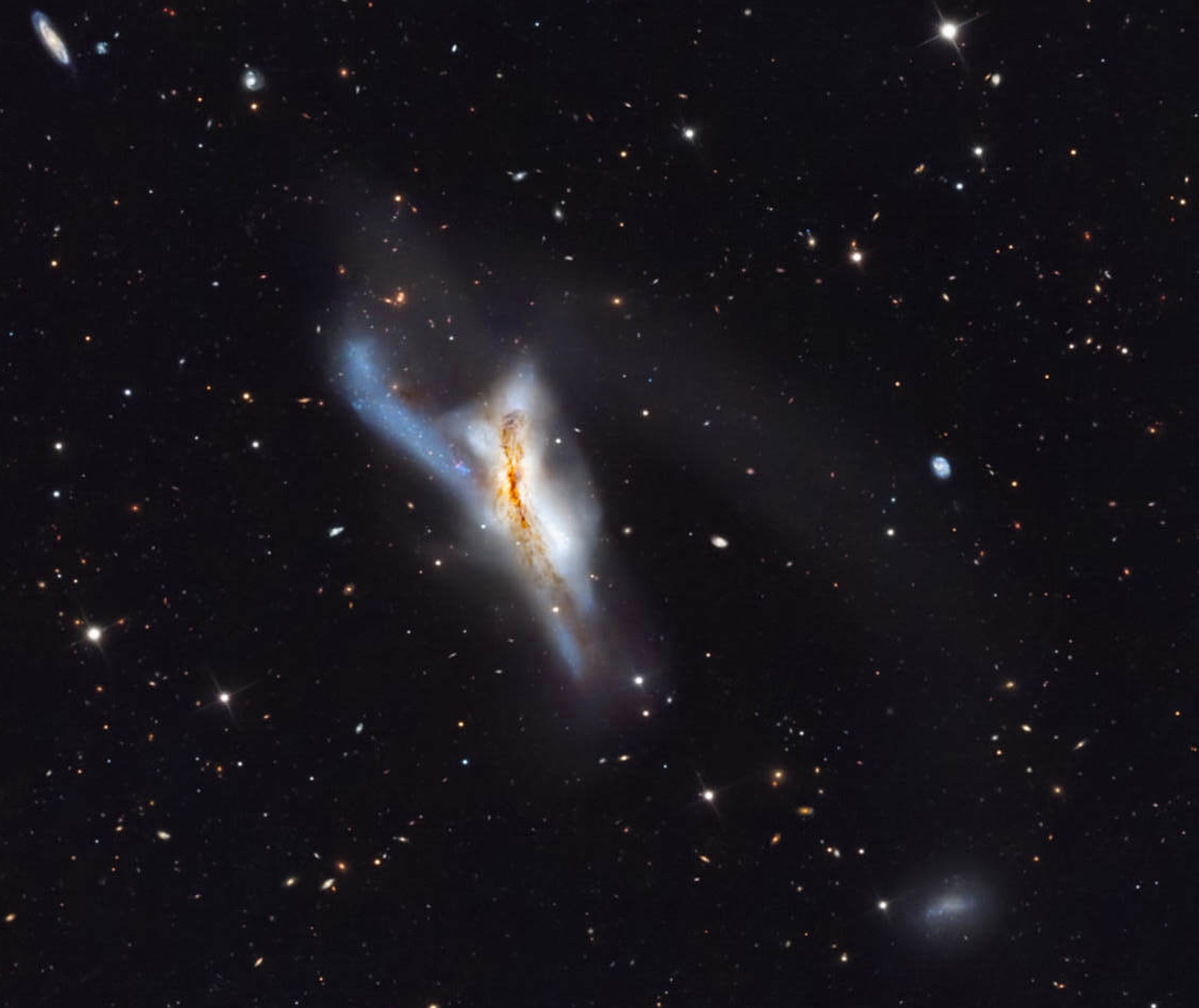
There’s a bright and highly distorted galaxy in the constellation Pisces, lying some 100 million light-years away. It is NGC 520, and was discovered by William Herschel in 1784. What Herschel didn’t know is that ultimately this object would be classified as a peculiar galaxy. In the 1960s astronomers really caught on to how strange this object is, and Arp dubbed it “the second brightest highly disturbed galaxy in the sky.”
NGC 520 glows at magnitude 12.2 and measures 4.5’ across. It is a bit of a challenge for visual observers with backyard scopes, but it is very bright in infrared and radio wavelengths.
Simulations suggest a significant merger led to this galaxy’s distorted form, and commenced about 300 million years ago. The merger, in fact, is still in its early stages.
Most of this galaxy’s mass appears to our vantage point essentially edge-on, and so the galaxy shows dust clouds along its edges that show up well in high-resolution images.