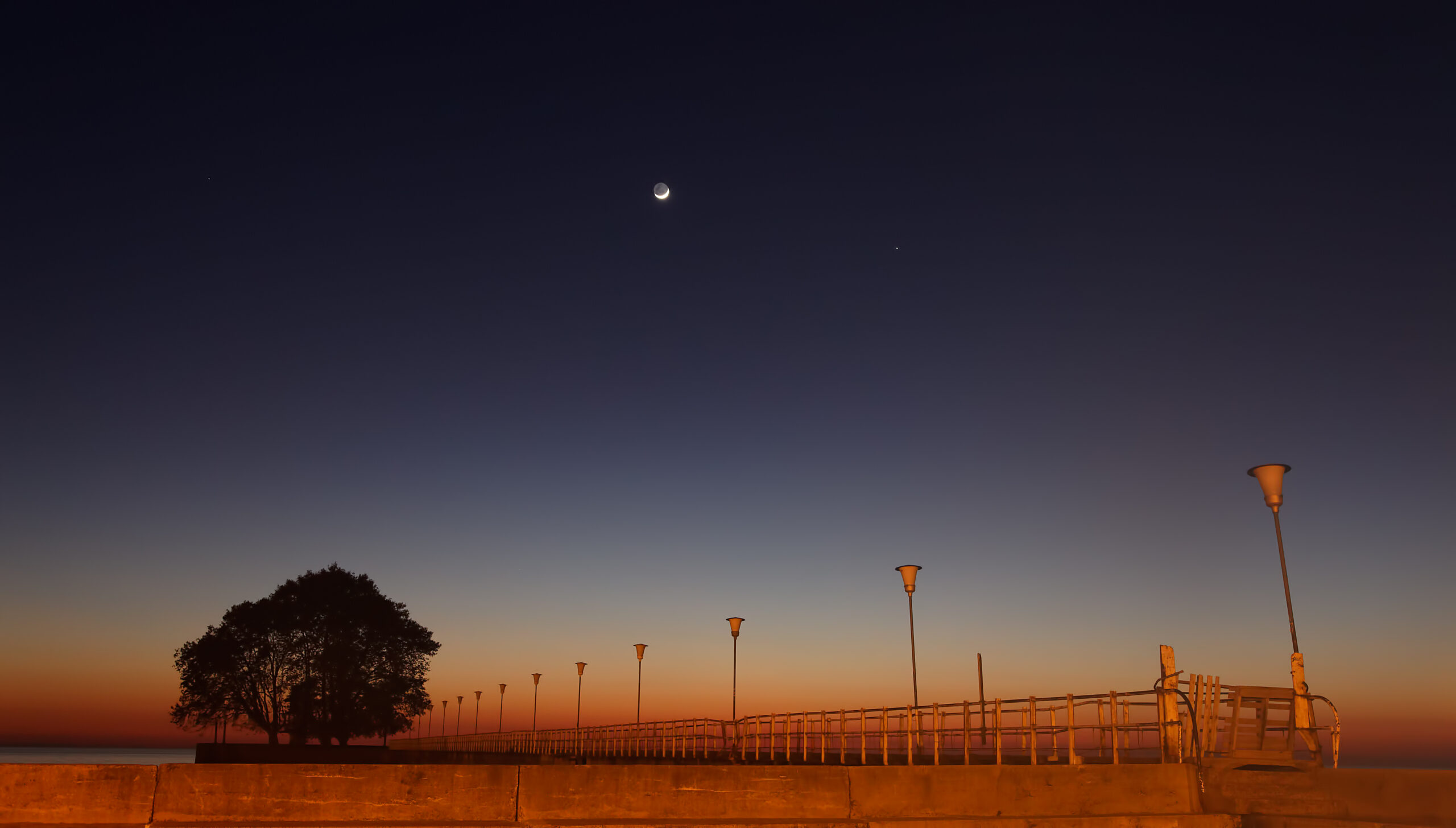
April evenings provide views of the two brightest planets, though only one stands out. Jupiter gleams at magnitude –2.1 and dominates the northern sky as twilight fades to darkness. It lies in Gemini the Twins, to the left and a bit above that constellation’s brightest star, magnitude 1.2 Pollux.
The giant planet sits well north of the celestial equator, so it hangs fairly low in our Southern Hemisphere sky. Still, it’s worth viewing through a telescope. Jupiter spans 37″ at midmonth and should show a wealth of atmospheric detail during moments of good seeing. And the gas giant’s four bright moons always put on a good show.
Although Venus shines at magnitude –3.9, some five times brighter than Jupiter, it’s not as prominent because it sets during twilight. Look for it low in the northwest about 45 minutes after sunset, particularly late in the month when it’s a little farther from the horizon. The inner planet doesn’t climb high because the ecliptic — the apparent path of the Sun across the sky that the planets follow closely — makes a shallow angle to the western horizon on April evenings.
Venus lies far from Earth and thus looks small through a telescope. On April 30, its disk measures 12″ across and appears nearly 90 percent lit.
While the predawn sky lacks the bright planets of evening, it makes up for it with several close encounters. Mercury, Mars, and Saturn gather during April’s second half, especially on the 19th and 20th.
The star of this trio has to be Mercury, which puts on its best morning show of the year. The inner planet reaches greatest elongation April 3, when it lies 28° west of the Sun and stands 15° high an hour before sunrise. Take a few moments to view magnitude 0.3 Mercury with your telescope. On the 3rd, the planet’s disk spans 8″ and appears half-lit.
Mars starts the month about 10° below Mercury. The ruddy planet shouldn’t be hard to spot, although its magnitude 1.2 glow is less than half as bright as Mercury’s. The two planets reach conjunction April 20, when 1.8° separate them. A telescope reveals no detail on Mars’ 4″-diameter disk.
Saturn completes our planetary trio. The ringed world has just started to edge away from the Sun and climbs higher in the morning twilight with each passing day. On the 20th, magnitude 0.9 Saturn passes 0.5° north of Mercury and 1.3° south of Mars. Unfortunately, the ringed planet lies too low to show much detail through a telescope.
A waxing gibbous Moon occults the 1st-magnitude star Regulus in Leo on April 26. The best viewing locations in the Southern Hemisphere are in eastern South America. From Vitoria, Brazil, the star disappears behind the Moon’s dark limb at 0h46m UT and reappears at the bright limb at 3h35m UT.
The starry sky
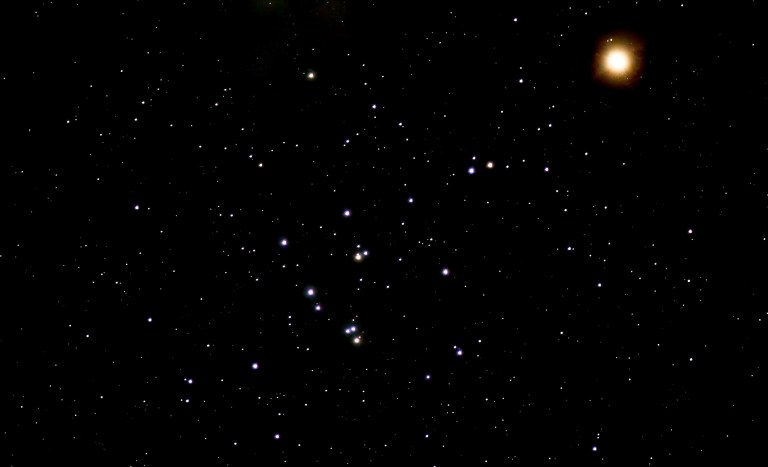
Without a doubt, one of the sky’s most striking asterisms is the three stars that form Orion’s Belt. Because Orion straddles the celestial equator, and the belt represents the Hunter’s midsection, many people think the trio marks the celestial equator. Although the three stars come close, all of them lie in the southern celestial hemisphere. The belt is well-placed in the western evening sky throughout April.
Of the three belt stars — Mintaka (Delta [δ] Orionis), Alnilam (Epsilon [ε] Ori), and Alnitak (Zeta [ζ] Ori) — Mintaka lies closest to the celestial equator, standing just 18′ south of the line that separates the two hemispheres. Alnilam and Alnitak reside at declinations of –1°12′ and –1°57′, respectively. (All positions are in epoch 2000.0 celestial coordinates.) Mintaka glows at magnitude 2.2 while the other two appear slightly brighter, shining at magnitude 1.7.
I have enjoyed viewing these stars since childhood. In my early days of stargazing, I naively thought they were bright because they were relatively close to us. Of course, a star’s apparent magnitude — the brightness we see from Earth — depends on both its intrinsic brightness and its distance.
It turns out that all three belt stars lie roughly 1,250 light-years from Earth, though keep in mind that distance determinations become less accurate the farther away a star resides. Even the European Space Agency’s Gaia spacecraft, the best instrument we have for measuring stellar distances, has difficulty when it comes to bright objects.
For the belt stars to shine so brightly despite their vast distances, they must be intrinsically luminous. One way to compare stars with different distances and luminosities is to look at their absolute magnitudes — how bright they would appear at a standard distance of 10 parsecs (32.6 light-years).
Bearing in mind slight uncertainties, all three belt stars would appear bright enough to see in daylight if they were just 10 parsecs away. Mintaka would shine around magnitude –4.4 while Alnitak would come in at magnitude –6.0 and Alnilam would beat them both at magnitude –6.4.
Of the three belt stars, Alnilam is the only one without a companion. Mintaka is a multiple system with five components, although only one, a 7th-magnitude object nearly 1′ away, is easy to see through a small telescope. Alnitak is a triple system. Its two bright components form a lovely but somewhat challenging double for small scopes. The stars shine at magnitudes 1.9 and 4.0 with just 2.4″ separating them.
Star Dome
The map below portrays the sky as seen near 30° south latitude. Located inside the border are the cardinal directions and their intermediate points. To find stars, hold the map overhead and orient it so one of the labels matches the direction you’re facing. The stars above the map’s horizon now match what’s in the sky.
The all-sky map shows how the sky looks at:
9 p.m. April 1
8 p.m. April 15
7 p.m. April 30
Planets are shown at midmonth