
Key Takeaways:
- Stellar spectral types were initially arranged alphabetically; however, subsequent detailed observations led to the consolidation and reordering of categories, establishing the current OBAFGKM sequence.
- Early classification efforts include Angelo Secchi's 1866 survey, which categorized approximately 4,000 stars into four numbered groups based on the visual appearance of their spectra.
- The extensive classification project at Harvard College Observatory, supported by the Henry Draper memorial fund, began with Edward C. Pickering assigning letters based on the strength of stellar hydrogen lines, with 'A' denoting the strongest.
- Under Pickering's guidance, astronomers such as Williamina Fleming, Antonia Maury, and Annie Jump Cannon refined the classification by rearranging and combining spectral types to ensure smooth transitions, an ordering that, unknown to them at the time, accurately reflects stellar surface temperatures, with O-type stars being the hottest.
What is the origin of the letters used in star classification? Why didn’t astronomers use ABCD?
J. Haldiman
Chicago, Illinois
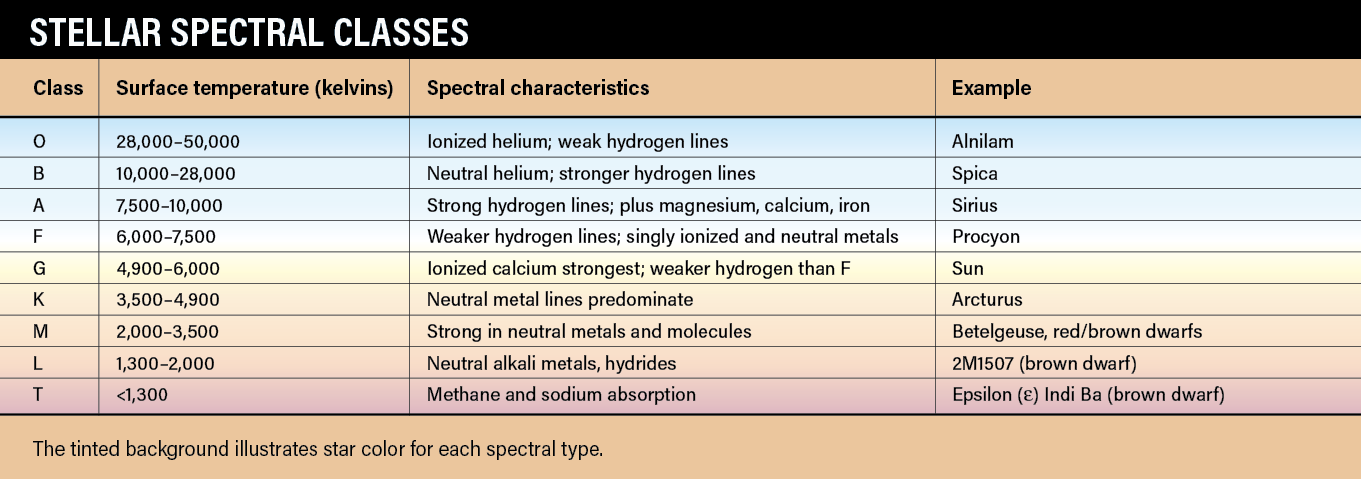
Stellar spectral types originally followed alphabetical order. But as astronomers observed more stars and obtained more detailed spectra, they consolidated some categories and reordered the remaining ones. This left seven basic stellar types, designated OBAFGKM, which generations of astronomers and science-fiction readers have learned through the mnemonic “Oh, Be A Fine Girl (or Guy), Kiss Me.”
In 1866, Angelo Secchi, a Jesuit astronomer working at the Vatican Observatory, surveyed some 4,000 stars and classified them by the visual appearance of their spectra. He divided stars into four broad, numbered categories based on common spectral features.
Henry Draper, an American physician, amateur astronomer, and pioneer in photography, recorded the first image of a stellar spectrum (Vega) in August 1872. After Draper’s death in 1882, his wife Anna established a memorial fund to support the development of photographic techniques in astronomy. This fund paid for the largest effort to classify stellar spectra attempted at the time — and the one that established the peculiar spectral alphabet we have today.
Between 1886 and 1897, Edward C. Pickering of Harvard College Observatory led a survey in which stellar spectra were photographed and classified by the thousands. Initially, Pickering assigned each spectral type a letter of the alphabet based on the strength of the star’s hydrogen, with A being the strongest. The result of this monumental effort, the Henry Draper Catalogue, was published between 1918 and 1924 and classified 225,300 stars; later extensions brought the total to 359,083.
Under Pickering’s supervision, his co-workers — particularly Williamina Fleming, Antonia Maury, and Annie Jump Cannon — gradually sorted out spectra, rearranging and combining some of the original categories. One motivation was to organize spectra so they created smooth transitions between different types. The final order actually reflects the surface temperatures of stars, with O stars being the hottest, but the Harvard astronomers didn’t realize it at the time.
Francis Reddy
Senior Science Writer, Astrophysics Science Division at NASA’s Goddard Space Flight Center, Greenbelt, Maryland
This question and answer originally appeared in the October 2005 issue.