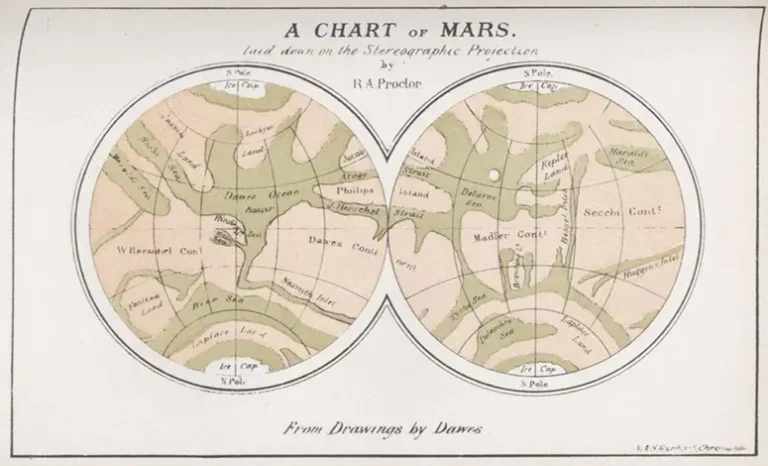
On Aug. 8 and Aug. 23, 1991, scientists from CalTech and the Jet Propulsion Laboratory turned the 70-meter dish antenna at the Goldstone Deep Space Communications Complex on Mercury. The goal was to produce a radar map of the portions of Mercury not photographed by Mariner 10 during its 1974-75 flybys. But to the researchers’ surprise, the radar image received by the Very Large Array revealed reflective material at the planet’s north pole, reminiscent of the polar caps on Mars and suggesting water ice. Although Mercury is the closest planet to the Sun and has an average temperature of 333 degrees Fahrenheit (167 degrees Celsius) with a maximum of 800 F (430 C), some craters rest in deep enough shadows for ice to survive – the axis on which Mercury spins is so tilted that in the polar regions, the Sun barely rises. Temperatures in those craters can be as low as -235 F (-148 C). In 2012, NASA’s MESSENGER spacecraft, which orbited Mercury, confirmed the presence of water ice.