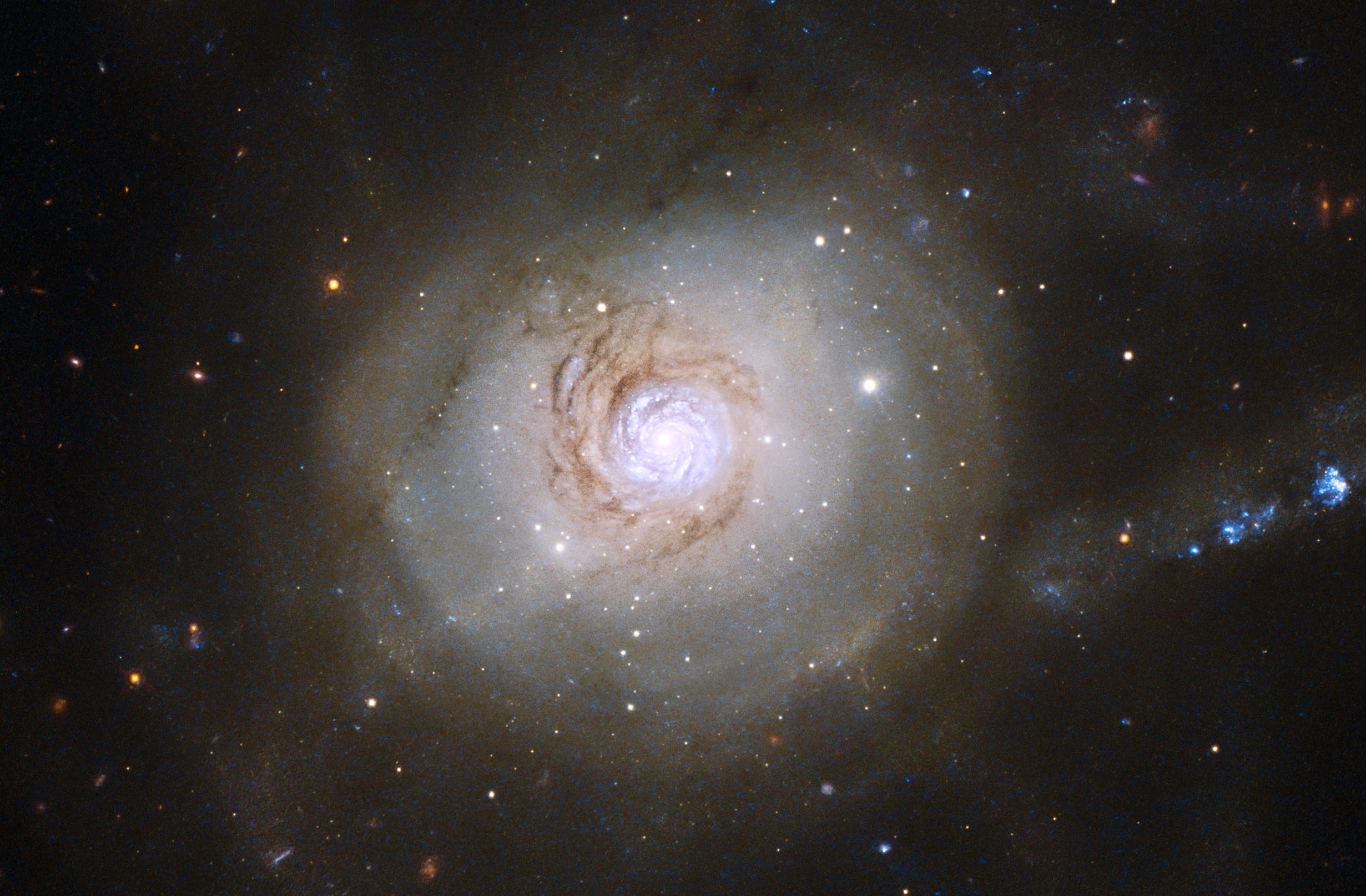
Imagine a face-on spiral galaxy lying at the center of a thick, spiraling ring of dust. Now place these at the center of a vast sphere of alternating concentric rings of gas and dust, across which slice several ghostly arms, rich in star formation, and pendulous matter at the ends. Put it all together and you have NGC 7252 in Aquarius, one of the most bizarre extragalactic sights in the universe.
The diminutive (2′ x 1.5′) galaxy lies about 200 million light-years distant. It shines at 12th magnitude, so moderate to large apertures will see it best. Still, you’ll have to use your imagination to “see” the wonder of it all — namely the dramatic aftermath of two spiral galaxies in an advanced stage of merging.
The main body of the galaxy (the blue spiral in the center) is a single-nucleus merger remnant. The merger caused significant star formation in both the nuclear remnant and the galaxy’s outskirts some 600 million to 700 million years ago. The observed formations have led astronomers to believe that this galaxy merger is in the initial stages of evolving into an elliptical galaxy — perhaps a blue, star-forming elliptical galaxy, which astronomers have found at much greater distances.
NGC 7252’s nickname seems a bit out of place. It honors the name of a speech President Eisenhower gave in 1953, in which he promoted nuclear power for peaceful purposes. That speech, combined with the fact that NGC 7252’s appearance recalls the orbits of electrons around the nucleus of an atom, led to the galaxy’s moniker — though the reality of mergers is anything but peaceful.