Looking for a sky event this week? Check out our full Sky This Week column.
March 22: Asteroid Iris passes a double star
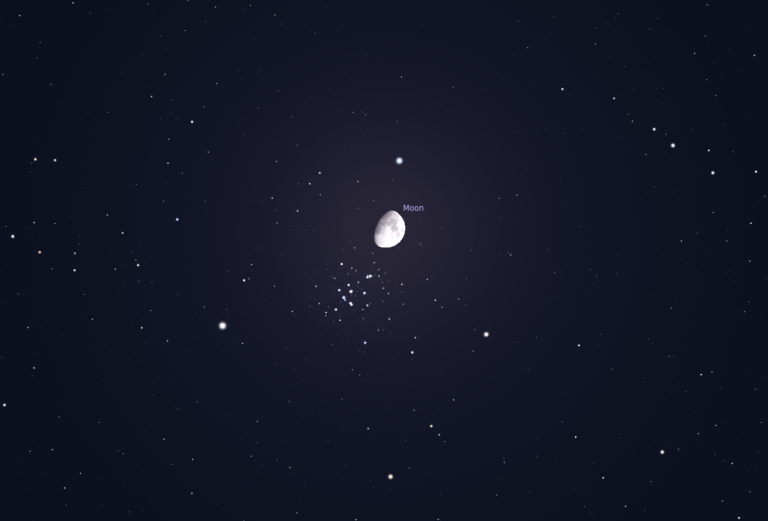
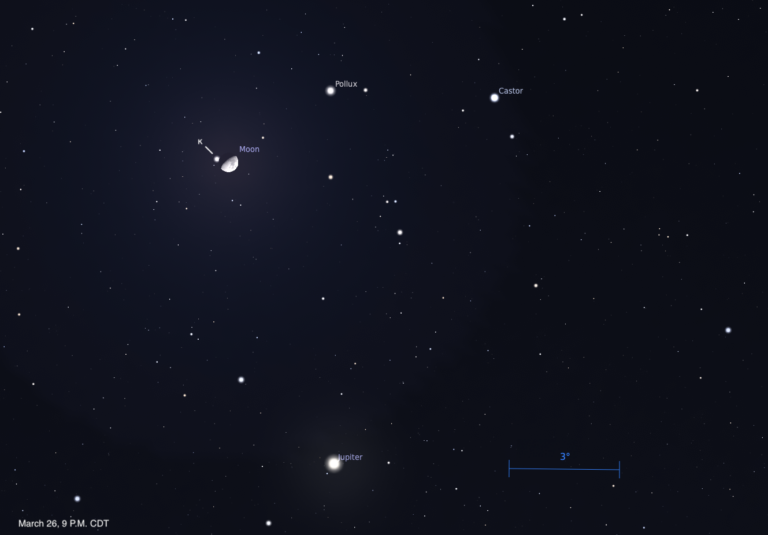
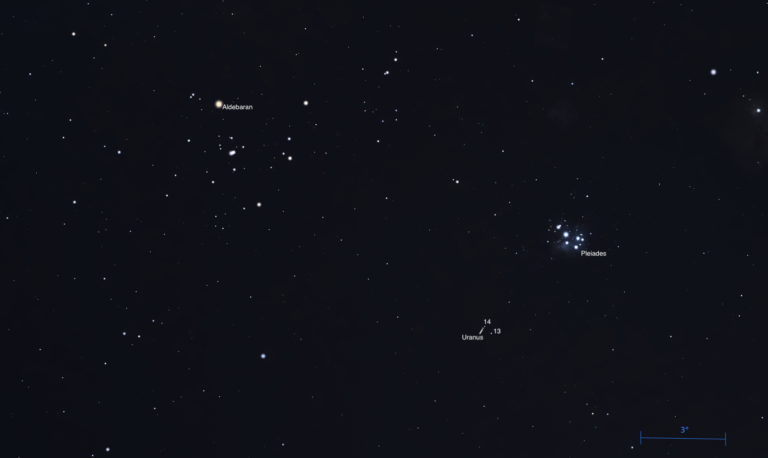
The waxing Moon passes 5° north of Uranus in Taurus at 4 A.M. EDT. By evening, our satellite is still within the bounds of the Bull, now nearly 13° from the distant ice giant. The Moon also sits above the bright Pleiades cluster as the region slowly sinks in the west; many observers likely visited here just a few days ago to catch the group of young suns as object no. 45 on Messier’s famous list.
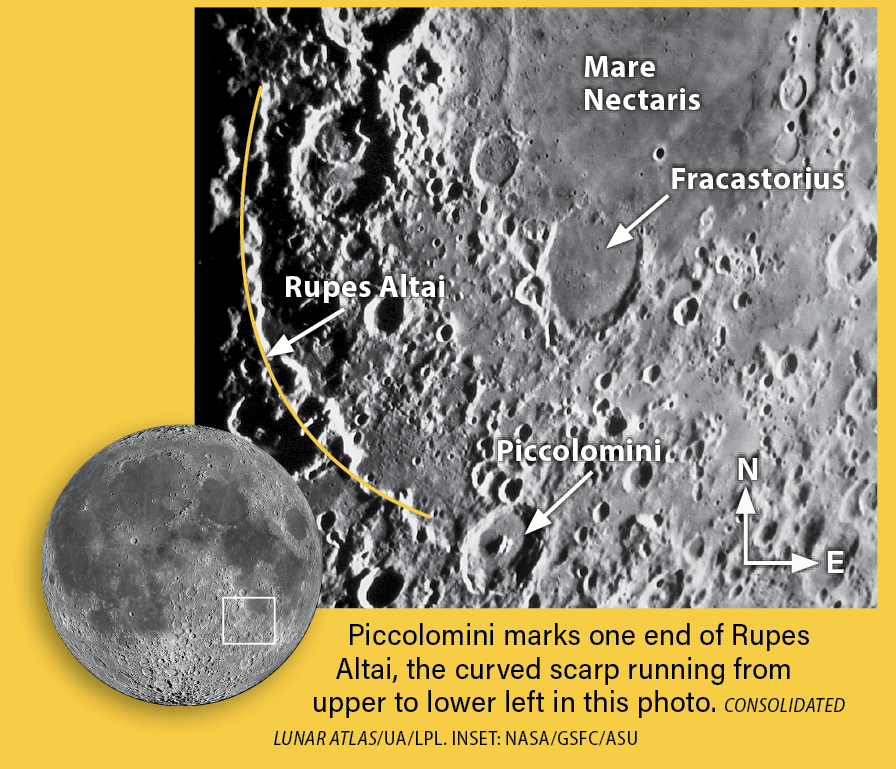
Dawn is slowly breaking across the lunar nearside. By now, all of Mare Nectaris — the Sea of Nectar — is bathed in sunlight. Look to the mare’s southwestern side to see the circular crater Piccolomini, with its central peak standing tall. This crater marks the end of the Altai Scarp (also called Rupes Altai), the most prominent scarp visible on our satellite from Earth. Piccolomini is a young crater that formed after the scarp, essentially coming on top of its lower end sometime 3.2 million to 3.8 million years ago.
Scarps are steeply sloped features that scientists believe formed as the Moon cooled. The ground level on each side of a scarp is at a different height, typically by several yards or more.
Sunrise: 6:58 A.M.
Sunset: 7:15 P.M.
Moonrise: 9:22 A.M.
Moonset: 12:05 A.M.
Moon Phase: Waxing crescent (31%)
*Times for sunrise, sunset, moonrise, and moonset are given in local time from 40° N 90° W. The Moon’s illumination is given at 10 P.M. local time from the same location.
March 24th’s target is for the early risers: Open cluster M18 in Sagittarius.
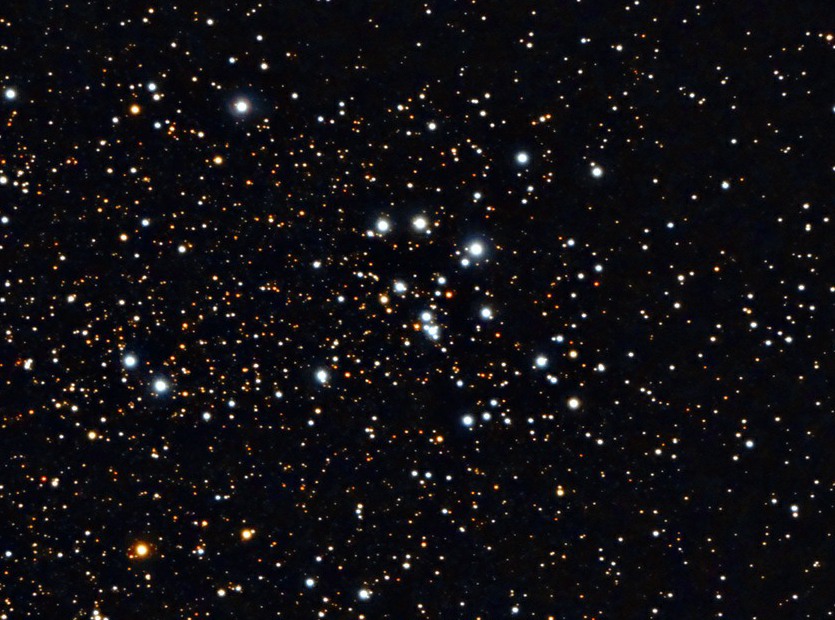
Rising around 2 A.M. local daylight time, by 4:30 A.M. the cluster has reached 20° in altitude above the southern horizon. It sits above the famous Teapot asterism, some 8.5° north-northeast of Lambda (λ) Sagittarii, the top of the Teapot’s lid, and near Sagittarius’ border with Scutum and Serpens Cauda.
A nearer jumping-off point is magnitude 3.8 Mu (μ) Sag; from this star, scan just over 4° north-northeast to land on magnitude 6.9 M18. Spanning just under 10’, M18 is a scattered grouping of young stars containing somewhere between one dozen and two dozen stars. 100x or so is the best magnification, according to Contributing Editor Michael E. Bakich, who notes that higher magnifications spread out the cluster’s stars too much for easy identification, mixing them in with the many background stars in this rich region of the Milky Way.