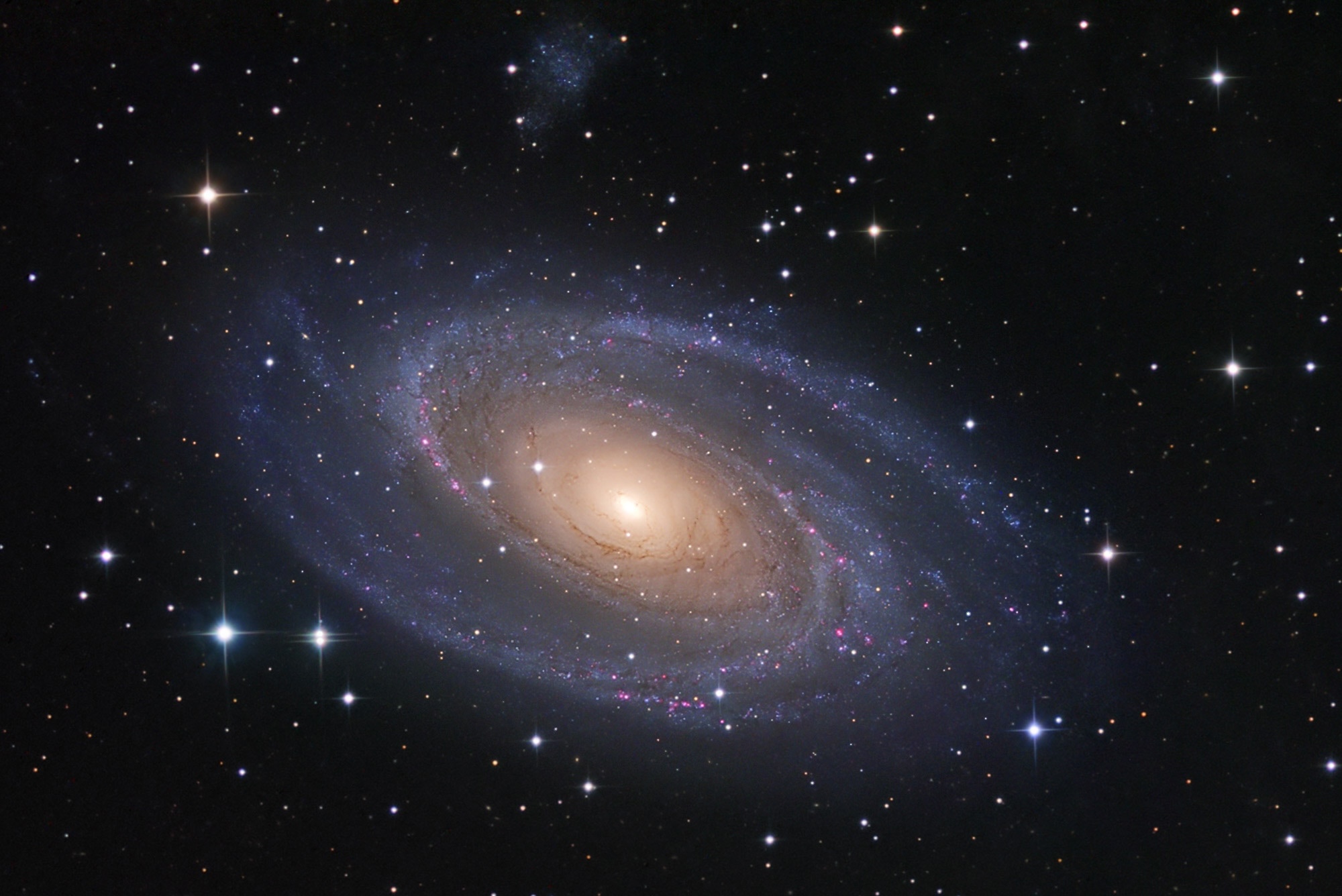
In the northwest section of Ursa Major the Great Bear sits the magnificent spiral galaxy M81 (NGC 3031). At magnitude 6.9, this ranks as one of the sky’s brightest galaxies. You’ll find it 2° east-southeast of the magnitude 4.5 star 24 Ursae Majoris.
German astronomer and celestial cartographer Johann Elert Bode discovered this object, and nearby irregular galaxy M82, on December 31, 1774. French astronomer Pierre Francois André Méchain independently discovered both galaxies in August 1779 and reported them to Messier, who added them to his list. But because Bode saw it first, astronomers informally named it after him.
With its relatively bright magnitude and a size of 24′ by 13′, Bode’s Galaxy glows strongly enough to show up through binoculars, but the larger the telescope you can point at it, the better. Through an 8-inch scope, you’ll see a large, bright central region surrounding the much brighter core. Through an 11-inch instrument, you’ll detect how the spiral arms wind tightly around the core. The easternmost arm appears brighter. Unfortunately, you won’t detect any dust lanes or star-forming regions through amateur scopes of any size.
M81 is the brightest member of the M81 Group, one of the closest galactic groups to our own Local Group. The M81 Group contains about a dozen galaxies and lies 12 million light-years away. Other members of this group include the Cigar Galaxy (M82), NGC 2403, NGC 2366, and NGC 3077.
So, sometime in the next couple of months, choose a clear moonless night and point your telescope at Bode’s Galaxy. You’ll be glad you did. Good luck!