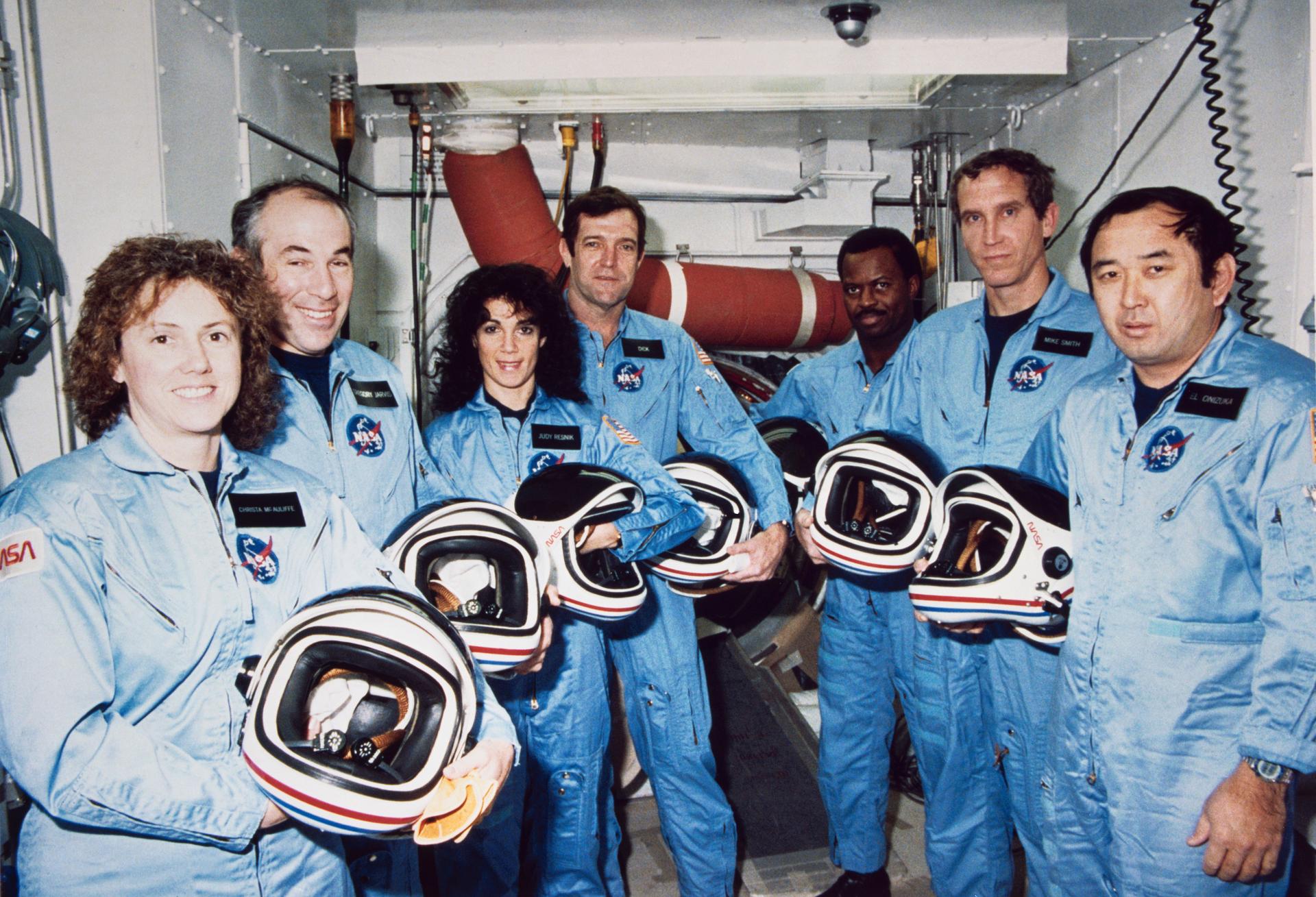
Nineteen years and one day after the deaths of the Apollo 1 astronauts, America suffered its first loss of astronauts during a spaceflight when Challenger exploded. About 73 seconds after lifting off from Cape Canaveral, Space Shuttle Challenger burst into a fireball in midair over the Atlantic Ocean. The explosion was viewed in real time by many Americans watching it broadcast live on CNN – including thousands of students watching the launch of NASA’s first “Teacher in Space,” Christa McAuliffe.
An investigation into the time and cause of death for the seven astronauts aboard – Dick Scobee, Michael Smith, Ellison Onizuka, Judith Resnik, Ronald McNair, Gregory Jarvis, and McAuliffe – was inconclusive. The crew capsule remained intact after separating from the rest of the spacecraft, and the activation of the three of the Personal Egress Air Packs for emergencies suggested that at least some of the crew was alive and aware for at least a small amount of time after the explosion. However, the investigation could not determine if the capsule had depressurized, concluding it was “possible, but not certain” that the astronauts had lost consciousness. The cabin hit the ocean surface two minutes and 45 seconds after the explosion, at 207 mph (333 km/h) – an impact that would not have been survivable.
The cause of the tragedy was later determined to be rubber O-rings in the rocket boosters joints that, because of record low temperatures on launch day, could not form the necessary seal to prevent hot gasses from escaping. The explosion was the result. Though engineers had voiced their concerns about the O-rings’ performance in the cold, NASA management went ahead with the launch. The O-rings had been cause for concern in the past and had previously held up despite those concerns. Though investigations and procedure changes followed the Challenger disaster, similar thinking and decision-making contributed to the Space Shuttle Columbia disaster in 2003.