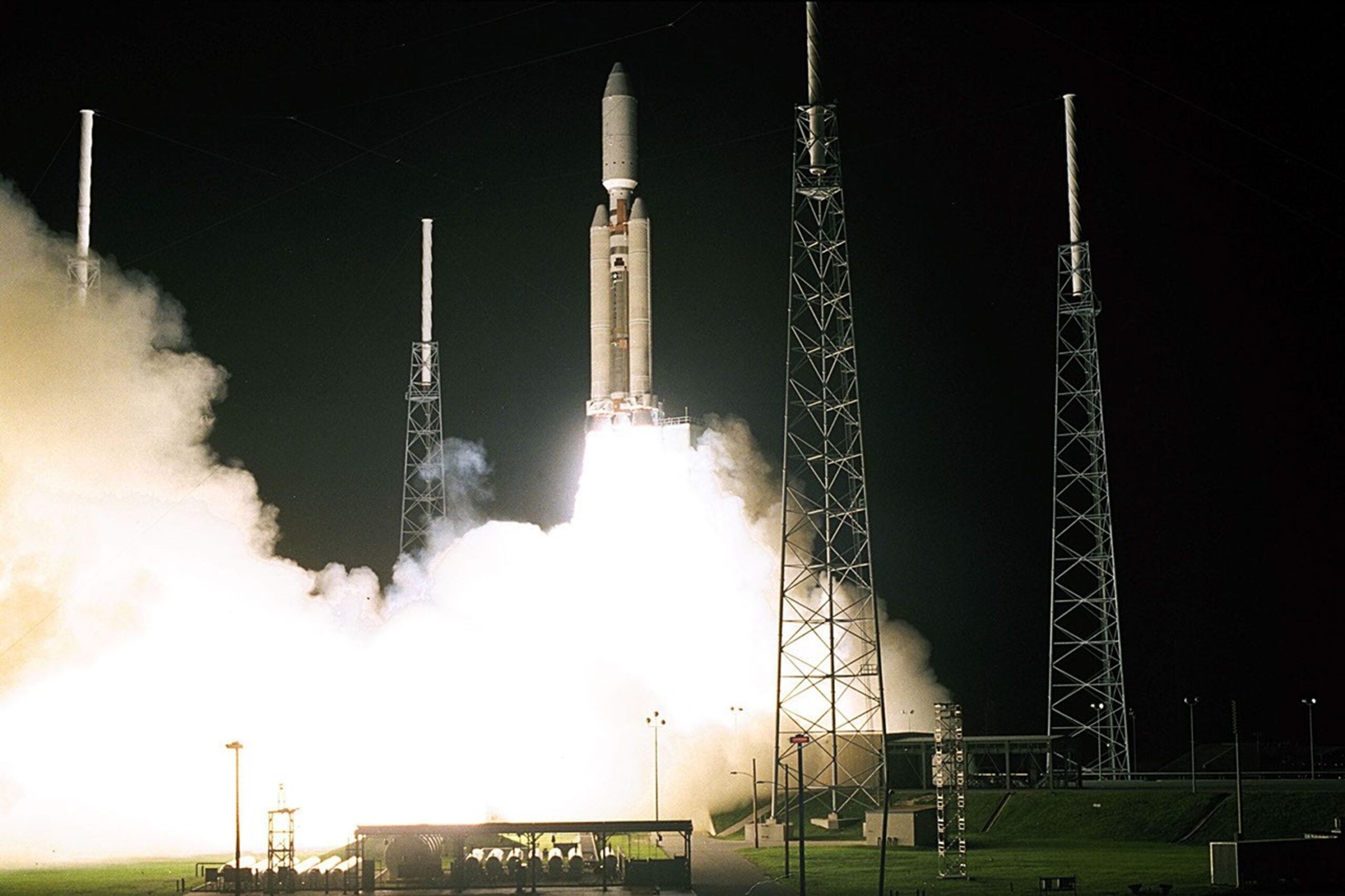
At 4:43 A.M. on Oct. 15, 1997, the staccato crackle of the Titan IVB/Centaur’s two side-mounted solid rocket boosters shattered the predawn gloom. Pushing Cassini-Huygens off the pad with a thrust of 3.4 million pounds (1.5 million kilograms), their bright glare turned night into day (and set off numerous car alarms) above a sleeping Florida. “Liftoff of the Cassini Mission,” exulted the NASA launch commentator, “on a billion-mile trek to Saturn!”
Cassini-Huygens would be an unprecedented foray into the unknown. It was not our first close-up glimpse of Saturn — the Pioneer 11, Voyager 1, and Voyager 2 probes had zipped by the planet in 1979, 1980, and 1981, respectively. But theirs were fast-paced flyby tours; scientists wanted a longer-term Saturn orbiter and Titan probe to truly explore the complex system.
A joint endeavor between NASA, the European Space Agency (ESA), and the Italian Space Agency (ASI), Cassini-Huygens would embark on a multiyear, multi-billion-mile trek into the gloomy and frigid reaches of the outer solar system. For 20 years, Cassini sent back data that transformed our understanding of Saturn, before its Sept. 15, 2017 “Grand Finale” plunged it into the gas giant’s clouds in an intentional self-destruct maneuver.