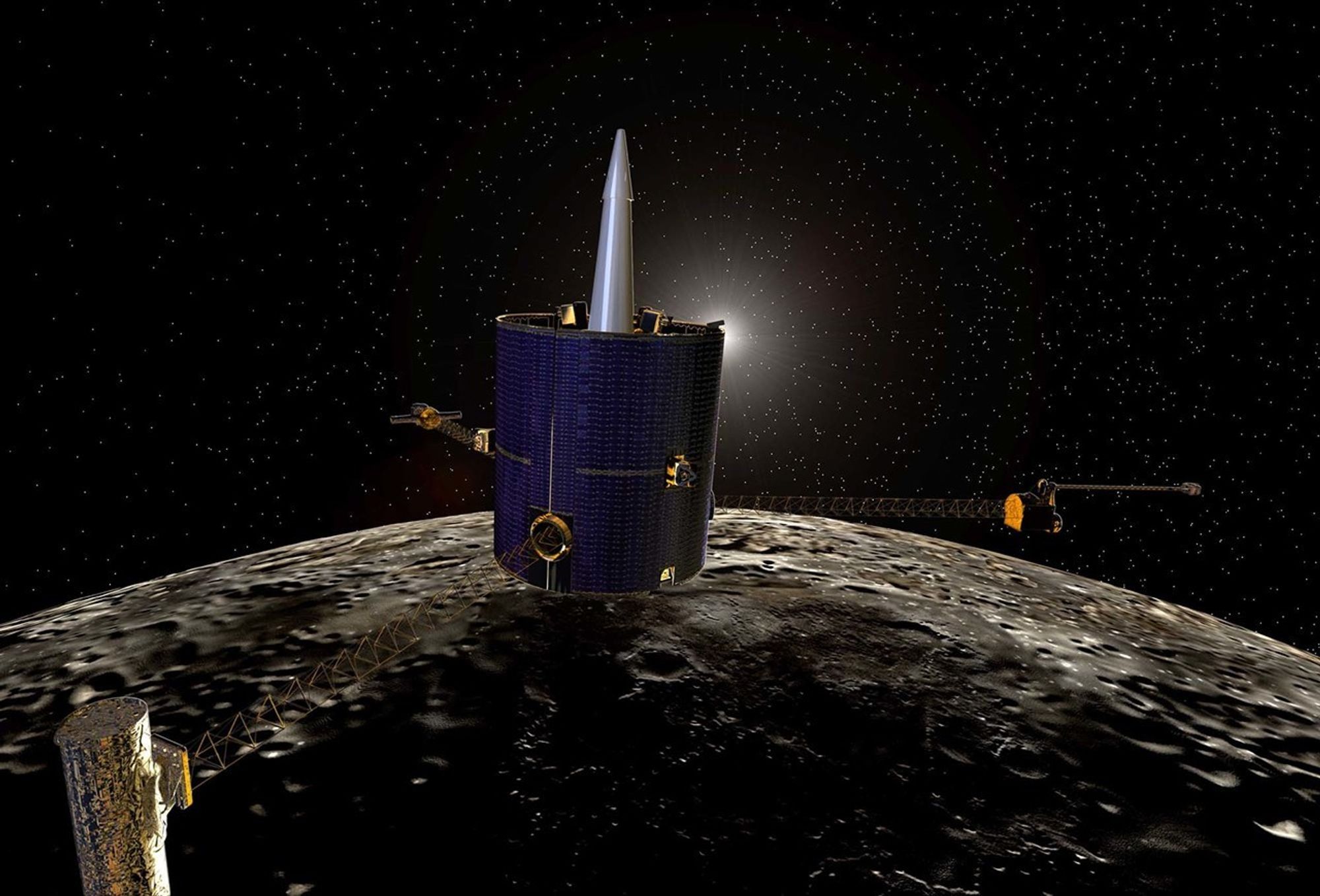
NASA’s Discovery Program, begun in the 1990s and continuing today with missions like Lucy and Psyche, is focused on frequent, cost-effective investigations of our solar system. Its first mission launched in 1996 to near-Earth asteroid Shoemaker; the second mission was the Mars Pathfinder mission, also launched in 1996. On Jan. 6, 1998, the third mission of the Discovery Program launched: Lunar Prospector.
With goals of mapping the lunar surface composition, searching for water ice at the poles, and analyzing its magnetic and gravitational fields, the spacecraft arrived at the Moon on Jan. 15. The craft itself was only about 4 feet tall and 4.5 feet in diameter, with three 8-foot booms that housed its instruments. It was also comparatively inexpensive, with a final cost around $65 million; as a money-saving step, there was no onboard computer and storage was limited. Instead, Lunar Prospector continually downloaded its data to Earth.
The mission results included the first evidence of ice at the Moon’s poles and a global map of rock types. When the mission concluded in July 1999, the spacecraft was deliberately crashed into Shoemaker Crater. Though it was a long shot, scientists hoped this impact would produce a plume of water vapor. However, nothing was seen. (It did accomplish the first off-Earth “burial,” though – the spacecraft had been carrying the cremains of geologist Eugene Shoemaker.)