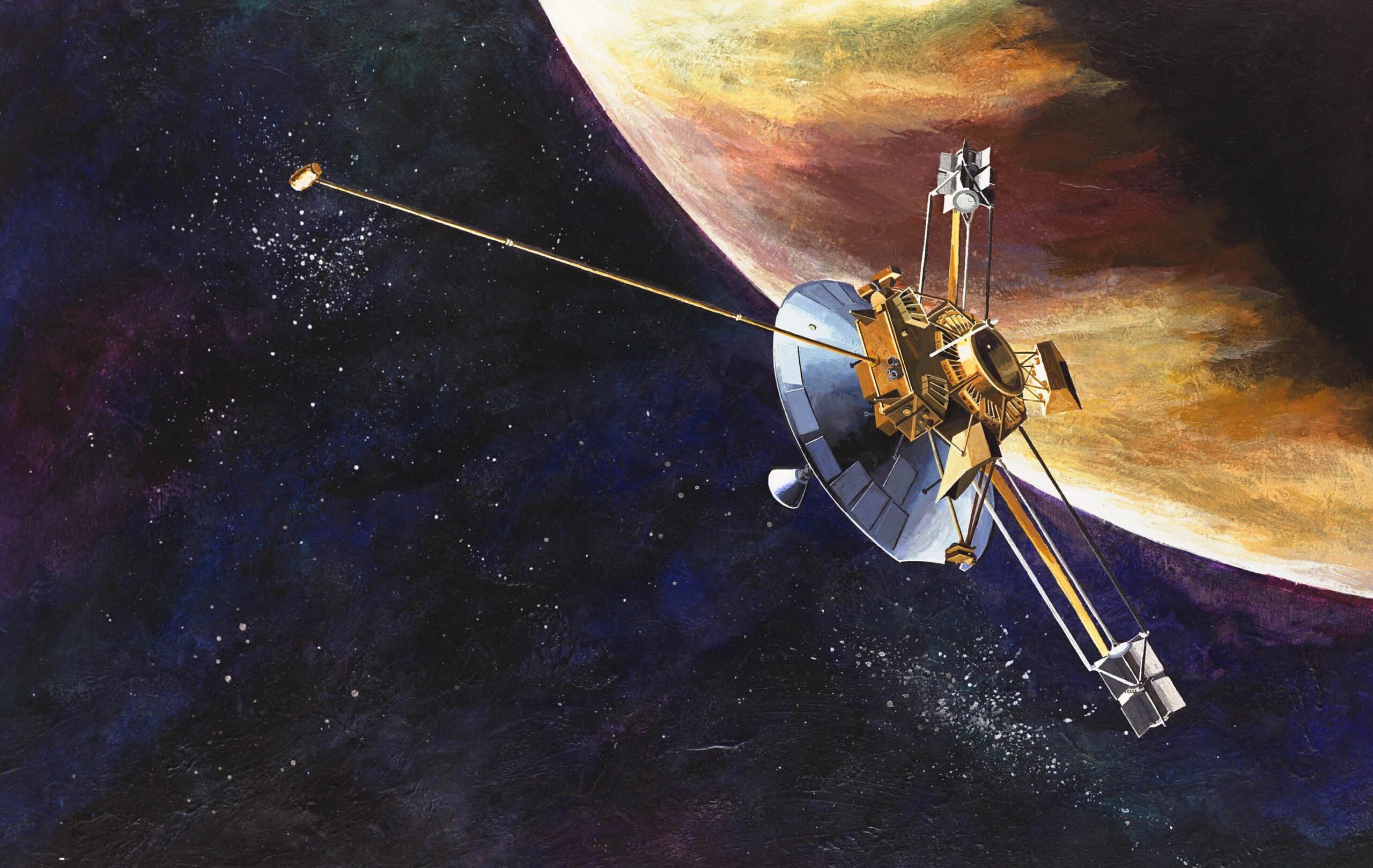
When Pioneer 10 flew by Jupiter on Dec. 3, 1973, its margin of survival was closer to the knife-edge than it seemed. It absorbed a thousand times the lethal dose of radiation for a human, suffering darkened optics and fried transistor circuits. Other unwanted side effects included the generation of false commands, which caused the craft to lose at least one image of the moon Io and several shots of Jupiter. Fortunately, any changes to Pioneer 10’s systems induced by radiation disappeared in the following months, as it continued on its way, its whistle-stop tour of Jupiter officially ending Jan. 2, 1974.
The probe then crossed the orbits of Saturn in 1976, Uranus in 1979, and Neptune — then the solar system’s most distant planet while Pluto swung interior to the ice giant’s orbit — in 1983. NASA received the spacecraft’s last feeble radio signal on Jan. 23, 2003, from a distance of 7.4 billion miles (11.9 billion km). Efforts to contact Pioneer 10 two weeks later were met with silence.
Five decades after its launch, Pioneer 10 continues silently at a velocity that could zip between New York and London in eight minutes. Each year, it crosses 230 million miles (370 million km), more than twice the gulf separating Earth from the Sun, heading generally in the direction of the red giant Aldebaran, the brightest star in the constellation Taurus. It may take a couple of million years to get there.