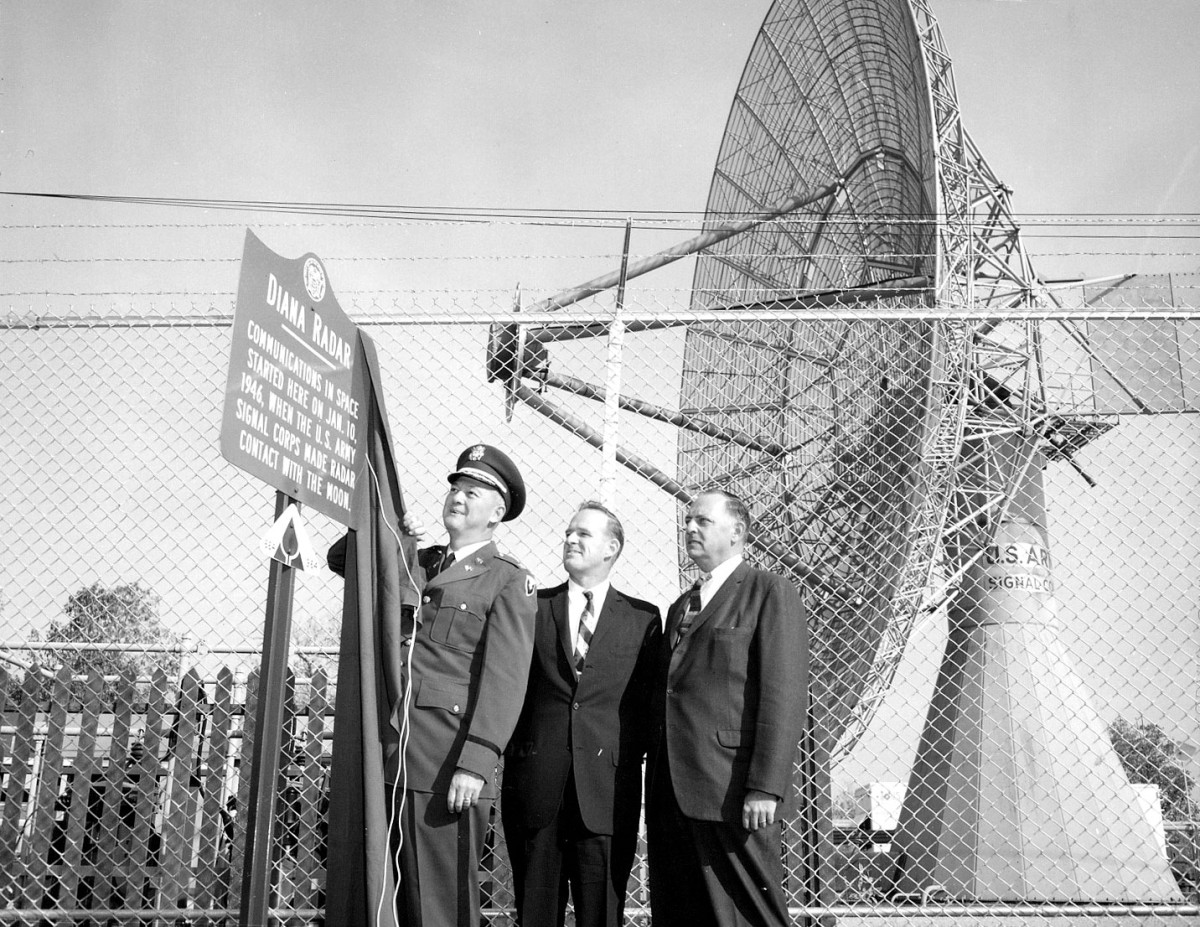
Charged with determining if the ionosphere could be penetrated by radar, Lt. Col. John DeWitt of the Army Signal Corps assembled a team of scientists, mathematicians, and engineers at Camp Evans (Fort Monmouth), New Jersey. Their plan was to attempt to bounce radar waves off the Moon, an experiment called Project Diana. A transmitter, four-antenna array, and receivers were constructed at Camp Evans. On Jan. 10, 1946, signals were directed at the rising Moon, and returned successfully for the first time. The response took 2.5 seconds – the amount of time it takes to go from Earth to the Moon and back at the speed of light.
Project Diana’s success not only had military implications for tracking incoming missiles, but also kicked off the age of radar astronomy. It was also an opening act of the Space Age, proving that communication was possible outside the bounds of Earth’s ionosphere.