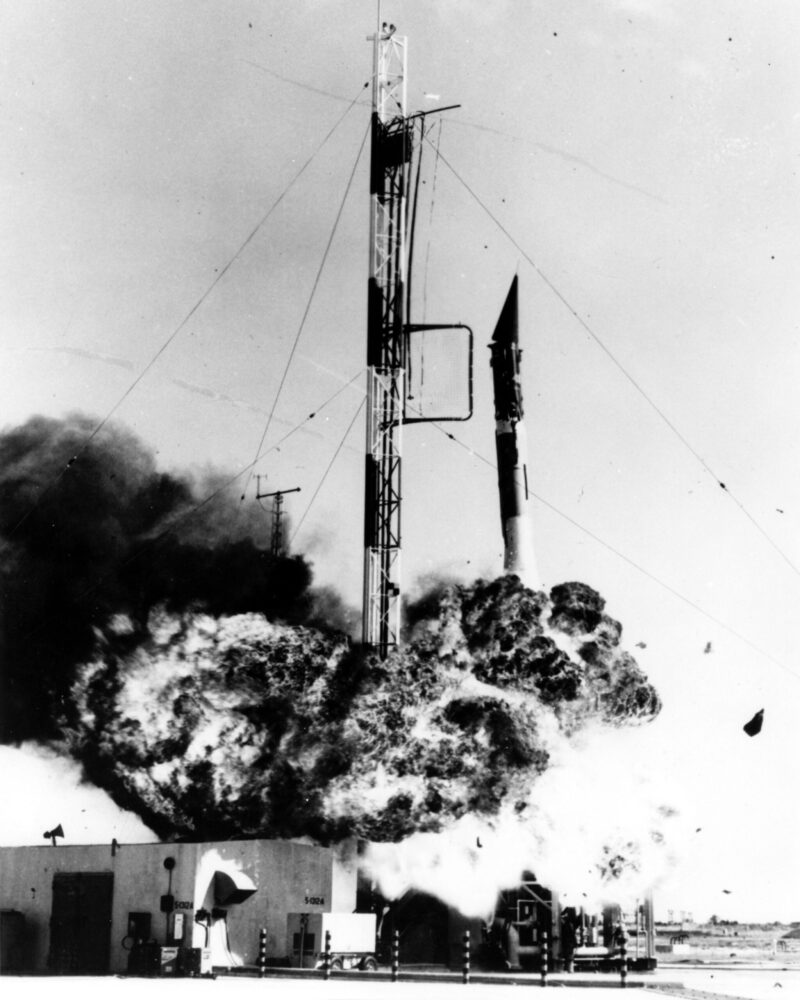
On Dec. 6, 1957, the Naval Research Laboratory attempted to launch Vanguard Test Vehicle 3, an answer to Sputnik and part of the American effort to put a satellite in orbit during the International Geophysical Year (July 1957-December 1958). Vanguard TV3 was diminutive, weighing only 3 pounds (1.36 kilograms) and only 6 inches (15.24 centimeters) in diameter, but carried two radio transmitters. If it had been a success, Vanguard TV3 would have supplied scientists with details about the Earth’s shape and gravitational field.
Unfortunately, the launch was a failure: The rocket rose only 4 feet (1.22 meters) before malfunctioning, dropping back to the launchpad, and exploding. Though the press ridiculed the failure, referring to the attempt as “Flopnik” and “Kaputnik,” it helped highlight the problems inherent in having multiple American agencies attempting spaceflight, and contributed momentum towards the development of a single organization in 1958: NASA.
Ironically, the satellite itself was thrown clear of the Vanguard TV3 explosion and survived. It now resides at the Smithsonian Air and Space Museum.